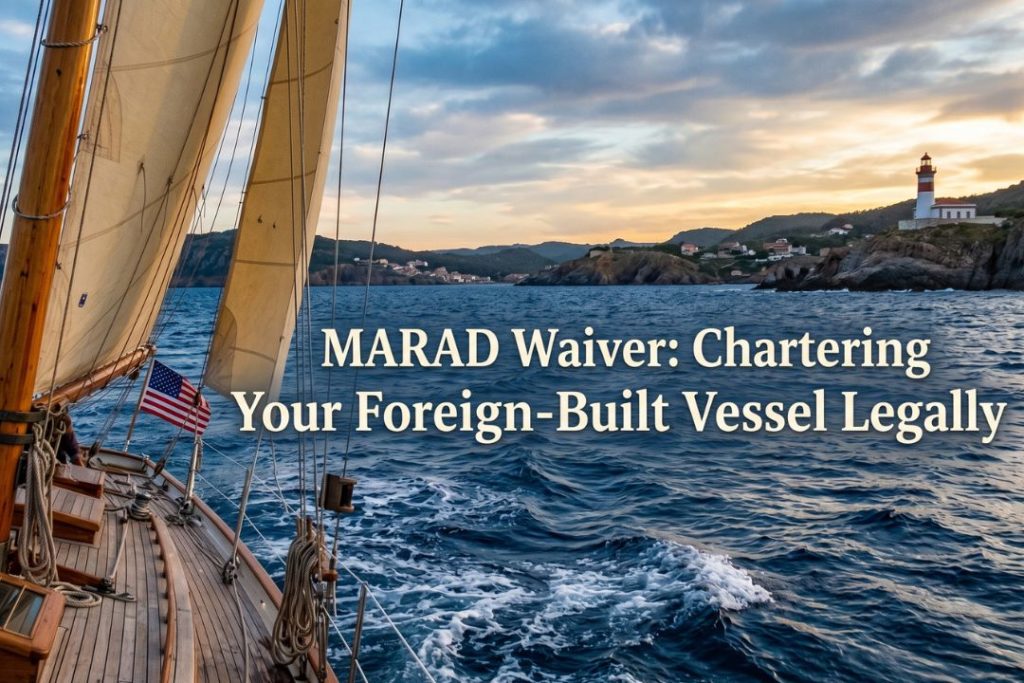
Operating a foreign-built boat for passenger charters in the United States involves more than purchasing the vessel and advertising trips online. Federal regulations place strict limitations on vessels that were constructed outside the United States. For many owners, obtaining a MARAD waiver is the legal path that allows limited commercial passenger operations.
At the National Documentation E-Portal, we help vessel owners complete and submit the federal documentation forms required for Coast Guard vessel documentation and related filings through our online portal.
Foreign-Built Vessel Restrictions in America
Federal maritime law generally limits coastwise trade to vessels that were built in the United States, owned by U.S. citizens, and properly documented with the Coast Guard. Passenger charters often fall under coastwise trade regulations because they involve transporting passengers between points in U.S. waters.
Foreign-built vessels typically cannot engage in these activities unless they qualify for a waiver through the Small Vessel Waiver Program administered by the Maritime Administration (MARAD).
These rules exist to protect the domestic maritime industry and regulate commercial vessel operations. If a foreign-built vessel begins charter activity without proper approval, the owner may face penalties and enforcement actions.
A waiver may allow eligible operators to legally:
- Conduct passenger charters
- Offer sightseeing excursions
- Operate recreational passenger trips
- Engage in limited commercial passenger activity
- Carry small groups of paying passengers
The waiver does not authorize cargo transportation or unrestricted commercial operations. Vessel owners must still comply with Coast Guard documentation requirements and all applicable maritime regulations.
When a MARAD Waiver May Be Necessary
Not every foreign-built vessel requires a waiver. The need depends on how the vessel will be operated and whether passengers will be transported for compensation.
You may need a MARAD waiver if:
- Your vessel was built outside the United States
- You intend to carry passengers for hire
- Your vessel will operate commercially in U.S. waters
- You want to legally conduct charter activity
- Your boat exceeds recreational-only use
Some vessel owners mistakenly assume that state registration alone authorizes charter activity. In many cases, federal authorization is also required.
Before diving into the application process, it is essential to review your boat’s current federal status. You can instantly check your hull’s history and active endorsements by running a quick Vessel Documentation Search. This can help determine whether your vessel already has an active documentation file or existing endorsements that may affect your next filing.
Additionally, owners should carefully review federal passenger vessel regulations and waiver eligibility requirements under federal maritime law. The applicable rules can be found within the Electronic Code of Federal Regulations for small vessel waivers and coastwise trade operations.
Vessel Documentation Still Matters
A common misconception is that a waiver replaces federal registration. In reality, the waiver works alongside your standard Vessel Documentation. Even with an approved waiver, your boat must still be federally documented with the Coast Guard if it measures 5 net tons or more.
Federal documentation remains important because it establishes:
- Vessel ownership records
- Nationality status
- Endorsement permissions
- Lien recording capability
- Coast Guard registry status
Owners frequently overlook the distinction between MARAD approval and Coast Guard documentation endorsements. Both may be necessary before charter operations can legally begin.
At the National Documentation E-Portal, our online portal allows vessel owners to complete documentation forms electronically instead of managing paper submissions manually.
MARAD Waiver and Coastwise Endorsements
An approved waiver alone does not automatically authorize passenger charter operations under your Coast Guard certificate. Vessel owners may still need to update their endorsement status through the Coast Guard documentation process.
Once MARAD approves your application, the waiver stays with the boat for life. However, to legally begin operating, you must update your Coast Guard registry to include a coastwise trade permission. You can submit a Change of Endorsement through our online portal to officially add passenger-for-hire privileges to your documentation.
This distinction is important because many owners incorrectly believe that MARAD approval immediately changes their documentation status.
Eligibility Requirements for Foreign-Built Charter Vessels
Not every vessel qualifies for the waiver program. MARAD applies eligibility standards that owners must satisfy before approval may be granted.
Requirements commonly include:
- The vessel must measure at least 5 net tons
- Ownership must involve qualified U.S. citizens
- The vessel must be used only for eligible passenger operations
- The vessel cannot transport merchandise commercially
- The vessel cannot engage in coastwise cargo trade
- Passenger capacity limitations may apply
There are also operational restrictions that vessel owners should understand before applying.
For example, waiver approval generally applies only to:
- Uninspected passenger vessel activity
- Small charter operations
- Recreational passenger services
- Limited commercial passenger transport
The waiver does not transform a foreign-built vessel into a fully coastwise-qualified vessel for all commercial purposes.
Ownership Records and Application Preparation
One of the most important parts of the waiver process involves proving ownership and documenting the vessel’s background accurately.
MARAD reviews ownership information carefully because the waiver program applies only to qualifying ownership structures and vessel histories.
Before submitting forms, owners should gather:
- Builder information
- Hull identification details
- Ownership transfer documents
- Coast Guard documentation records
- Vessel dimensions and tonnage information
- Citizenship documentation where applicable
Errors or inconsistencies can delay approval or create complications during processing.
Using an Abstract of Title Before Filing
To qualify for the small vessel waiver program, you must prove uninterrupted U.S. citizenship ownership and verify the vessel’s build history. If you are buying a foreign-built boat and need to verify its underlying liens or previous operational history, securing a certified Abstract of Title is the safest way to ensure a clean application.
An Abstract of Title may help vessel buyers identify:
- Existing liens
- Outstanding mortgages
- Ownership transfers
- Previous documentation records
- Historical vessel information
Reviewing these records before filing documentation forms can help avoid problems later in the process.
Charter Activity That May Require Additional Compliance
A MARAD waiver does not exempt operators from other federal or local requirements. Vessel owners must still comply with safety, licensing, and operational rules that govern passenger activity.
Depending on the operation, owners may also need to address:
- Coast Guard captain licensing requirements
- Passenger safety regulations
- Local harbor requirements
- Insurance obligations
- Inspection standards
- Passenger capacity restrictions
Commercial passenger operations often involve overlapping regulatory responsibilities. Receiving waiver approval does not eliminate these obligations.
Operators should also understand that certain modifications to vessel operations may affect documentation endorsements or regulatory classifications later.
Common Filing Errors Vessel Owners Encounter
Many vessel owners experience delays because of incomplete filings or misunderstandings about eligibility.
Some of the most common issues include:
- Incorrect ownership information
- Missing documentation forms
- Confusion regarding endorsements
- Failure to disclose foreign construction
- Inconsistent vessel identification details
- Improper transfer records
- Filing outdated forms
Another common issue involves assuming recreational documentation automatically authorizes passenger-for-hire activity.
Federal vessel documentation categories serve different purposes, and charter operations may require endorsement updates beyond standard recreational registration.
At the National Documentation E-Portal, we provide online access to the federal forms vessel owners use when handling documentation-related filings.
How Vessel Documentation Changes After Approval
After waiver approval and endorsement updates are completed, vessel owners should maintain accurate federal documentation records moving forward.
Changes involving ownership, vessel names, endorsements, or operational status may require additional filings with the Coast Guard.
These updates can include:
- Documentation renewal submissions
- Ownership transfer filings
- Address changes
- Endorsement updates
- Mortgage recordings
- Replacement certificate requests
Maintaining accurate records helps preserve compliance and reduce complications during future transactions or renewals.
Maintaining Compliance After a MARAD Waiver Approval
Even after receiving a MARAD waiver, vessel owners should continue monitoring their federal documentation status carefully.
Owners should routinely verify:
- Documentation expiration dates
- Current endorsement classifications
- Accurate ownership information
- Recorded lien status
- Vessel identification details
Keeping documentation records current may help avoid interruptions in charter activity and reduce problems during inspections or ownership transfers.
Filing Documentation Forms Through Our Online Portal
Managing federal vessel documentation paperwork independently can become confusing, especially for first-time charter operators dealing with foreign-built vessels.
Our online portal allows vessel owners to electronically access and complete forms related to Coast Guard vessel documentation and related filings.
Depending on the vessel owner’s needs, available forms may include:
- Documentation renewals
- Initial documentation filings
- Change of endorsement requests
- Replacement certificate requests
- Transfer and ownership filings
- Mortgage-related submissions
Electronic access to documentation forms can simplify the filing process and help owners organize their submissions more efficiently.
Foreign-built vessel ownership does not automatically prevent charter operations in the United States. However, owners must understand the legal limitations tied to coastwise trade and passenger transportation before beginning commercial activity. A properly approved MARAD waiver, combined with the appropriate federal documentation status, may allow eligible vessel owners to operate passenger charters lawfully while remaining compliant with Coast Guard requirements