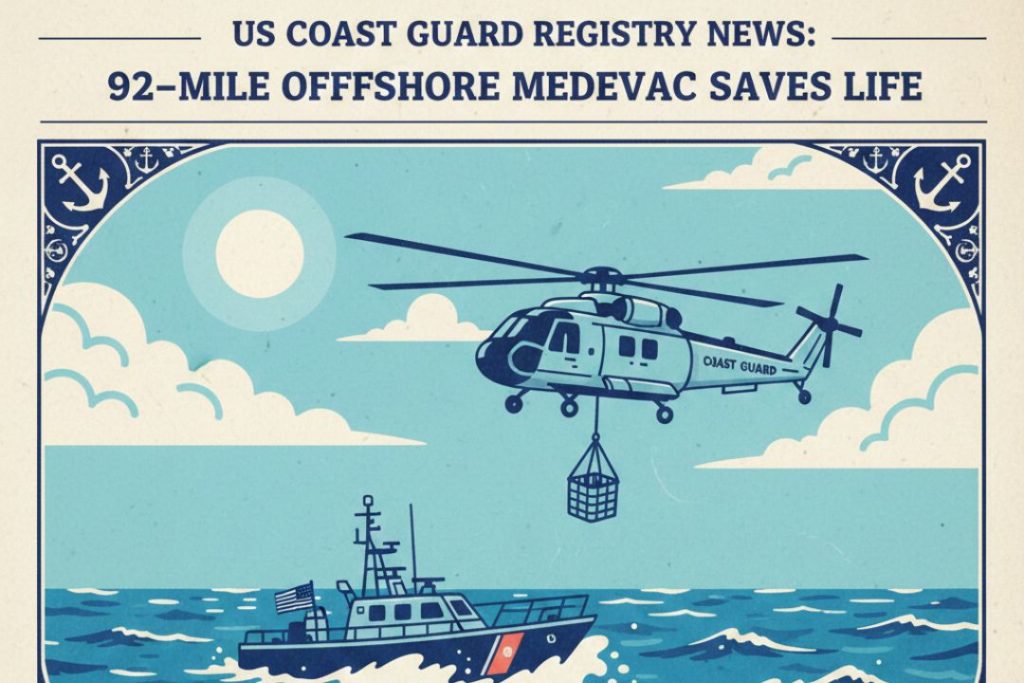
When the call came in from nearly 100 miles offshore, every second mattered. A 61-year-old passenger aboard the 857-foot Pacific World required immediate medical evacuation, far beyond the range of routine coastal response. In moments like this, coordination, accuracy, and verified information become lifesaving tools. Stories like this highlight how the US Coast Guard boat registry supports the broader maritime safety system long before an emergency unfolds.
The Details of This Heroic Rescue
According to reporting by Stars and Stripes, the rescue took place approximately 92 miles off Kauai, where a U.S. Coast Guard MH-65 Dolphin helicopter crew executed a complex hoist operation in open ocean conditions. The helicopter crew successfully lifted the passenger from the massive cruise vessel and transported her to medical care.
While the aviation skill and calm execution of the aircrew rightly draw attention, this mission also underscores the quieter infrastructure that supports offshore rescues. Aiding those heroes: accurate vessel records, accessible data, and properly maintained documentation.
At the National Documentation E-Portal, our role centers on that preparatory foundation. We help vessel owners complete and maintain Coast Guard documentation so that when the Coast Guard needs answers fast, those answers are there.
The US Coast Guard Boat Registry and the Unseen Work Behind Offshore Rescues
Offshore medevac missions differ dramatically from nearshore responses. Distance alone changes the equation, requiring extended flight planning, precise fuel calculations, and complete confidence in the information available about the vessel involved.
When a distress call is received, Coast Guard command centers rely on verified registry data to confirm what they are responding to.
This is where USCG documentation becomes part of the search and rescue infrastructure. Properly documented vessels allow responders to immediately access critical details without delays or guesswork.
From our perspective, registry accuracy supports operational clarity by providing:
- Confirmed vessel identity tied to official records
- Reliable ownership and point-of-contact information
- Verified vessel dimensions and tonnage
- Clear classification as a documented vessel under federal standards
- Consistent recordkeeping across Coast Guard systems
When a helicopter crew is dispatched nearly 100 miles offshore, there is no room for uncertainty. Knowing exactly which vessel is involved, how it is constructed, and who holds responsibility for it allows operational decisions to be made faster and with greater confidence.
The Pacific World Rescue and What It Demonstrates
The Pacific World is an 857-foot vessel, placing it in a category that demands careful coordination during any emergency response. Hoisting a patient from a ship of that size requires knowledge of deck layout, superstructure height, and safe approach zones.
. Emergencies rarely announce themselves in advance, and offshore incidents remove many safety margins.
This rescue demonstrates several realities:
- Offshore distance multiplies response complexity
- Accurate vessel identification saves time during distress calls
- Centralized registry records reduce confusion between agencies
- Prepared documentation supports faster verification
- Clear records help responders focus on the rescue itself
Our service exists to help vessel owners meet these documentation standards efficiently, without unnecessary administrative friction.
USCG Documentation As Part of Emergency Identification
From the moment a mayday or medical distress call is received, Coast Guard watchstanders begin verifying information. This includes matching the reported vessel to existing records and confirming details that may influence response planning.
USCG documentation enables this verification process by ensuring that vessel records are standardized, searchable, and accessible within federal systems. When documentation is current, identification happens quickly. When it is outdated or incomplete, valuable time can be lost resolving discrepancies.
Through our online portal, we assist vessel owners with submitting and maintaining documentation in a format that aligns with Coast Guard requirements. Our role is administrative, but the impact reaches far beyond paperwork. For example, accurate documentation supports:
- Faster vessel identification during distress calls
- Reduced risk of miscommunication
- Clear ownership verification
- Immediate access to registry details
- Seamless coordination across response units
This preparation does not replace the heroism of rescue crews. It supports it.
Emergencies Require US Coast Guard Boat Registry Accuracy
An emergency 92 miles offshore leaves little margin for error. Weather conditions can change rapidly, fuel reserves must be managed precisely, and alternative response options may be limited. In these situations, responders rely heavily on pre-existing information.
Registry data informs:
- Vessel classification and compliance status
- Expected onboard equipment standards
- Structural considerations for hoisting operations
- Ownership accountability
- Legal standing under federal maritime law
This is why maintaining current records is not merely a regulatory obligation. It is part of responsible vessel ownership.
Our US Coast Guard boat registry portal exists to make this process more accessible, allowing owners to complete required submissions accurately and efficiently.
How Our US Coast Guard Boat Registry Portal Supports Coordination in SAR Operations
Search and rescue operations involve multiple layers of coordination, often across air, sea, and shore-based units. Registry data acts as a shared reference point that ensures everyone involved is working from the same information set.
Our US Coast Guard boat registry portal can assist with this coordination by:
- Providing a single, authoritative vessel record
- Reducing conflicting reports during emergencies
- Allowing quick confirmation of vessel status
- Supporting interoperability between Coast Guard units
- Establishing a verified chain of ownership
When responders know they can trust the data in front of them, they can focus fully on execution.
Documentation Services Vessel Owners Rely On
While high-profile rescues highlight the importance of registry accuracy, documentation plays an ongoing role throughout a vessel’s operational life. Our service focuses on helping owners manage Coast Guard documentation requirements through a centralized online portal.
We assist with:
- Initial Coast Guard documentation applications
- Documented vessel renewal submissions
- Requests for an abstract of title
- Filing related to a preferred ship mortgage
- Access to vessel documentation search tools
Each of these services contributes to a complete and accurate vessel record, which in turn supports regulatory compliance and operational readiness.
USCG Documentation As Part of a Boater’s Preparation Mindset
One of the most important takeaways from offshore rescue stories is the value of preparation. While the Coast Guard handles emergency response, vessel owners control the accuracy of their documentation.
We aim to make our US Coast Guard boat registry part of that preparation mindset. Keeping records current ensures that if the unexpected occurs, identification and verification do not become obstacles.
Preparation includes:
- Ensuring documentation reflects current ownership
- Verifying vessel details are accurate
- Maintaining compliance with federal requirements
- Submitting updates promptly when changes occur
- Using a centralized portal to reduce errors
Our role is to support this process by making documentation tasks clearer and more accessible.
Connecting Registry Readiness to Real-World Outcomes
The successful medevac from the Pacific World is a reminder that maritime safety depends on both action and preparation. Helicopter crews, watchstanders, and medical teams execute the response, but accurate records support the response framework.
We designed our US Coast Guard boat registry to connect vessel owners to that framework. It ensures that when information is needed most, it is already verified and available.
Through our National Documentation E-Portal, we help vessel owners fulfill these requirements efficiently, supporting both compliance and readiness. While emergencies may be rare, preparation is ongoing, and accurate documentation remains a quiet but essential part of maritime safety.