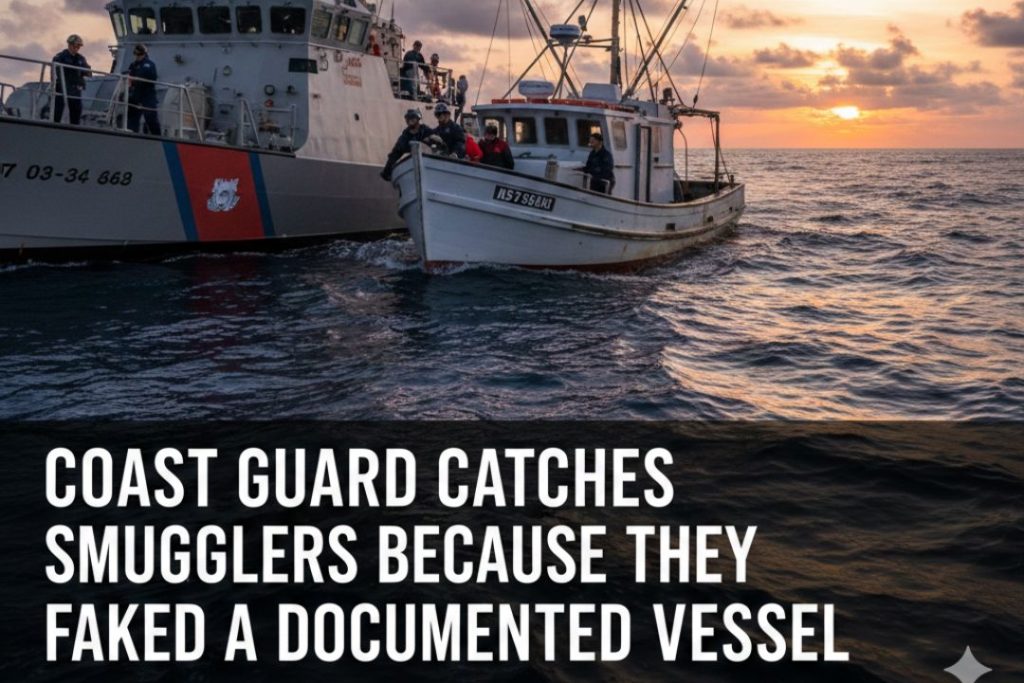
When federal authorities intercept suspicious activity at sea, paperwork can be just as important as radar, patrol boats, or aircraft. In a recent interdiction reported by the U.S. Coast Guard and partner agencies, smugglers attempted to blend into legitimate maritime traffic by presenting themselves as a Coast Guard documented vessel. Fortunately, they were caught.
The result demonstrates how digital verification, strict documentation standards, and coordinated enforcement quickly expose fraudulent claims of federal status—and why maintaining accurate records is essential for lawful boaters.
The Case Study: A Faked Coast Guard Documented Vessel Exposed
The interdiction highlighted in the Coast Guard press release involved coordinated action between maritime and homeland security authorities. The vessel in question attempted to operate under the appearance of legitimacy. By claiming federal documentation status, smugglers hoped to avoid suspicion among commercial shipping lanes and higher-end recreational traffic.
That strategy failed.
How the Fraud Was Identified
In 2026, Coast Guard enforcement is not limited to visual inspection of hull markings. Officers use integrated systems that connect directly to federal databases. When a boarding team encounters a vessel claiming federal documentation, they do more than read a name off the stern.
They verify:
- The official vessel name
- The hailing port
- The official number assigned by the National Vessel Documentation Center (NVDC)
- The endorsement type (such as Registry or Coastwise)
- Ownership records on file
The Coast Guard uses the Maritime Information for Safety and Law Enforcement (MISLE) system to cross-reference vessel data. A claimed status must align with the NVDC database. If the digital record does not match the vessel’s physical markings, officers immediately recognize the discrepancy.
In the reported interdiction, the mismatch became the “tell.”
The Formatting Errors Smugglers Often Miss
Individuals attempting to fake documentation often misunderstand federal requirements. Official documentation numbers follow precise formatting standards. They must also be permanently affixed to the interior structure of the vessel in accordance with regulations.
Common mistakes include:
- Incorrect spacing or numbering sequences
- Improper display of the official number
- Absence of interior permanent marking
- Mismatched vessel name and NVDC records
- Incorrect endorsement designation
A fraudulent claim rarely survives database verification. When officers detect inconsistencies, a vessel can be detained until its status is confirmed.
For legitimate owners, that risk alone makes accurate federal documentation important.
Your Coast Guard Documented Vessel Is a Passport at Sea
For lawful operators, federal documentation provides far more than a number on a certificate. A properly maintained Coast Guard documented vessel carries recognized nationality under the U.S. flag.
That nationality matters.
When traveling internationally—to destinations such as The Bahamas or Mexico—federal documentation serves as proof of U.S. registry. Many vessels carry a Registry endorsement specifically for international trade or navigation.
The benefits include:
- Recognition under U.S. maritime law
- Clear identification of nationality
- Acceptance in foreign ports
- Reduced confusion during inspections
- Structured ownership records
Unlike state registration, federal documentation establishes a national record that carries legal weight beyond individual state boundaries.
Clear Ownership Through Federal Records
Federal documentation also provides a structured ownership history. The official record maintained by the NVDC can be reflected in the abstract of title, which details ownership transfers, recorded instruments, and encumbrances.
This transparency benefits:
- Buyers
- Lenders
- Sellers
- Maritime attorneys
- Financial institutions
How Does Documentation Relate to Liens?
Banks frequently require federal documentation because it enables the recording of a preferred ship mortgage. That designation offers lenders the highest level of secured interest recognized under U.S. maritime law. Not everyone has to document their vessel, but many do. For all who are eligible and choose to do so, we make the process easier.
The Risk of Fraudulent or Expired Coast Guard Documented Vessel Papers
Even if you are not engaged in wrongdoing, discrepancies in your records can attract scrutiny.
An expired certificate, unresolved ownership transfer, or conflicting data can create unnecessary complications during a boarding.
The “Accidental Smuggler” Appearance
If your federal documentation has lapsed, you may unintentionally resemble a vessel attempting to hide something. Boarding officers rely on documentation consistency as an indicator of compliance.
Potential red flags include:
- Lapsed documentation status
- Incomplete ownership transfers
- Conflicting vessel names
- Missing endorsements
- Outdated information in the NVDC database
When inconsistencies appear, officers have authority to investigate further.
Boarding Protocols and Authority
If documentation does not align with NVDC records, a boarding officer can detain the vessel while ownership and status are verified.
Verification may involve:
- Database review
- Contact with the National Vessel Documentation Center
- Inspection of interior official number placement
- Review of endorsements and trade authority
- Examination of recorded instruments
In some situations, documentation issues can delay travel, disrupt operations, or complicate international entry procedures.
Maintaining compliance prevents avoidable interruptions.
Maintaining Your Coast Guard Documented Vessel
Federal documentation has evolved in recent years. One notable shift involves renewal cycles for recreational vessels.
Historically, many owners renewed annually. Recreational vessels are now eligible for five-year renewal terms, reducing administrative burden.
Vessel Documentation Renewal Options
Recreational owners can choose:
- Five-year renewal cycles
- Annual renewal if preferred
Commercially endorsed vessels may still require annual renewal depending on endorsement type.
Timely vessel documentation renewal ensures that your status remains active in federal records. A lapse does not simply pause your documentation—it can invalidate your federal standing.
Our service provides online access to renewal applications, allowing you to complete the process through a streamlined digital platform.
The Change of Ownership Trap
A common mistake occurs when a vessel changes hands. Buyers sometimes believe they can continue operating under the previous owner’s documentation without filing a transfer.
That is incorrect.
When ownership changes:
- Documentation must be formally transferred
- The new owner must file appropriate applications
- NVDC records must reflect updated ownership
- Any recorded instruments must be addressed
Failure to transfer properly can result in a mismatch between physical documentation and federal records. During a boarding, that discrepancy may lead to detention until ownership is verified.
If a vessel has a MARAD waiver associated with certain trade permissions, those conditions must also be properly documented in federal records.
Accuracy protects your operational freedom.
The Enforcement Reality Behind a Coast Guard Documented Vessel
The interdiction reported by the Coast Guard and DHS partner agencies illustrates the broader enforcement landscape.
Federal maritime law enforcement is:
- Digitally integrated
- Interagency coordinated
- Database driven
- Rapidly verifiable
- Documentation dependent
Attempting to fabricate documentation status is ineffective in a system built on centralized federal records.
When a boarding team checks a vessel, they are not relying on visual appearance alone. They confirm digital data, recorded ownership, endorsement classification, and documentation validity.
If any element fails to match, the vessel stands out immediately.
For lawful boaters, that same system works in your favor. A clean record, accurate filings, and up-to-date status create a seamless verification process.
How Our Online Portal Supports Compliance
At the National Documentation E-Portal, our service focuses exclusively on facilitating federal vessel documentation filings through an accessible online system.
We provide digital access to applications for:
- Initial documentation
- Ownership transfer
- Renewal filings
- Replacement certificates
- Endorsement changes
Our platform is structured to simplify submission of required information so that your records align with NVDC standards.
Maintaining an active Coast Guard documented vessel record reduces uncertainty during inspections and supports lawful maritime operations at home and abroad.
Documentation Is Not Cosmetic—It Is Foundational
The recent interdiction demonstrates a clear lesson: federal documentation cannot be improvised.
The status of a Coast Guard documented vessel is tied to:
- Federal databases
- Official numbering systems
- Ownership history
- Endorsement classification
- Recorded maritime instruments
When smugglers attempt to mimic legitimate operators, enforcement systems detect the gaps.
Law-abiding owners benefit from ensuring that every element of their federal documentation remains accurate, current, and properly filed.
If your documentation is approaching expiration, if ownership has changed, or if you need to update endorsements, taking action now protects your standing under U.S. maritime law.