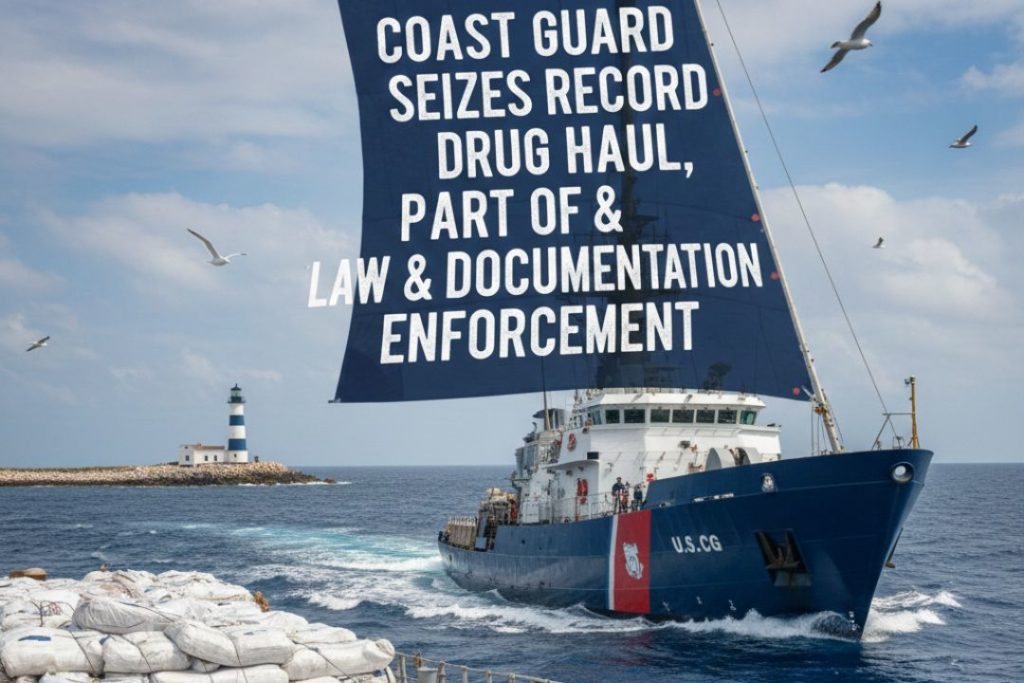
The recent interdiction and offload of more than $203 million worth of cocaine in San Diego is a powerful reminder of how maritime law enforcement, safety, and accountability intersect on the water. For vessel owners, operators, lenders, and maritime professionals, this operation underscores how Coast Guard documentation is closely tied to enforcement authority, lawful commerce, and the protection of U.S. waters.
From our perspective as an online portal that makes it easier to apply for federal vessel documentation, the events surrounding this seizure highlight lessons that extend far beyond the headlines.
The operation involved the U.S. Coast Guard Cutter Active and multiple partner agencies, culminating in the seizure of approximately 13 tons of cocaine and the detention of suspected traffickers. The vessels involved shared one critical trait: they were stateless, meaning they lacked nationality, flag state registration, or valid documentation. That absence alone made them immediate red flags.
What Happened During the San Diego Offload
According to official Coast Guard reporting and local news coverage from CBS8, the Cutter Active intercepted three separate vessels in international waters off Central America. Each interdiction followed a similar pattern:
- The vessels displayed no national flag
• No valid registration or ownership papers were produced
• Crews could not establish nationality
• Suspicious navigation and behavior patterns were observed
Because these vessels were stateless, they fell squarely within U.S. jurisdiction for enforcement action. Once boarded, Coast Guard teams discovered large quantities of narcotics concealed onboard. The combined seizures were later transported to San Diego for offload and processing.
This operation was not spontaneous. It was the result of coordinated patrols, intelligence sharing, and routine enforcement authorities that the Coast Guard exercises daily. The presence or absence of documentation was not a side issue; it was central to how the interdictions unfolded.
Stateless Vessels and Immediate Enforcement Authority
A stateless vessel is one that is not registered with any country and does not have the right to fly a national flag. Under international maritime law, these vessels receive no legal protection from any nation. That status alone gives enforcement agencies broad authority.
For the Coast Guard, statelessness changes everything:
- Boarding authority is immediate
• Jurisdictional disputes are eliminated
• Document inspections become enforcement gateways
• Detention and seizure actions are legally supported
This is where the legal framework becomes essential to understand, especially for legitimate vessel owners who want to avoid any ambiguity.
The Right to Board and Examine Documentation
Under the law, the Coast Guard has the authority to board vessels subject to U.S. jurisdiction in order to examine documentation and papers. This authority applies on the high seas and in U.S. waters, and it is the legal entry point for nearly every major drug seizure.
The statute allows Coast Guard personnel to:
- Stop a vessel
• Board the vessel
• Examine the ship’s documents and papers
• Question individuals onboard
• Conduct safety and compliance checks
When a vessel cannot produce documentation, or when the documents do not match the vessel, crew, or voyage, enforcement actions escalate quickly. In this San Diego case, the absence of documents removed any legal ambiguity.
Coast Guard Documentation as a Compliance Baseline
Coast Guard documentation is not merely an administrative process. It is a federally recognized status that establishes nationality, ownership, and lawful operation. Documented vessels are entered into a national registry that law enforcement can verify during boardings.
For lawful vessel owners, this status provides clarity:
- Proof of U.S. nationality
• Recognition under international maritime law
• Clear ownership records
• Alignment with federal enforcement expectations
In contrast, vessels without documentation often trigger deeper scrutiny, even when no criminal activity is present. This San Diego seizure demonstrates how quickly undocumented or improperly documented vessels can become enforcement priorities.
Lessons From the Seizure That Matter to Vessel Owners
While most vessel owners will never encounter a drug interdiction, the principles illustrated by this operation apply broadly. Documentation is often the first thing examined during any boarding, regardless of purpose. Remember:
- Documentation establishes legitimacy before questions arise
• Statelessness removes legal protections instantly
• Paperwork discrepancies invite expanded inspections
• Enforcement authority begins with document review
From our standpoint, these lessons reinforce why proper filing matters at every stage of ownership.
Living Marine Resources and Broader Enforcement
The same authority that allows the Coast Guard to interdict drug traffickers also supports its Living Marine Resources mission. This mission focuses on protecting ecosystems and ensuring sustainable use of ocean resources for economic and ecological health.
Living marine resources enforcement includes:
- Patrols in protected and regulated waters
• Vessel boardings to verify compliance
• Gear inspections for fishing vessels
• Enforcement against illegal, unreported, and unregulated fishing
• Prevention of overfishing
• Pollution response and prevention
• Habitat protection
These boardings also begin with documentation checks. Whether the focus is narcotics, fishing compliance, or environmental protection, valid documentation establishes transparency and accountability.
Coast Guard Documentation
Documentation in Law and Environmental Enforcement
Coast Guard documentation plays a role not only in criminal interdictions but also in routine inspections tied to conservation and sustainability. A documented vessel can be quickly identified, classified, and evaluated against applicable regulations.
This supports:
- Enforcement of fisheries laws
• Prevention of habitat destruction
• Monitoring of regulated activities
• Cooperation with international partners
The San Diego operation shows one extreme outcome, but the same legal tools are used daily to protect lawful operators and marine ecosystems alike.
How Documentation Supports Financial and Ownership Clarity
Beyond enforcement, documentation creates a clear chain of ownership that supports financing, transfers, and long-term vessel management. Federally documented vessels have records that can be verified through an abstract of title, which outlines ownership history, liens, and encumbrances.
This matters for:
- Buyers evaluating a purchase
• Lenders securing a preferred ship mortgage
• Owners preparing for a documented vessel renewal
• Parties verifying lawful ownership
When documentation is missing or inconsistent, these processes become more complicated and riskier.

Where Our Service Fits Into This Framework
We operate as an online portal designed to make it easier to apply for federal vessel documentation. Here, we help users complete and submit documentation filings accurately and efficiently, ensuring that paperwork aligns with federal requirements.
Through our service, users can:
- Conduct a documented vessel search
• Manage renewals
• File ownership-related forms
• Maintain alignment with federal standards
We do not conduct investigations, provide follow-ups, or perform research on behalf of users. Our focus is on making the documentation process accessible and clear.
Coast Guard Documentation and Day-to-Day Accountability
USCG documentation serves as a day-to-day accountability tool. During a routine boarding, officers rely on documentation to determine:
- Vessel nationality
• Ownership structure
• Intended use
• Compliance category
Without that baseline, even compliant operators may experience delays, expanded inspections, or operational disruptions.
In contrast, properly documented vessels benefit from clarity during interactions with enforcement personnel.
Documentation Lessons Reinforced by the San Diego Operation
The Cutter Active interdictions demonstrate how documentation, or the lack of it, shapes outcomes on the water. Stateless vessels are not simply noncompliant; they exist outside recognized legal frameworks.
The broader lessons include:
- Documentation is foundational, not optional
• Enforcement begins with paperwork
• Transparency protects lawful operators
• Federal records support international recognition
For vessel owners who want to operate confidently, these lessons are practical, not theoretical.
Coast Guard Documentation as a Preventive Measure
Coast Guard documentation functions as a preventive measure by reducing ambiguity. This preventive value applies across scenarios:
- Safety inspections
• Environmental compliance checks
• Fisheries enforcement
• Border and customs coordination
The San Diego seizure highlights what happens when that clarity is absent.
Supporting Lawful Use of U.S. Waters
Our work supports lawful navigation, commerce, and recreation by helping vessel owners meet federal documentation requirements. That alignment benefits not only individual owners but also the broader maritime system.
Clear documentation supports:
- Law enforcement efficiency
• Environmental stewardship
• Financial transparency
• International cooperation
The record-setting seizure off San Diego illustrates the far-reaching impact of enforcement authority rooted in documentation law. While the headlines focus on narcotics, the underlying lesson is about accountability on the water.
Coast Guard documentation remains a central pillar of that accountability, shaping how vessels are identified, boarded, and evaluated every day.