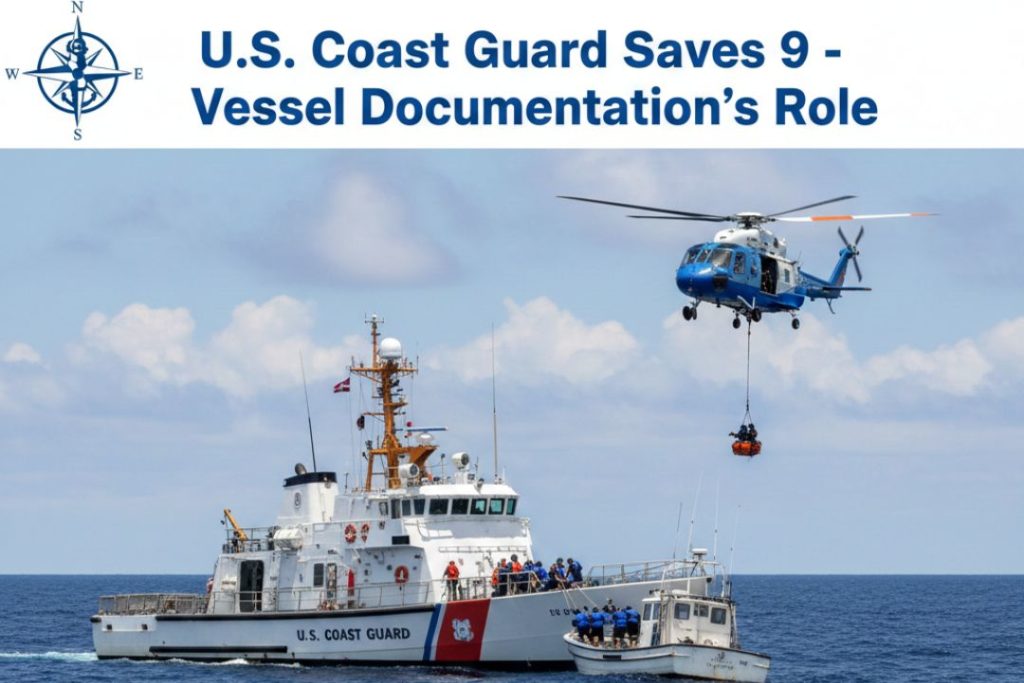
On January 5, 2026, the U.S. Coast Guard carried out a high-risk rescue in the Bering Sea, saving nine people from a grounded fishing vessel near St. George Island, Alaska. For those of us who work every day with U.S. Coast Guard vessel documentation, this incident reinforces something we see repeatedly: documentation is not an abstract compliance step.
It directly supports emergency response, decision-making, and post-incident recovery when conditions leave no margin for error.
At the National Documentation E-Portal, our service exists to make Coast Guard documentation more accessible and accurate for vessel owners. Events like this one demonstrate how properly recorded vessel information can play a meaningful role when crews, aircraft, and rescue swimmers are operating in extreme environments.
A Grounding in the Bering Sea Under Severe Conditions
According to KIRO 7 News, the fishing vessel Arctic Sea, measuring approximately 135 feet, became grounded near the cliffs of St. George Island while operating in gale-force weather. The Bering Sea is known for rapidly changing conditions, and on this day, sustained winds reached approximately 50 knots, with seas building to around 10 feet.
These conditions immediately limited response options:
- Nearby vessels were unable to safely approach or assist.
- Visibility and sea state ruled out surface-based rescue.
- Time was critical due to the vessel reportedly taking on water.
The crew’s only viable support came from the Coast Guard’s air stations in Cold Bay and Kodiak, which launched aircraft capable of operating in extreme weather.
From the moment the distress signal was received, accurate vessel identification became a central factor in the rescue plan.
U.S. Coast Guard Vessel Documentation and the Identity Phase of Rescue
Search and Rescue operations begin with what responders refer to as the identity phase. Before any hoist, swimmer deployment, or evacuation can occur, responders must know exactly what they are approaching. This is where U.S. Coast Guard vessel documentation becomes operationally relevant rather than administrative.
Through documented records, responders can immediately access verified vessel particulars, including:
- Official length, breadth, and depth.
- Gross tonnage and vessel type.
- Ownership and registration details tied to a unique Official Number.
In regions like Alaska, where vessel names are often reused across fleets and generations, relying on names alone can introduce uncertainty. Documentation eliminates that ambiguity by linking distress signals to a single, verified vessel profile.
Helicopter Hoists and the Value of Verified Vessel Particulars
When an MH-60 Jayhawk helicopter approaches a grounded vessel in high winds, the margin for error is minimal. Rescue swimmers and flight crews must identify safe areas for cable deployment while avoiding hazards such as rigging, antennas, and deck equipment.
Documentation records help inform these decisions by providing:
- Accurate vessel dimensions that match the actual hull.
- Confirmation of vessel class and layout expectations.
- Reduced reliance on visual estimation in poor visibility.
In high winds, knowing the approximate deck configuration before arrival allows crews to plan safer hoist paths. This type of preparation supports faster extraction while minimizing risk to both rescuers and those awaiting evacuation.
EPIRBs, Official Numbers, and Immediate Verification
According to reporting, the vessel’s Emergency Position Indicating Radio Beacon activated at approximately 7:30 a.m. In many cases, an EPIRB signal alone only provides a location and a general distress alert. When that signal is tied to a documented vessel, responders receive a complete identity profile instead of a generic alert.
With a documented vessel, the Coast Guard can immediately see:
- The unique Official Number assigned to the vessel.
- Confirmed ownership information.
- Vessel size and tonnage data aligned with documentation records.
This level of verification allows command centers to coordinate assets more efficiently. It also reduces the chance of misidentification when multiple vessels may be operating in the same region under similar conditions.
U.S. Coast Guard Vessel Documentation as a Safety Multiplier
While documentation is often discussed in regulatory terms, incidents like the Arctic Sea grounding show how it can boost safety during emergencies. Accurate records allow responders to act decisively rather than spending valuable time confirming basic facts.
From our perspective, this is where U.S. Coast Guard vessel documentation supports more than compliance. It supports:
- Faster situational awareness during distress calls.
- Better-informed aerial rescue planning.
- Clear linkage between distress signals and verified vessel data.
Our role is to help vessel owners ensure that the information associated with their documentation is complete, consistent, and properly filed so it can be relied upon when it matters most.
The Role of a Vessel Documentation Search After an Incident
Once all nine individuals were safely rescued, the situation shifted from emergency response to recovery and accountability. At this stage, vessel records again become central. A vessel documentation search allows involved parties to confirm the legal and recorded status of the vessel following a casualty.
This type of search can be used to verify:
- Current ownership as recorded with the Coast Guard.
- Existing encumbrances tied to the vessel.
- Documentation status at the time of the incident.
For owners and operators, having up-to-date records reduces uncertainty during an already complex post-incident process.
Salvage Operations and Authority to Proceed
The reporting notes that Resolve Marine was contracted to handle salvage operations for the grounded vessel. Before any salvage work can legally begin, the salvaging party must confirm who has the authority to authorize that work.
This verification depends on documentation records, including:
- Confirmation of the legal owner.
- Identification of any recorded lienholders.
- Assurance that the party signing the salvage agreement has standing.
Without this clarity, salvage efforts can be delayed or challenged, increasing risk to the vessel and the surrounding environment.
Abstract of Title and Financial Interests
One of the most important records in this phase is the abstract of title. This document provides a complete history of ownership transfers, mortgages, and recorded claims associated with a documented vessel.
An accurate abstract helps establish:
- Whether a preferred ship mortgage is recorded.
- Which parties must be notified or involved in salvage decisions.
- Clear authority to contract for recovery services.
From our standpoint, maintaining accurate documentation records ensures that this information is available when it is needed, without additional administrative barriers.
Ongoing Accuracy Through Renewal
Accidents do not occur on a schedule, and outdated records can complicate both rescue and recovery. Maintaining current U.S. Coast Guard vessel documentation through documented vessel renewal helps ensure that ownership and vessel details reflect reality at all times.
Consistent renewal supports:
- Accurate linkage between EPIRBs and vessel records.
- Clear ownership verification after incidents.
- Reduced delays in post-casualty processes.
Our service focuses on making the renewal process more accessible so vessel owners can keep their records aligned with operational reality.
U.S. Coast Guard Vessel Documentation as Part of Preparedness
The rescue of the Arctic Sea’s crew illustrates how documentation integrates into real-world response scenarios. When aircraft are dispatched from hundreds of miles away and weather conditions limit options, every verified detail contributes to safer outcomes.
From our perspective, U.S. Coast Guard vessel documentation is part of overall preparedness. It connects administrative accuracy with operational effectiveness, supporting responders, owners, and recovery professionals alike.