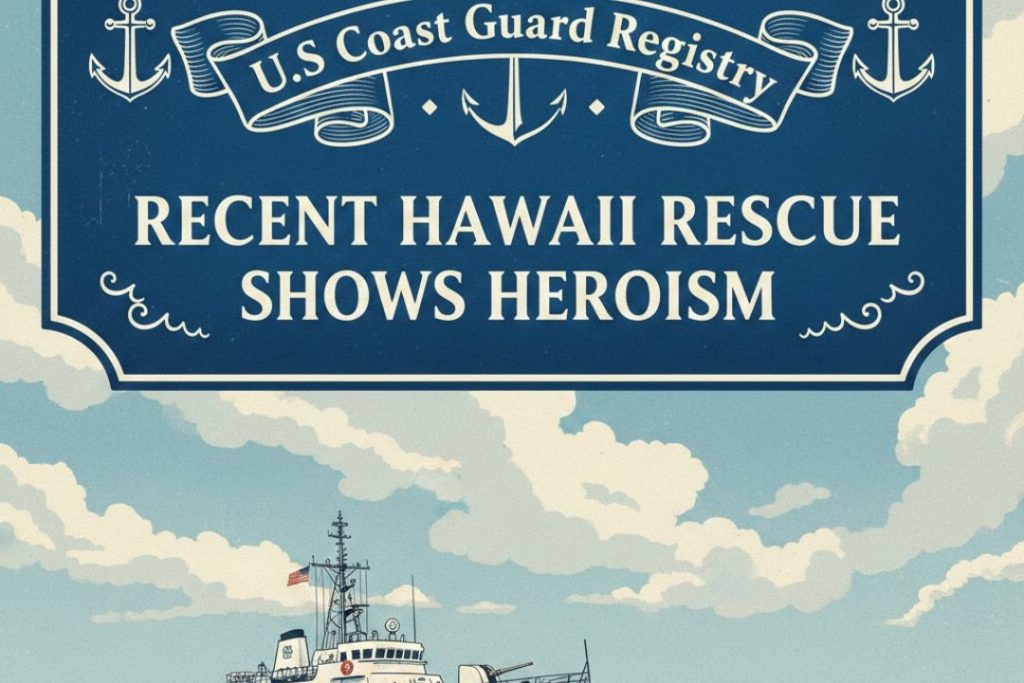
The recent rescue near Molokaʻi, where two men were saved from a life raft after their vessel began taking on water, offers a powerful reminder of how quickly routine outings can become emergencies. Stories like this underscore why proper preparation matters long before a distress call is made, including maintaining accurate records through the US Coast Guard Registry.
In this particular case, the Coast Guard responded swiftly, locating the life raft and bringing both individuals to safety. From our perspective, this incident highlights how documentation, readiness, and clear vessel identification all play a role when seconds matter.
What Happened During the Molokaʻi Rescue and Why It Matters
As reported by Kauai Now, the rescue unfolded after the vessel encountered water intrusion it could not control. As conditions worsened, the occupants transitioned to survival mode, deploying their life raft and awaiting assistance.
The Coast Guard, alerted to the situation, conducted a search and successfully located the raft, bringing both men aboard safely.
This incident reinforces several realities of boating in Hawaiian waters and elsewhere:
- Mechanical issues can escalate rapidly, even on well-planned trips
- Distance from shore increases the complexity of rescue operations
- Clear vessel records help authorities understand what they are responding to
- Timely communication and identification support faster outcomes
From our standpoint, the heroism displayed by Coast Guard personnel is matched by the systems that support them, including accurate vessel records tied to federal documentation.
Lessons for Owners Using the US Coast Guard Registry
One of the most important takeaways from this rescue is how vessel documentation fits into the broader safety picture. Federal documentation establishes a vessel’s identity, ownership, and nationality, all of which are essential during emergency situations.
When a vessel is properly recorded, responders can more easily:
- Confirm ownership details
- Match distress information to official records
- Understand vessel characteristics that may affect rescue planning
- Reduce confusion during multi-agency coordination
Using the US Coast Guard Registry creates a centralized, standardized record that supports these efforts. While documentation alone does not prevent emergencies, it strengthens the framework within which rescue operations occur.
Between emergencies, documentation also serves owners in practical, everyday ways:
- Maintaining clear proof of ownership
- Supporting financing arrangements tied to maritime assets
- Preserving an accurate chain of title
Our role is to make access to this documentation process more straightforward through an online portal designed for efficiency and accuracy.
Coast Guard documents
Documentation Lessons Highlighted by the Rescue
Beyond the immediate drama of the rescue, there are broader administrative lessons worth noting. In stressful situations, incomplete or outdated records can slow response times and complicate recovery after an incident.
Key documentation-related points emphasized by this event include:
- Keeping ownership records current as circumstances change
- Ensuring vessel details are accurate and legible in federal records
- Understanding how documentation interacts with emergency response systems
For owners, this means staying proactive rather than reactive. A documented vessel with current records supports clarity when clarity is needed most.
How Federal Documentation Supports Search and Response
While we do not conduct investigations or research on behalf of owners, we provide access to the tools needed to manage documentation efficiently. Federal documentation allows authorities to reference existing records quickly during emergencies, which can be especially important in offshore or remote areas.
In rescue scenarios, documentation can assist with:
- Verifying the vessel’s official name and identification
- Cross-referencing distress calls with known vessel data
- Supporting coordination between Coast Guard units
Access to a vessel documentation search can be particularly valuable for confirming publicly available record details when questions arise.
Financial and Legal Considerations Tied to Documentation
The Molokaʻi rescue also reminds owners that documentation is not only about safety. It carries legal and financial significance that continues regardless of whether a vessel is underway or docked.
Federal documentation plays a role in:
- Recording a preferred ship mortgage
- Establishing priority interests in the vessel
- Maintaining a clear abstract of title
These records protect ownership interests and provide transparency, which remains important even after an incident such as flooding or abandonment. Our service supports owners by providing access to the forms and filing pathways associated with these records.
US Coast Guard Registry as a Foundation for Accountability
Using the US Coast Guard Registry creates a standardized framework that benefits owners, lenders, and authorities alike. It ensures that vessel information is housed in a recognized federal system rather than scattered across inconsistent records.
Benefits of this structure include:
- National recognition of vessel status
- Consistent ownership history
- Clear linkage between the vessel and its official documentation
In emergencies, this consistency supports faster understanding. Outside of emergencies, it supports smoother transactions and compliance.
Renewal and Ongoing Accuracy
Another lesson underscored by real-world incidents is the importance of keeping documentation current. Expired or outdated records can introduce uncertainty at precisely the wrong time.
Maintaining accuracy involves:
- Updating records when ownership changes
- Completing documented vessel renewal within required timeframes
- Reviewing information periodically for errors or omissions
Our portal exists to make these processes more accessible, allowing owners to complete required filings without unnecessary complexity.
Why Documentation Complements Preparedness
Safety equipment, training, and planning remain essential. Documentation does not replace those elements, but it complements them by ensuring that a vessel’s identity and ownership are clearly established.
When documentation is in order:
- Authorities can reference reliable records
- Ownership disputes are less likely to arise after incidents
- Recovery and administrative processes are more straightforward
Using the US Coast Guard Registry integrates these benefits into a single federal system.
Our Role in Supporting Vessel Owners
We focus on simplifying access to Coast Guard documentation through an online portal designed for clarity and efficiency. We provide access to required forms and filing pathways so owners can manage their documentation needs in one place.
Our service supports:
- Initial Coast Guard documentation applications
- Renewals and updates to existing records
- Access to documentation-related filings connected to ownership and financing
Always, our goal is to make the administrative side of vessel ownership more manageable.
A Rescue That Reinforces Administrative Readiness
The successful rescue near Molokaʻi demonstrates the Coast Guard’s commitment to saving lives. It also highlights how administrative readiness, including accurate documentation, underpins effective maritime operations.
For owners, this means recognizing that paperwork is not separate from safety. Instead, it forms part of a larger system that supports accountability, clarity, and response when it matters most.
By maintaining proper records through the US Coast Guard Registry, vessel owners contribute to that system while protecting their own interests.