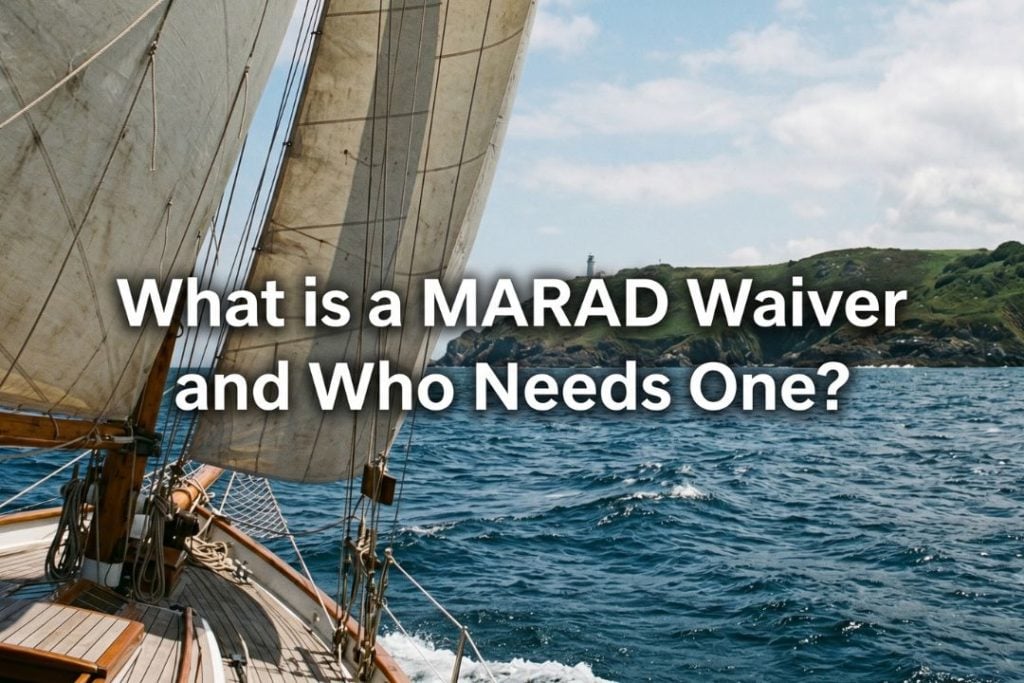
Federal regulations place specific restrictions on which commercial activities foreign-built vessels may engage in. Meeting those requirements, or waiving them, is essential before beginning operations. That’s what the MARAD waiver can do.
This waiver is a special authorization that may allow a qualifying foreign-built vessel to participate in limited commercial passenger service.
The Core Problem: Foreign-Built Boats and the Jones Act
Many vessel owners are surprised to learn that the place where a boat was built can affect how it may be used commercially in the United States.
The primary reason is the Merchant Marine Act of 1920, commonly referred to as the Jones Act. This federal law establishes requirements for vessels engaged in coastwise trade. Generally speaking, a vessel carrying passengers or cargo for compensation between points in the United States must be built in the United States and meet additional eligibility standards.
The law was designed to support the domestic maritime industry and encourage the construction and operation of American-built vessels.
As a result, many foreign-built vessels cannot automatically participate in commercial passenger operations, even if they are otherwise seaworthy, federally documented, and properly maintained.
The Small Vessel Waiver Program administered by the Maritime Administration (MARAD) creates an exception to this restriction for certain qualifying vessels. Under this program, eligible foreign-built boats may obtain authorization that allows them to seek commercial passenger operations within the limitations established by federal law.
For many vessel owners, this waiver serves as the pathway that makes limited charter activity possible when a vessel would otherwise be excluded because of its place of construction.
Who Needs a MARAD Waiver?
Not every vessel owner requires this authorization.
Generally, owners seeking to use a foreign-built vessel in commercial passenger service should determine whether their intended activities fall under coastwise trade requirements. If they do, obtaining a waiver may be necessary before pursuing the appropriate Coast Guard endorsements.
Federal regulations establish several important eligibility standards.
MARAD Waiver Eligibility Requirements
To qualify, vessel owners must satisfy specific conditions established by the Maritime Administration.
Key requirements include:
- The vessel must be owned by a United States citizen.
- Corporate ownership structures must meet U.S. citizenship requirements.
- The vessel must be at least three years old.
- The vessel may carry no more than 12 passengers for hire.
- Operations must be limited to passenger transportation activities.
- The vessel cannot be used to transport cargo for compensation.
- The vessel cannot be employed for commercial fishing operations.
- The vessel cannot be used for dredging activities.
- The vessel cannot perform towing services.
- The vessel must satisfy all applicable federal requirements associated with its intended use.
The age requirement is particularly important because it helps protect domestic boatbuilders from competition involving newly imported foreign-built vessels.
Similarly, the passenger limitation ensures that the waiver program remains focused on smaller-scale passenger operations rather than larger commercial transportation services.
Typical activities that may qualify include:
- Captained sightseeing excursions
- Eco-tour operations
- Passenger charters
- Harbor tours
- Recreational excursion services
- Dinner cruises operating within applicable regulations
Eligibility depends on multiple factors, and vessel owners should carefully review federal requirements before beginning the application process.
Activity Restrictions
Although the waiver can provide significant opportunities, it does not remove every limitation affecting a vessel.
Many owners mistakenly assume that receiving approval allows a vessel to participate in any type of commercial operation. In reality, the authorization is narrow in scope and intended specifically for passenger service within the boundaries established by law.
Activities generally associated with cargo transportation remain prohibited.
Commercial fishing operations are not covered.
Marine construction services are not covered.
Towboat operations are not covered.
Dredging work is not covered.
The authorization focuses on passenger transportation and similar activities involving a limited number of passengers for hire.
Because operational restrictions remain attached to the vessel, owners should understand how they intend to use their boat before applying. A waiver that supports one business model may not authorize another. It’s like trying to make a change on your vessel documentation renewal form. If you have any questions, please reach out.
The MARAD Waiver Process: The 30-Day Federal Register Review
Once a MARAD waiver application is submitted, the process enters a public review stage that many first-time applicants do not expect.
MARAD publishes a notice regarding the application in the Federal Register. This publication initiates a review period that generally lasts 30 days.
The purpose of this review process is to provide interested parties with an opportunity to comment on the application.
During this period, objections may be submitted by parties that believe the proposed operation could create an unfair economic impact on existing businesses operating compliant U.S.-built vessels.
Organizations that may submit comments include:
- Commercial vessel operators
- Charter businesses
- Maritime industry participants
- Domestic shipyards
- Other interested stakeholders
Federal authorities evaluate submitted comments as part of the overall review process.
The review period is an important component of the waiver system because it balances opportunities for qualifying vessel owners with the interests of domestic maritime businesses.
Applicants should understand that approval is not immediate upon submission. The public notice process forms a required part of the overall evaluation.
Accurate vessel information and properly completed forms help support an efficient application experience.
Required Vessel Information During the Application Process
Federal applications require detailed vessel information.
Applicants are commonly asked to provide data regarding:
- Vessel name
- Hull identification information
- Vessel dimensions
- Ownership information
- Place of construction
- Intended operating area
- Passenger capacity
- Net tonnage information
- Documentation-related details when applicable
Because federal forms require accuracy, vessel owners often spend significant time gathering information before submission.
Net tonnage calculations, ownership details, and operational descriptions must be consistent with the vessel’s intended commercial use.
Providing complete and accurate information helps ensure that the application contains the data required for federal review.
What Happens Next? Applying for Your Coastwise Endorsement
One of the most common misunderstandings involves what occurs after approval.
Receiving a waiver does not automatically authorize a vessel to begin commercial charter operations.
Instead, approval generally creates the opportunity to pursue a Coastwise Endorsement through federal vessel documentation procedures.
This distinction is extremely important.
The waiver addresses the foreign-build restriction.
The endorsement addresses the vessel’s authority within the federal documentation framework.
As a result, vessel owners typically need to address both requirements before engaging in qualifying passenger operations.
Federal documentation may include endorsements that reflect how a vessel is authorized to operate.
Depending on eligibility and operational goals, vessel owners may need to apply for a new endorsement or change an existing endorsement on their Certificate of Documentation.
This is one reason many vessel owners review their documentation status carefully after receiving approval.
Another important feature is that the waiver remains attached to the vessel itself.
If ownership changes in the future, the authorization generally remains with the hull rather than expiring upon sale.
This characteristic can provide long-term value because future owners may benefit from the authorization already associated with the vessel.
Streamline Your MARAD Waiver and USCG Forms Online
Navigating federal vessel requirements often involves more than a single application.
Applicants pursuing authorization must address government filing requirements, provide vessel-specific information, and submit the applicable fees associated with the process.
For vessel owners pursuing a MARAD waiver, ensuring that application information aligns with federal documentation records can be an important part of the overall process. Through our portal, applicants can access documentation forms, endorsement-related filings, documentation searches, and other documentation services that support compliance with Coast Guard requirements.
Whether you are applying for documentation, updating endorsements, renewing documentation, or managing other eligible filing needs, our online system provides a convenient way to access the forms necessary for your vessel documentation objectives.