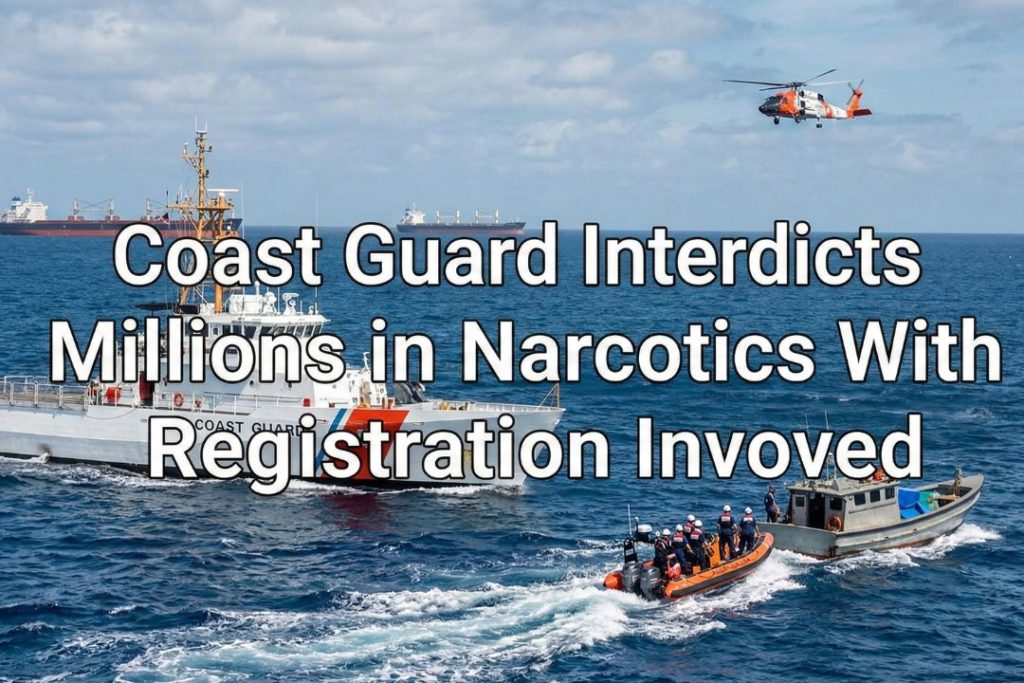
Eight miles off the coast of Miami, a fast-moving vessel cut across open water in a way that immediately drew attention. Within minutes, a Coast Guard cutter closed in, boarding teams prepared to deploy, and another maritime interdiction unfolded. It may not seem like it, but incidents like this highlight how Coast Guard documentation plays a critical role in identifying vessels at sea and separating lawful boaters from criminal operators.
The Miami Interdiction and the Role of Coast Guard Documentation
According to an official report from the Coast Guard, the crew of the CGC Richard Etheridge interdicted a suspected drug-smuggling vessel and seized approximately 174 pounds of cocaine and 17 pounds of marijuana, valued at more than $1.3 million.
The interdiction occurred when the crew of the United States Coast Guard cutter CGC Richard Etheridge encountered a “go-fast” style vessel operating offshore near Miami.
During the boarding, Coast Guard personnel discovered:
- Approximately 174 pounds of cocaine
- Approximately 17 pounds of marijuana
- An estimated total value of $1.3 million in narcotics
Beyond the contraband itself, the first step in nearly every boarding is not a cargo inspection. It is a verification of nationality.
Nationality Verification at Sea
When a boarding team approaches a vessel, one of the most important questions is simple: What nation does this vessel belong to?
In the case of a boat claiming U.S. status, officers verify:
- The vessel name displayed on the hull
- The hailing port marked on the stern
- The official number (if documented)
- The existence of a corresponding record in the Coast Guard’s database
If a boat claims to be documented but its physical markings do not match the digital record maintained by the National Vessel Documentation Center, that discrepancy becomes an immediate red flag.
For smugglers, false markings are a tactic. For legitimate boaters, mismatched or expired records can create unnecessary complications.
This is where our online portal supports vessel owners. We simplify the process of applying for and maintaining active Coast Guard documentation so that your records align with what enforcement systems show in real time.
Stateless Vessels, Legal Authority, and Coast Guard Documentation
Out on the high seas, maritime law operates under international frameworks that most recreational boaters rarely consider. Yet these rules become central during interdictions.
A vessel that cannot establish nationality is considered “stateless” under international law. That designation has significant consequences.
The Stateless Trap
A vessel may be considered stateless if it:
- Fails to claim nationality
- Claims nationality that cannot be verified
- Displays inconsistent or fraudulent documentation
- Has no valid registration under any flag
A stateless vessel may be boarded by any nation on the high seas. It does not enjoy the legal protections that come with a recognized flag state.
By contrast, a properly documented U.S. vessel is operating under the protection and authority of the U.S. flag. This status defines:
- Which enforcement bodies may board
- What legal standards apply
- What procedures must be followed
Federal regulations governing vessel documentation are outlined in Title 46 of the Code of Federal Regulations.
Defined Protocols for Documented Vessels
When a vessel holds a valid Certificate of Documentation:
- Its official number is recorded and searchable
- Ownership information is on file
- Vessel particulars are digitally stored
- Nationality is immediately confirmable
This clarity protects lawful operators. It reduces ambiguity and allows boarding teams to confirm status quickly before moving forward.
Through our service, vessel owners can apply for initial documentation, vessel documentation renewal, and other required filings so that their status remains current in federal records.
The Digital Shield: MISLE and Coast Guard Documentation
Modern maritime enforcement does not rely solely on painted lettering and visual inspection.
The Coast Guard uses an integrated system known as MISLE (Maritime Information for Safety and Law Enforcement). When a boarding team runs a vessel’s information, they can access far more than just a name.
MISLE allows officers to verify:
- Official number
- Registered owner
- Vessel length
- Propulsion details
- Endorsements
- Historical records
Smugglers sometimes attempt to “clone” legitimate vessels by painting a real name and hailing port on their hull. The goal is to blend into recreational traffic, particularly in high-traffic areas like South Florida.
But cloning only works at a surface level.
When the physical vessel does not match its digital profile—such as incorrect engine configuration or different length measurements—the deception becomes obvious.
If you have made changes that require a change of endorsement/trade indicator, keeping your federal record aligned with reality prevents confusion during inspections.
Accurate Records Protect Lawful Owners
Most recreational boaters will never encounter a narcotics interdiction. However, routine boardings remain common.
When officers approach a vessel, they are trained to look for indicators of risk. These include:
- Inconsistent hull markings
- Expired certificates
- Outdated hailing ports
- Gaps in ownership records
Even innocent administrative lapses can resemble patterns seen in criminal operations.
Avoiding the “Accidental” Red Flag
If your Certificate of Documentation has expired, your vessel’s federal status may not appear active in the system. Similarly, if your hailing port has changed and your record has not been updated, discrepancies may arise.
Maintaining active documentation reduces the likelihood of:
- Extended verification delays
- Additional questioning
- Escalated inspections
When your record is current and consistent, boarding officers can confirm your status quickly and allow you to continue your voyage.
If documentation has lapsed, our online portal allows you to pursue reinstatement where eligible, ensuring your federal record reflects active status once again.
Ownership Clarity and the Abstract of Title
For documented vessels, the federal record establishes a clear chain of ownership. An abstract of title provides an official history of:
- Previous owners
- Recorded liens
- Satisfaction of mortgages
- Filing chronology
Accurate federal records protect lawful owners by ensuring that the vessel’s legal identity is transparent.
Through our service, vessel owners can request documentation-related filings required under federal regulations, streamlining access to the appropriate application process.
Coast Guard Documentation as a Maritime Identity
A documented vessel carries more than a registration number. It carries a federally recognized identity.
That identity establishes:
- Nationality
- Ownership
- Eligibility for endorsements
- Regulatory compliance
In enforcement scenarios, this identity becomes the first reference point.
During the Miami interdiction, nationality verification was an immediate step before narcotics were even confirmed. Establishing a vessel’s legal status is foundational to determining how officers proceed.
Coast Guard documentation can serve as a safeguard that clearly distinguishes lawful maritime activity from illicit conduct.
Keeping Your Federal Record Current Through Coast Guard Documentation
Maritime enforcement in 2026 is highly digitized. Boarding teams rely on databases, cross-checking tools, and real-time data access.
Our online portal is designed to simplify the process of submitting documentation applications and renewals required by federal law. We provide a direct pathway to:
- Initial documentation filings
- Renewal applications
- Updates to vessel information
- Reinstatement requests when applicable
Enforcement Headlines and What They Mean for Boaters
High-profile interdictions serve as reminders of the broader enforcement environment operating offshore.
Smuggling networks:
- Exploit speed
- Attempt to manipulate vessel identity
- Rely on deception
The Coast Guard responds with:
- Rapid interception capabilities
- Digital verification tools
- International legal authority
- Structured boarding procedures
For lawful operators, the difference between smooth verification and prolonged scrutiny often comes down to one factor: whether your federal record matches the vessel in the water.
A current Certificate of Documentation, accurate ownership records, and properly aligned vessel information create clarity.
In a maritime environment where enforcement teams routinely intercept multi-million-dollar narcotics shipments, documentation is not a minor detail. It is the foundation of vessel identity.
By maintaining accurate Coast Guard documentation through a streamlined online filing process, you reinforce that identity every time you leave the dock.