When a documented vessel’s particulars are changed, it is a formal application for change or Exchange of USCG Documentation. Repeatedly, vessel owners face this need during changes to ownership, modification or status. Making sure an Exchange of USCG Documentation is completed correctly keeps federal records accurate and compliant. Operational and legal problems may arise if this process is missed and/or delayed.
Vessel documentation essential information about ownership, eligibility and vessel details. When changes occur, the certificate must be presented for an exchange of an updated one. Official records are safeguarded through this process. This too makes sure that the vehicle operates freely.
In this guide, we will explain the Exchange of USCG Documentation. You will discover when it’s appropriate to engage, how it varies from other processes, and how to achieve success in it. By knowing these steps and best practices, vessel owners can prevent delays, penalties and other troubles.
Understanding the Exchange of USCG Documentation
USCG Documentation exchange consists of quite a few steps. It is important to correctly complete all the steps to avoid rejection and delay. Preparation is key for smooth execution.
An applicant must specify current vessel information and the required changes. Supporting documentation may be needed depending on the type of change. Every field must be rigorous in accuracy.
The particulars of the official numbers and vessel names as well as the owner details must match with the existing records. Discrepancies often cause delay in processing. Before processing, review the records.
Key Requirements and Steps in the Exchange Process
The process of exchanging USCG documentation has many steps. Complete the stages accurately, or the process will reject or delay it. It is essential to prepare for making things run smoothly.
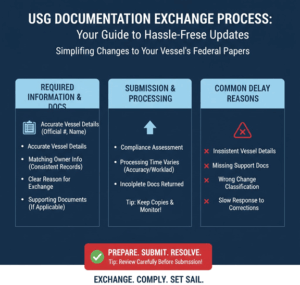
Required Information and Documentation
The vessel details and reasons for change must be current. Supporting records can be necessitous depending on the type of change. It is important to be accurate in every field.
The official number and the vessel’s name and owner name must match with the records at all times. Going over the records ahead of time can prevent mistakes.
Submission Review and Processing
After submission the request gets assess for compliance, the processing time varies depending on accuracy and volume of request. It is important for applicants to keep copies of their all submitted materials. The updated documents should be closely monitored. Submitting ahead of time gives room for chance to resolve concerns.
Common Reasons for Processing Delays
- Inconsistent vessel identification details
- Missing supporting documentation
- Incorrect classification of requested change
- Delayed response to correction requests
These problems slow up the approval process. When you make proper preparations, it saves time and trouble.
Exchange of USCG Documentation Compared to Other Actions
Owners of many vessels confuses an exchange with renewal or transfer. Every process has a different purpose. A better understanding of these differences ensures proper action.
| Action | Primary Purpose | Ownership Change |
|---|---|---|
| Exchange | Update details | No |
| Renewal | Maintain validity | No |
| Transfer | Change ownership | Yes |
Processing Time Comparison
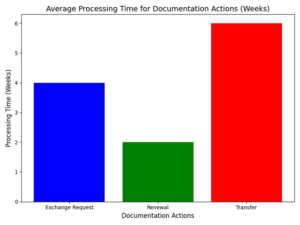
- Request for exchange takes anywhere between 4 weeks to process.
- Renewal is the fastest at 2 weeks on average.
- Transfer generally takes the longest time of around 6 weeks.
- The processing of exchanges is more complex than that of a renewal but less so than a transfer.
Practical Tips for a Successful Exchange
Examine your current Certificate of Documentation. Find all details that need updating. Giving full and accurate information can speed up the review time.
Have all supportive documents ready before commencement. Easy to fetch records make verifications easy. Documents need to be consistent.
Quickly submit the exchange request after a change. Holds may lead to noncompliance. Keeping documentation up to date protects operational authority.
Best Practices to Follow
- Review existing documentation carefully
- Double-check all updated information
- Submit requests soon after changes occur
- Keep confirmation records securely
Following these practices ensures smoother processing. Attention to detail is the key to success.
Maintaining Accurate Vessel Records
At National Documentation E‑Portal the importance of USCG documentation exchange in maintaining accurate information on vessels. It guarantees that official federal papers reflect current vessel details. Essential exchanges safeguard compliance and operational continuity. It also prevented delays through provision of guidance. These processes help vessel owners.
Owners safeguard their legal position by accurately and timely completing the Exchange of USCG Documentation. Accurate documentation aids in inspections and financing. A proactive compliance approach helps build long-term confidence.