
The proper documentation and accuracy are essential to transferring a federal vessel’s ownership. A Coast Guard documentation transfer form is essentially what permits official records to be updated upon a vessel’s change in ownership. No matter if the transfer occurs by way of sale, inheritance or group reorganization, correct filing establishes the new ownership.
Federal documentation of vessels is maintained by Coast Guard. These records provide confirmation of nationality, ownership status and related eligibility. Whenever there is a change of ownership, the documents should be updated.
If the transfer paperwork is not done correctly, it can cause delays, applications being rejected and/or compliance being breached. Knowing how the required form, related documents and filing work can prevent expensive hiccups.
This document provides information about the ownership transfer form, assessing filling in scenarios, and outlining procedures to efficiently complete ownership changes.
The function of the Coast Guard Documentation Transfer Form
The Coast Guard documentation transfer form is used to formally record a transfer in ownership of vessels. Federal documentation accurately reflects the true legal owner.
Federal vessel documentation is not the same as state registration. Official registration assigns a number to documented vessels and lists them in a registry. When the ownership changes, this must be updated.
The following comparison table highlights the major differences between documented vessel transfers and title transfers by the state.
| Feature | Federal Documentation Transfer | State Title Transfer |
|---|---|---|
| Governing Authority | U.S. Coast Guard | State boating agency |
| Official Vessel Number | Permanent federal number | State registration number |
| Mortgage Recording | Preferred ship mortgage option | Limited state lien recording |
| Processing Requirements | Federal form and supporting docs | State title paperwork |
| International Recognition | Yes | No |
When completing federal transfers, you will need a bill of sale. Sometimes one may need notarization.
Keeping good records ensures constant compliance
Grasping each step of the transfer process lowers chances of rejection.
Required Paperwork
The transfer of a boat usually entails a bill of sale, proof of ownership, and the transfer itself. Back up documents must match existing records.
Names and vessel numbers need to be correct.
Popular Filing Situations
Ownership can transfer due to sale, gift, inheritance, restructure, and other reasons.
Common documentation features comprise
- First sale of bill.
- New owner proof of citizenship.
- Satisfaction of mortgage (if any)
- Check and cross-check.
Review all entries thoroughly before submission.
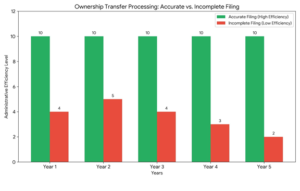
- A good filing provides high administrative efficiency. Likewise records are clear. As such compliance remains stable over five years.
- Varying the cycle of inefficiencies from incomplete filing creating administrative debt. Hiccups that begin as minor document rejections in Year 1 snowballs into increased cumulative delays, reprocessing requirements, and registration setbacks by Year 5.
- Financing and operational impact: Delays caused by incomplete filing, go beyond merely being administrative inconveniences, they directly affect the financial status and operational capability of the vessel, highlighting the importance of clear title and mortgage record for business continuity.
Precise Submission Safeguards Legal Certainty
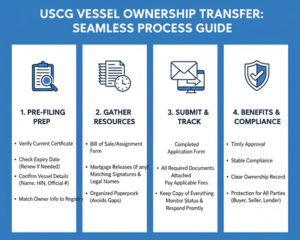
Proper preparation simplifies filing the Coast Guard documentation transfer form.
Confirm Current Document Status
Check that the vessel’s Certificate of Documentation is current.
Ensure the details of the vessel’s number and ownership are correct.
Start Collecting Resources Early for Coast Guard Documentation Transfer Form
Gather bills of sale and mortgage releases ahead of time. Make sure signatures match legal names exactly.
- Systematic arrangement avoids gaps.
- Useful filing practices comprise.
- Confirm the spelling of all names.
- Verify precision in official vessel count.
Please include all necessary documents
- Keep a copy of everything.
- Improving confidence helps you file.
- Keep an Eye on Processing Status.
- It improves the speed of approval.
Coast Guard documentation transfer form should not be daunting
Accurate completion of the Coast Guard documentation transfer form ensures the legal recording of changes in vessel ownership. Documentation protects buyers, sellers, and lenders alike.
Being clear on required forms and supporting materials helps avoid delays. Proper preparation leads to smoother filings compared to incomplete submissions. National Documentation E-Portal helps ensure accurate documentation, national recognition, and proper recording of mortgages and transfers.
Vessel owners can ensure an efficient transfer by verifying the details, gathering the documentation early and careful review of entries. Properly organized filing ensures compliance and the integrity of federal vessel records.