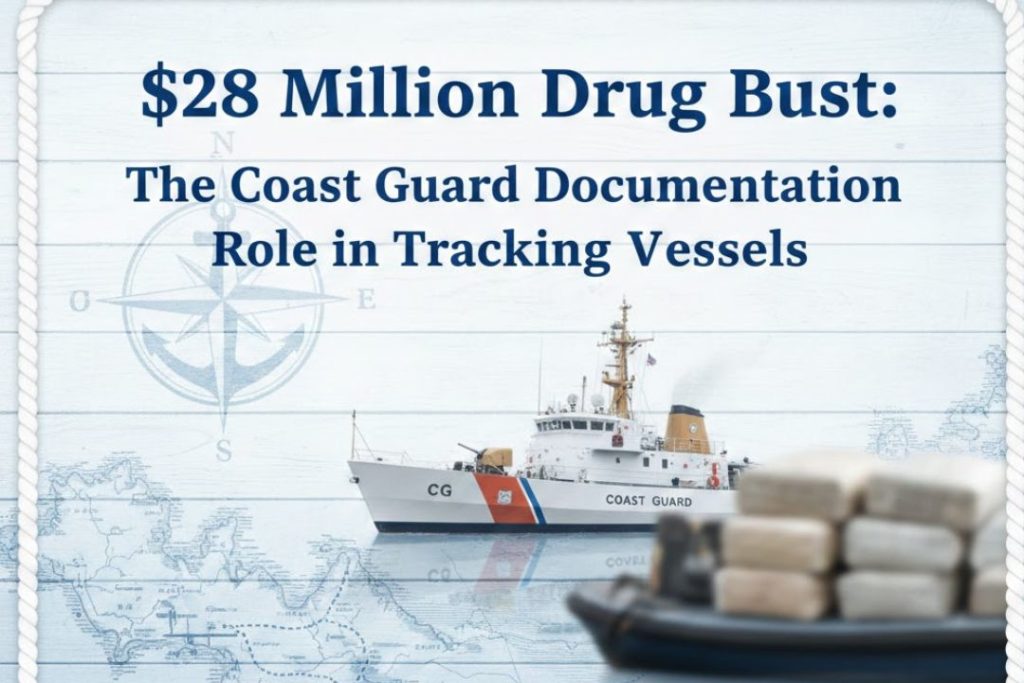
The recent seizure of a vessel carrying about $28 million in cocaine off Miami Beach offers powerful proof of the Coast Guard’s heroism. Additionally, it also shows how tracking and Coast Guard documentation matter.

According to Fox LA, on December 2, 2025, a joint law-enforcement operation intercepted a suspected smuggling boat just two miles east of Government Cut. The bust, which netted roughly 3,715 pounds of cocaine, stands as the largest haul ever recorded by a small-boat station of the U.S. Coast Guard (USCG) since 1995.
What Happened Off Miami Beach
- USCG Station Miami Beach patrol boats stopped a suspicious vessel near Government Cut.
- Once intercepted, the USCG crew called in support from U.S. Customs and Border Protection (CBP) Air and Marine Operations (AMO) and Homeland Security Investigations (HSI).
- CBP AMO brought additional marine units and “specialized search tools” to inspect the vessel.
- After the boat was brought pierside, CBP’s Office of Field Operations deployed a K-9 team. The dog alerted to multiple hidden compartments.
- A physical search revealed over 1,000 concealed packages — totaling about 3,715 pounds of cocaine — with a street value estimated at $28 million.
- Three individuals aboard were taken into custody.
USCG officials say this is the largest cocaine seizure by any of their small-boat stations in nearly three decades.
Coast Guard Heroism and Inter-Agency Teamwork
This wasn’t a simple paperwork check. It was a tense maritime enforcement action that required coordination, courage, and precision.
- USCG crews boarded a vessel on open water. That alone carries risk.
- They identified suspicious behavior and called in reinforcements from CBP and HSI. That shows alertness and judgment.
- Specialized search tools were used to scan and search the vessel. That shows tactical readiness.
- After the boat reached shore, a K-9 search uncovered hidden packages — that led to the massive haul. That highlights careful procedure and follow-through.
- Three suspects were detained. The drugs were removed before hitting U.S. communities.
Such actions demonstrate the bravery and vigilance of the USCG and partner agencies. They stand watch at sea so illicit drugs don’t reach shore.
The Role of Coast Guard Documentation in Vessel Tracking
You might wonder: what does vessel documentation have to do with a drug bust? The truth is that Coast Guard documentation can help to track certain vessels.
Vessel identity and ownership traceability
- A properly documented vessel carries an official record of ownership, registration status, and key identifying information.
- That record helps law enforcement quickly verify whether a boat is registered, who owns it, and whether it has been previously flagged.
- If a vessel lacks valid documentation or there are inconsistencies, officers may raise suspicions and investigate further.
Data sharing and inter-agency coordination
- Documentation allows agencies like the USCG, CBP, and HSI to cross-reference vessel records across federal databases.
- That helps link vessels to prior alerts, smuggling routes, or criminal organizations — especially when specialized search tools are employed.
- In the Miami bust, the report explicitly mentions specialized search tools brought in after the Coast Guard’s initial interdiction.
Enabling legal enforcement
- Proper documentation lays the groundwork for lawful boarding and seizure. Authorities rely on registration records when justifying stops and searches.
- It helps establish jurisdiction and accountability — vital when seizing vessels under suspicion.
How Our Service Supports Responsible Vessel Ownership
At our portal, we simplify several key Coast Guard documentation steps. When you use us, you can:
- Conduct a vessel documentation search to confirm your vessel’s registration status quickly.
- Manage documented vessel renewal to keep registration current.
- Handle preferred ship mortgage filings properly should you seek financing.
- Obtain an abstract of title to demonstrate clear ownership history.
These services ensure your vessel is legally documented, registered, and traceable. That matters not only for compliance — but also for safety, legality, and potential liability if law enforcement queries your vessel.
Maritime Enforcement Relies on Documentation
The Miami Beach drug seizure illustrates a larger truth: tracking vessels isn’t just bureaucratic red tape. It is a cornerstone of maritime law enforcement.
- Smugglers often use unregistered or poorly documented boats to avoid detection.
- A well-documented vessel makes it harder for wrongdoers to hide.
- Documentation supports coordination among agencies — from Coast Guard patrols to CBP AMO and HSI.
- It enables use of specialized search tools and intelligence databases to catch illicit activity.
When you keep your Coast Guard documentation paperwork current, you help maintain a transparent and traceable maritime environment. You help uphold safety and deter crime.
What the Miami Bust Teaches Boat Owners
- Illicit drug smugglers keep trying. What happened off Miami Beach shows they will exploit unmonitored vessels.
- The Coast Guard and partner agencies remain vigilant — and ready to act.
- Legal vessel documentation exists for more than just compliance. It helps law-enforcement track, identify, and, when needed, intercept suspicious vessels.
- Being a responsible boat owner isn’t just about completing Coast Guard documentation because you’re supposed to. This genuinely supports security on our waters.
Our service exists to help you stay on the right side of maritime law. We provide fast, reliable tools for vessel registration, renewal, ownership records, and financing documentation.