In the United States, documented vessel owners have to renew USCG documentation every year. It helps you keep your boat legally documented to prove ownership, financing, and travel. Failing to renew on time can attract penalties or delays, or loss of documentation. Many owners don’t recognize its importance until complications arise during inspections or transactions.
Avoid stress by accurately completing and submitting your USCG documentation renewal on time. Although it looks simple, errors can cause rejects or delays in processing. Why do vessel owners often not understand their eligibility, what to provide, and when to submit? This guide clearly and professionally clarifies the renewal process.
Make sure you understand how USCG Documentation Renewal works to protect your boat’s status. This manuscript addresses prerequisites, timeliness, contrasts, and practicality. It also points out mistakes and best practices. Staying compliant is important no matter whether you’re commercial or recreational. You shall learn all about it in the following sections of this guide.
Understanding USCG Documentation Renewal and Its Importance
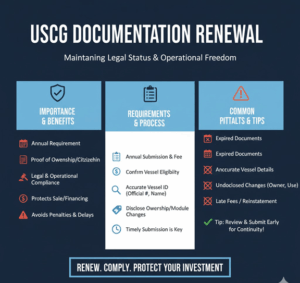
Every vessel which has USCG Documentation must renew it on an annual basis. Paperwork is evidence of citizenship and ownership. It also permits vessels to participate in specific market activities. Without renewal, the documentation becomes invalid.
The renewal process ensures that the details of the vessel are valid and the details are current. Vessel characteristics, usage type, and owner information included. If you keep the documentation valid, it keeps you legal and protects you during inspections. You’ll also be protected in your ability to sell or finance the vessel.
The USCG Documentation Renewal must be completed, or else late fees or reinstatement may occur. Expired documents can restrict operators in some cases. To transfer or charter an agreement, a vessel owner may be delayed. To guarantee continuous compliance, keep documentation current.
The renewal process has become more organized over time. It is necessary for the owners to submit true information and applicable fee. It depends on the accuracy of the submission. When owners understand the basics, they can avoiding the usual traps and administrative delays.
Key Benefits of Timely Renewal
- Maintains legal vessel status and compliance
- Prevents penalties and reinstatement delays
- Protects resale and financing options
- Ensures smooth inspections and operations
- Detailed Renewal Requirements and Process
Renewing USCG Documentation is a process that must be carefully followed. Prior to application submission, vessel owners must confirm eligibility. Coast Guard requirements still apply to documentation. The size of the vessel is important as well as ownership qualifications.
Owners must provide exact details of the vessel ID. This could be, for example, the official number and name of the vessel. Processing delays often happen due to errors in these fields. It is important to submit the accurate information to get approval.
Required Information and Eligibility
To be eligible for USCG Documentation Renewal, the vessel must remain documentable. A qualifying entity or citizen must hold ownership. Any ownership changes must be communicated prior to renewing.
The size and use of the vessel must also remain unchanged. Changes in the Module when tonnage or service type is modified. Changes can invalidate your documentation if not disclosed. The process requires accuracy at every step.
Submission and Processing Timeline
The renewal application must be submitted before expiry. It is suggested to submit your application early. Most renewals are processed within several weeks. Incomplete applications often cause delays in processing.
Applicants should track their submission status. Peak periods can lead to longer processing times. Scheduled documentation can help in keeping things uninterrupted. It is advisable to maintain a log of submissions.
USCG Documentation Renewal Compared to State Registration
Renewal of USCG Documentation is different from state vessel registration. Federal documentation gives you national recognition. The state registration is only within state waters. Several owners confuse both the systems.
Larger vessels are more prefer federal documentation. It enables you to travel abroad and finance. State registration tends to be less complex but also less extensive. Owners can choose wisely by understanding these differences.
| Feature | USCG Documentation | State Registration |
|---|---|---|
| Jurisdiction | Federal | State |
| Renewal Frequency | Annual | Varies by state |
| International Recognition | Yes | No |
| Financing Benefits | Strong | Limited |
USCG Documentation Renewal offers broader legal advantages. It is often required for commercial operations. State registration may still be necessary in some cases. Owners should evaluate their vessel’s usage carefully.
- Optimal Status Continuity: The only way to keep the legal status of a vessel without interruption is that the renewal of its documentation is done before the expiration date.
- Significant Processing Delays: Letting the documentation expire means a reinstatement procedure, which on average takes 5 weeks more than twice the 2, week average period for a standard renewal.
- Consequences of Inaction: When no administrative action is taken, the vessel privileges are lost.
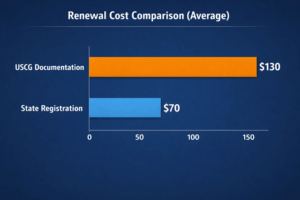
- Cost Disparities: Typically, USCG Documentation renewals cost $130, which is substantially more than the average $70 for State Registration.
- Replacement Timeline: In case the certificate is lost, a replacement request usually takes 3 weeks to be processed, thus, the time is closer to renewal than to reinstatement duration.
It shows the standard differences in cost. Depending on the case, the actual fee may differ. Extra Compliance Benefits Often Exist In Federal Documentation
Practical Tips for a Smooth Renewal Process
The most effective way to renew your USCG Document is to prepare in advance. Before submission vessel particulars must be checked by owners. Double checking accuracy can avoid delays.
Maintain a list of required information. This will contain official figures and records of ownership. Organized documentation speeds things up. Before you submit, double-check.
Do not wait for the expiry. If you turnaround your assignments in time you will be safe from penalties. Renewing early gives us time to fix mistakes. It also brings a sense of calm.
Common Mistakes to Avoid
- Submitting incorrect vessel identification details
- Failing to update ownership changes
- Missing renewal deadlines
- Providing incomplete information
These errors are not made by the owners to keep the documentation status uninterrupted. A careful consideration of detail makes a huge difference. A good plan avoids problems later.
Staying Compliant with USCG Documentation Renewal
It is important for the owners of documented vessels to undergo National Documentation E-Portal. It maintains legal status and continuing permissions. Understanding the process prevents unnecessary delays and penalties.
This guide has explained basics, requirements, and comparisons. It also gave practical pointers for a successful renewal. Staying updated ensures the protection of their investment.
When vessel owners renew on time and accurately, they are assured of compliance. Having proper documentation will ensure smooth running of operations as well as future transactions. To ensure successful ownership of the vessel and its longevity, it requires a consistent attention to renewal requirements.