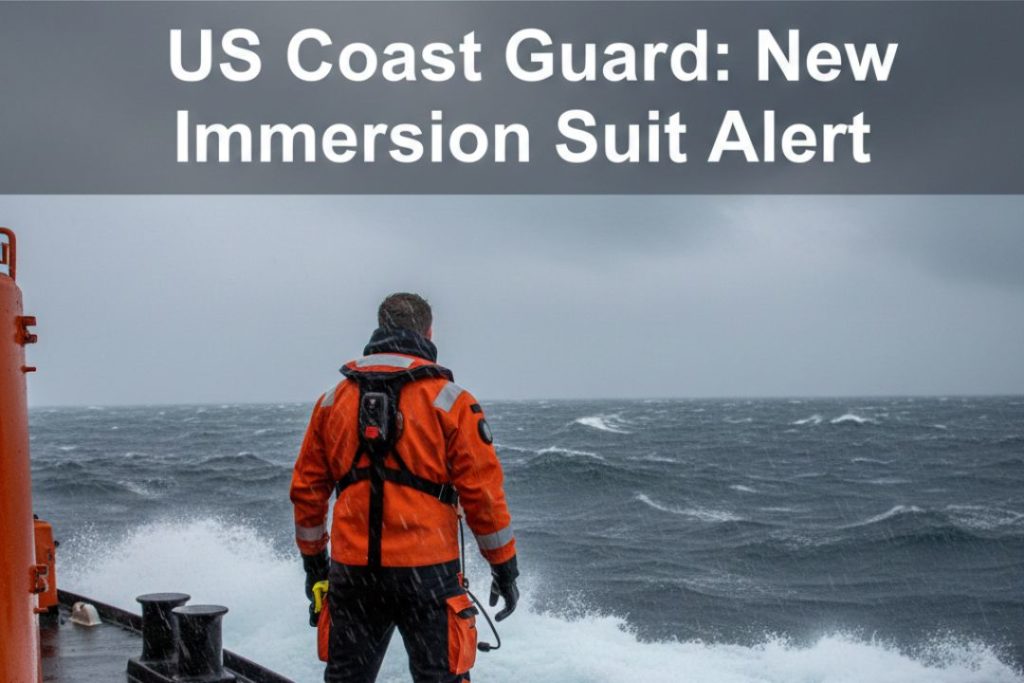
In January 2026, the United States Coast Guard issued a safety alert that directly affects owners of federally documented vessels, particularly those operating in cold-water environments. As a company that helps owners complete and manage US Coast Guard Boat Registration through a streamlined online portal, we pay close attention to regulatory updates.
This new alert highlights a serious issue with immersion suit integrity and reinforces how closely safety compliance and federal documentation are tied together.
The alert focuses on immersion suits that appear serviceable during routine visual checks but may fail under real-world conditions. For owners of documented vessels, this matters because inspections, safety gear standards, and documentation status are evaluated together during Coast Guard boardings.
Safety Alert Issued in January 2026 and What It Means for US Coast Guard Boat Registration
On January 16, 2026, the Coast Guard released Safety Alert 03-26 after inspectors identified a recurring problem with immersion suits equipped with adhesive-sealed zippers. During examinations, some suits passed visual inspection but failed air and water integrity testing due to adhesive degradation along the zipper seam. In freezing conditions, even minor leakage can lead to rapid heat loss.
For owners maintaining US Coast Guard Boat Registration, this alert underscores how safety equipment and federal documentation are reviewed together. During a boarding or inspection, officers typically examine:
- The vessel’s Certificate of Documentation
- The expiration status of that certificate
- Required lifesaving equipment, including immersion suits when applicable
- Maintenance and inspection records for safety gear
When immersion suits do not meet current expectations, deficiencies can be cited alongside documentation issues. Our service helps owners keep their documentation current so that safety-related findings are not compounded by expired or incorrect paperwork.
The Immersion Suit Adhesive Issue Identified by the Coast Guard
The central issue described in Safety Alert 03-26 is not obvious damage. Inspectors found that zipper adhesives were failing internally, even when suits looked intact. This creates a false sense of security for crews relying on suits as last-resort lifesaving equipment.
The Coast Guard emphasized several key points in the alert:
- Visual inspection alone is not sufficient to confirm immersion suit integrity
- Adhesive breakdown may occur with age, storage conditions, or repeated use
- Cold-water exposure magnifies the consequences of even small leaks
- Older suits may require more frequent inspection than previously expected
For documented commercial vessels and yachts, immersion suits are treated as essential lifesaving appliances. Federal law requires that they be properly maintained and inspected under 46 CFR 199.190. When documentation is current and accurate, inspections tend to focus on equipment condition rather than administrative deficiencies.
How US Coast Guard Boat Registration Supports Safety Communication
One aspect of the alert that often goes unnoticed is how safety information reaches vessel owners in the first place. When a vessel is federally documented, owner and vessel details are maintained in a centralized system. This supports the Coast Guard’s ability to distribute safety information, alerts, and regulatory updates.
With active US Coast Guard Boat Registration, vessel owners benefit from:
- Accurate association between the vessel and its registered owner
- Clear identification during inspections and enforcement actions
- Reduced confusion when safety alerts reference specific vessel categories
- Easier verification of vessel status during port state control and boardings
Our portal helps owners submit and maintain documentation information accurately, which supports this information chain. While we do not provide monitoring or notifications, we assist with the filing process so records reflect current ownership and vessel status.

Inspection Readiness and Documentation Status During Boardings
During Coast Guard boardings, documentation and safety equipment are reviewed together. An expired certificate or inconsistent vessel information can escalate an otherwise routine inspection. When immersion suits are now under increased scrutiny due to the 2026 alert, having documentation in order becomes even more important.
Common documentation-related items reviewed include:
- Certificate of Documentation validity
- Vessel name and hailing port consistency
- Owner information accuracy
- Evidence of a documented vessel renewal when applicable
If an immersion suit fails inspection under the updated guidance, penalties may be more significant when combined with documentation deficiencies. Our service focuses on helping owners submit renewals and filings correctly so documentation issues do not add unnecessary complications during inspections.
Immersion Suit Maintenance Checklist for 2026 Compliance
The Coast Guard’s alert also included updated guidance on how immersion suits should be evaluated going forward. While we do not provide maintenance advice or recommendations, owners should be aware of the general inspection expectations referenced by the Coast Guard.
Key elements highlighted in the alert include:
- Air pressure leak testing at least every three years
- More frequent testing for suits over ten years old
- Careful evaluation of zipper seams and adhesive integrity
- Avoidance of substances that could degrade adhesives
- Proper marking of suits to identify vessel association
Every immersion suit must be marked with the vessel’s name, and that name must exactly match the name listed on the federal documentation. Mismatches can result in deficiencies even if the suit itself passes testing.
Marking Requirements and US Coast Guard Boat Registration Accuracy
Correct marking is an area where documentation and safety equipment intersect directly. If the vessel name on an immersion suit does not match the Certificate of Documentation, the suit may be considered improperly marked.
This is where accurate US Coast Guard Boat Registration becomes especially important. Vessel names, hailing ports, and ownership details must be consistent across:
- The Certificate of Documentation
- Safety equipment markings
- Posted vessel identification
- Official Coast Guard records
Our portal helps owners file name changes, renewals, and updates so that documentation reflects the vessel’s current identity. We do not assist with physically marking equipment, but accurate paperwork supports compliance during inspections.
Regulatory Framework Governing Immersion Suits
Federal requirements for lifesaving equipment are outlined in 46 CFR 199.190, which states that all such equipment must be properly maintained and inspected. For commercial fishing vessels and documented yachts, the Coast Guard has described immersion suits as the mariner’s equivalent of a parachute.
Within this framework, documentation plays a supporting role by:
- Establishing the vessel’s regulatory category
- Identifying applicable safety equipment requirements
- Clarifying whether commercial standards apply
- Supporting enforcement decisions during inspections
When documentation is incomplete or outdated, determining applicable safety rules can become more complicated during an inspection.
Documentation Services That Support Compliance
As an online portal dedicated to federal vessel documentation, our service is designed to simplify the paperwork side of compliance. While we do not conduct research or provide follow-up services, we offer access to forms and filing assistance related to:
- Initial federal documentation
- Documented vessel renewal submissions
- Preferred ship mortgage filings
- Requests for an abstract of title
- Assistance with a vessel documentation search
These services support owners who want their records to accurately reflect the vessel’s legal and operational status. In the context of heightened safety scrutiny, accurate documentation helps ensure inspections focus on equipment condition rather than administrative errors.
Preferred Ship Mortgages and Safety Oversight
For vessels with financing, a preferred ship mortgage is recorded against the federal documentation. While primarily a financial instrument, this filing reinforces the importance of keeping documentation current. Lenders often require active documentation, and inspections that uncover deficiencies can have broader implications when a mortgage is involved.
Accurate documentation supports:
- Clear lien recording
- Verified vessel identity
- Consistent ownership records
- Reduced complications during enforcement actions
Our portal assists with the submission of preferred ship mortgage filings as part of the federal documentation process.
Why the 2026 Alert Matters for Documented Vessels
The immersion suit alert issued in January 2026 is a reminder that safety standards evolve, and inspections adapt accordingly. For owners of documented vessels, compliance is not limited to onboard gear alone. It also includes maintaining accurate, current federal records.
By keeping US Coast Guard Boat Registration up to date, owners place themselves in a stronger position when safety requirements change. Documentation does not replace equipment maintenance, but it supports clarity, accountability, and consistency during inspections and enforcement.
Staying aligned with federal documentation requirements allows owners to focus on meeting safety standards with fewer administrative obstacles. Our role is to help make that documentation process more accessible, so vessel owners can address regulatory changes like the 2026 immersion suit alert with confidence and clarity.