When emergencies unfold offshore, clarity saves time. As an online portal dedicated to simplifying Coast Guard documentation, a Certificate of Documentation can become a quiet but powerful factor during real-world rescues.
Recent Coast Guard operations off New Jersey and Florida underscore how verified vessel identity, accurate specifications, and linked records help responders act decisively when conditions are unforgiving.
Our service exists to help owners put that clarity in place before it is ever needed.
How a Certificate of Documentation Supports Coast Guard Rescues in Real Time
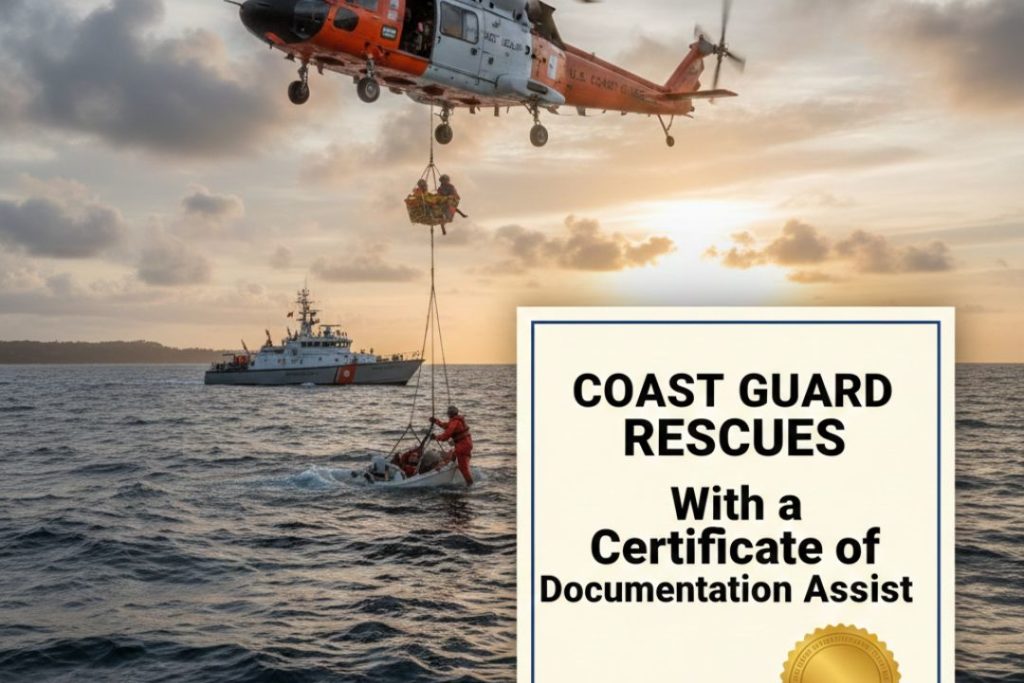
From an official Coast Guard press release, early on the morning of January 17, a 74-foot pleasure craft began taking on water roughly four miles off Shark River Inlet. Heavy seas, darkness, and the size of the vessel immediately elevated the risk profile for everyone involved.
From our perspective, this incident highlights how documentation informs rescue operations before crews ever reach the scene. A vessel of that size exceeds the five net ton threshold, meaning it qualifies for federal documentation rather than state titling alone.
With federal records in place, the Coast Guard had access to a verified identity tied to a unique Official Number.
That information supports operational decisions in ways many owners never see:
- Confirmation of exact vessel length and beam before deploying assets
- Awareness of hull construction, including whether responders are dealing with wood, fiberglass, or metal
- Knowledge of onboard fuel capacity, in this case hundreds of gallons of diesel, which affects safety planning
- Reduced confusion when multiple vessels share similar or identical names
In fast-moving situations, these details allow watchstanders to move directly into response rather than verification.
Between the New Jersey incident and the Florida rescue the following day, one theme remains consistent: identity drives efficiency.
The Identity Phase and the Certificate of Documentation in SAR Operations
Every search and rescue effort begins with identification. Before a helicopter lifts off or a boat crew gets underway, responders must know who they are looking for and what they are approaching.
Vessel names alone are not reliable identifiers. Repetition across ports and states introduces uncertainty, especially at night or in poor weather.
Federal documentation eliminates that ambiguity by assigning a permanent Official Number that follows the vessel through ownership changes.
This becomes especially important when emergency signaling devices are involved. According to another example from a Coast Guard press release, on January 18, a boat capsized off Ponce Inlet, Florida.
Here, reliable communication played a critical role. When an EPIRB or personal locator beacon is activated, the Coast Guard works to associate that signal with a confirmed vessel profile.
When records are current, responders gain:
- Immediate linkage between the distress signal and a verified vessel identity
- Owner and vessel details that align with federal records
- Reduced time spent sorting through similar names or outdated listings
- Greater confidence during the initial identity phase of the mission
Our role is to help ensure that the documentation supporting that identity is properly filed and accessible.
From Capsize to Coordination: Documentation Beyond the Initial Rescue
Rescue is only the first stage of a maritime incident. Once people are safely removed from danger, attention shifts to environmental protection, salvage planning, and insurance coordination.
In the New Jersey sinking, responders began formulating a salvage approach shortly after the crew was rescued. Documentation plays a supporting role here as well, particularly when multiple stakeholders are involved.
With valid federal records in place, it becomes easier for third parties to confirm standing without delays that can stall recovery efforts.
This is where related having a Certificate of Documentation and Coast Guard heroism can intersect:
- Ownership verification without the need for manual cross-checking
- Clear standing for insurers evaluating coverage
- Faster coordination with salvage operators
- Reduced disputes when multiple claims arise
Structural Familiarity and Safer Boarding Operations
Another often overlooked aspect of having a proper Certificate of Documentation is structural familiarity. Federally documented vessels have verified dimensions on file, including length, breadth, and depth.
For rescue crews, this matters during nighttime boardings or aerial hoists. Knowing the layout and scale of a vessel ahead of time improves crew safety and reduces risk during transfers.
From our standpoint, this reinforces the practical value of keeping documentation accurate and current, not just compliant.
How Our Portal Helps Maintain Documentation That Works When It Matters
We operate as an online portal designed to make the process of acquiring a Certificate of Documentation more accessible. Our service focuses on helping owners apply, file, and maintain federal records so that accurate information is available when it is most needed.
Through our platform, we assist with:
- Initial applications for federal documentation
- Documented vessel renewal submissions
- Requests for an abstract of title
- Filings related to a preferred ship mortgage
- Access to records used in a vessel documentation search
We do not conduct research, provide follow-ups, or manage communications beyond the filing process itself. Our role is to help owners submit the required information correctly and efficiently.
Documentation as a Preventive Measure, Not a Paper Exercise
The rescues off New Jersey and Florida illustrate that documentation is not merely administrative. It functions as part of the Coast Guard’s situational awareness toolkit.
When records are accurate and current, responders spend less time confirming identity and more time executing the rescue.
From our perspective, the value shows up in:
- Faster decision-making during emergencies
- Reduced confusion in multi-vessel areas
- Improved safety for rescue crews
- Smoother post-rescue recovery and verification
Maintaining a Certificate of Documentation is one of the proactive steps owners can take that directly supports emergency response infrastructure.
Keeping Federal Records Aligned With Reality
Vessels change hands, undergo refits, or shift operating profiles over time. When documentation lags behind reality, the Coast Guard may be working with incomplete or outdated information.
Our portal exists to help bridge that gap by making it easier to keep filings aligned with the vessel as it exists today.
Accurate records support:
- Reliable linkage between distress signals and vessels
- Clear ownership standing after incidents
- Faster coordination with insurers and third parties
- Reduced administrative friction following a rescue
While no one plans for an emergency, the events of January show how preparation influences outcomes. Federal documentation does not prevent accidents, but it can help ensure that when help is needed, responders arrive informed and ready.
That is the practical role we support every day through our service and through the proper maintenance of a Certificate of Documentation.