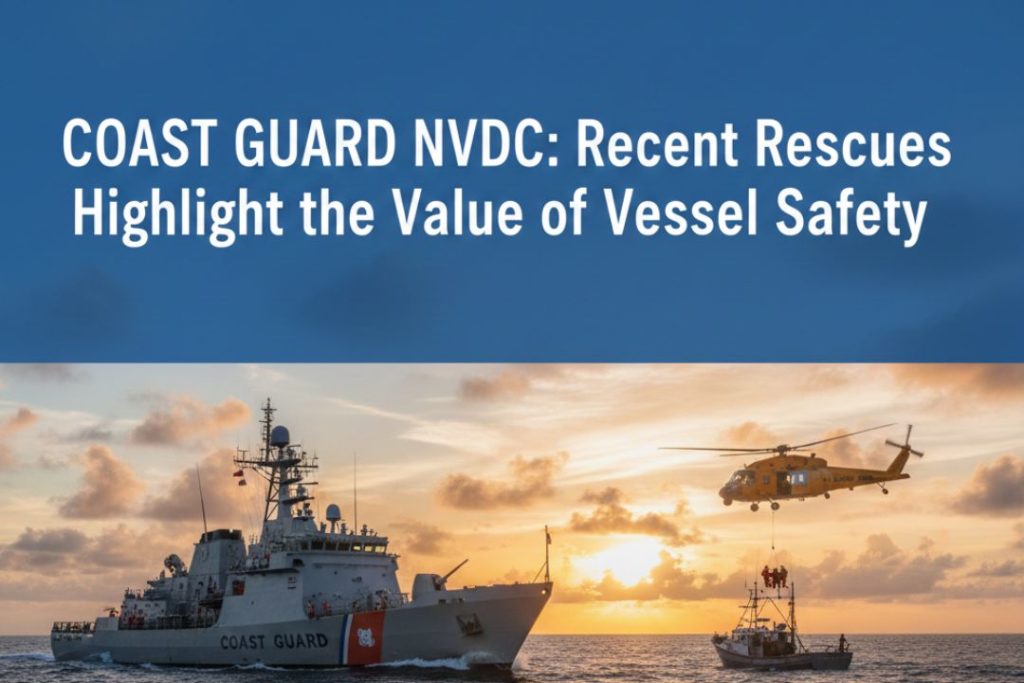
Coast Guard NVDC data often sits quietly in the background of maritime operations, but recent rescues show just how central accurate vessel information is when lives are on the line.
Two recent rescues, one off Port Canaveral and another near Aguadilla, Puerto Rico, demonstrate how preparation, coordination, and reliable documentation work together in real-world emergencies.
At the National Documentation E-Portal, our service focuses on helping vessel owners keep their federal records clear, current, and properly filed so that critical information is available the moment the Coast Guard needs it.
Recent Coast Guard rescues remind vessel owners that paperwork is not just administrative. It is part of a larger safety ecosystem that supports faster response times, clearer identification, and better situational awareness across busy waterways.
Coast Guard NVDC News and the Port Canaveral Rescue
As detailed by the Coast Guard, the rescue near Port Canaveral in January 2026 involved a boater whose vessel capsized offshore, leaving the individual in immediate danger. Conditions can change quickly in this region, where recreational traffic, commercial activity, and weather patterns intersect.
When a distress call is received, the Coast Guard’s command center must quickly determine what assets to deploy and what they are searching for. In cases involving a documented vessel, the Coast Guard NVDC registry becomes a primary reference point during the earliest stage of the response.
This early phase, often referred to as the identity phase, depends on reliable data that can be accessed instantly. Details responders look for include:
- Vessel length and general configuration
- Hull color and visible markings
- Owner name and contact information
- Hailing port and official documentation number
If this information is current and accurately filed, rescue crews can begin their mission with a clear visual and operational target before an aircraft or boat ever leaves the station. For the Port Canaveral rescue, this clarity helped narrow the search area and reduce delays during a critical window of time.
From our perspective, this moment highlights why keeping documentation accurate is not a formality. It is a functional tool that supports lifesaving decisions under pressure.
How Our Service Supports Documentation Accuracy
Our service exists to help vessel owners submit, update, and manage their federal documentation through a streamlined online process. We focus on making it easier to complete filings correctly so that the Coast Guard NVDC database reflects what is actually on the water.
We assist with filings that support registry accuracy like:
- Initial Coast Guard documentation applications
- Ownership changes and transfers
- Recorded lien filings tied to a preferred ship mortgage
- Requests for an abstract of title
- Documented vessel renewal submissions
By helping owners file these materials properly, we reduce the likelihood of outdated or conflicting information appearing in the federal system. In emergency scenarios, fewer discrepancies mean fewer questions for responders and faster confirmation of what they are searching for.
This accuracy also supports routine operational efficiency, allowing the Coast Guard to distinguish between similar vessels in crowded regions like Florida’s Atlantic coast.
Coast Guard NVDC and the Role of the Identity Phase
The identity phase of a rescue is not limited to locating a vessel. It also helps determine whether a reported incident is active, resolved, or potentially a false alarm. Accurate documentation data supports this assessment.
When records are current, command centers can:
- Verify ownership quickly
- Contact registered owners when appropriate
- Compare reported sightings against documented characteristics
- Reduce unnecessary deployment of limited resources
From our standpoint, this reinforces the idea that vessel owners are participants in maritime safety. Maintaining current records removes friction from the response process and supports better allocation of rescue assets.
Coordination Across Regions in the Puerto Rico Surfer Rescue
Another Coast Guard rescue near Aguadilla, Puerto Rico, involved a stranded surfer rather than a documented vessel. Even in this case, federal maritime systems played a role in coordinating the response.
The Coast Guard utilized its Search and Rescue Optimal Planning System to calculate drift patterns and probable locations based on environmental data. While the individual was not operating a documented vessel, the response assets were coordinated through the same command infrastructure that relies on Coast Guard NVDC data for overall maritime awareness.
Aircraft such as the HC-144 Ocean Sentry and supporting surface units operate within a framework that depends on accurate registries to manage traffic density, identify nearby vessels, and assess regional risk conditions.
Situational awareness matters because:
- Rescue units often operate near documented and undocumented vessels simultaneously
- Accurate registries help distinguish unrelated vessels from those involved in an incident
- Command centers can avoid confusion in high-activity areas
Even when a rescue does not directly involve a documented boat, the integrity of federal vessel data supports safer and more efficient operations overall.
How Vessel Owners Act as Partners in Safety
We view vessel owners as partners in maintaining a safer maritime environment. Accurate filings contribute to what the Coast Guard has referred to as improved data integrity, an effort aimed at reducing response delays and minimizing false alerts.
Owners support this effort by ensuring:
- Ownership changes are recorded promptly
- Physical vessel characteristics in the registry match reality
- Any lien and ship mortgage is properly filed and released when applicable
- Renewals are submitted on time
Our service is designed to help with these exact tasks, using an online system that simplifies submission while maintaining alignment with federal requirements.
In regions like Florida and the Caribbean, where vessel density is high and weather can change rapidly, even small improvements in data accuracy can make a difference.
The Practical Value of a Vessel Documentation Search
During emergencies and routine enforcement alike, a vessel documentation search allows authorities to confirm registration status, ownership, and recorded interests quickly. This process is only as reliable as the information entered into the system.
From our standpoint, helping owners submit accurate documentation supports:
- Faster confirmation during emergency calls
- Clearer identification during patrols
- Reduced administrative delays following incidents
This practical value extends beyond rescues and into everyday maritime operations, reinforcing the importance of keeping records current.
Maintaining Readiness Through Documented Vessel Renewal
A documented vessel renewal is more than a compliance requirement. It is a checkpoint that allows owners to confirm that their information remains accurate and complete.
When renewals are handled correctly:
- Registry data stays aligned with the vessel’s current condition
- Ownership records remain clear
- Emergency response teams can rely on consistent information
Our service supports this process by providing an accessible platform for submitting renewal filings, helping owners maintain continuity within the federal registry.
Coast Guard NVDC Data Integrity and High-Traffic Waterways
The Coast Guard has emphasized the importance of higher data integrity in federal registries, particularly in congested areas. Coast Guard NVDC records play a central role in this effort by providing a reliable reference point during both routine monitoring and emergency response. This can lead to:
- Reduced false distress alerts
- Faster verification of reported incidents
- Better coordination between air and surface units
From our perspective, this focus aligns directly with our mission. By helping owners file and maintain accurate documentation, we support a system that functions more smoothly when every second matters.
How Our Service Fits Into the Larger Safety Picture
We do not conduct research, monitor vessels, or provide follow-up notifications. Our role is specific and focused. We help vessel owners submit required documentation accurately and efficiently so that federal records remain dependable. Their work supports:
- Clear ownership records
- Accurate vessel identification
- Reliable access to registry information by authorities
Recent rescues off Port Canaveral and near Puerto Rico illustrate how preparation and coordination intersect. While heroism is visible in the actions of rescue crews, accuracy behind the scenes enables those actions to happen faster and with greater confidence.
By maintaining current records within the Coast Guard NVDC system, vessel owners contribute to a maritime environment where responders can act decisively. Our service exists to make that contribution easier to achieve, supporting safer waterways through reliable documentation practices.