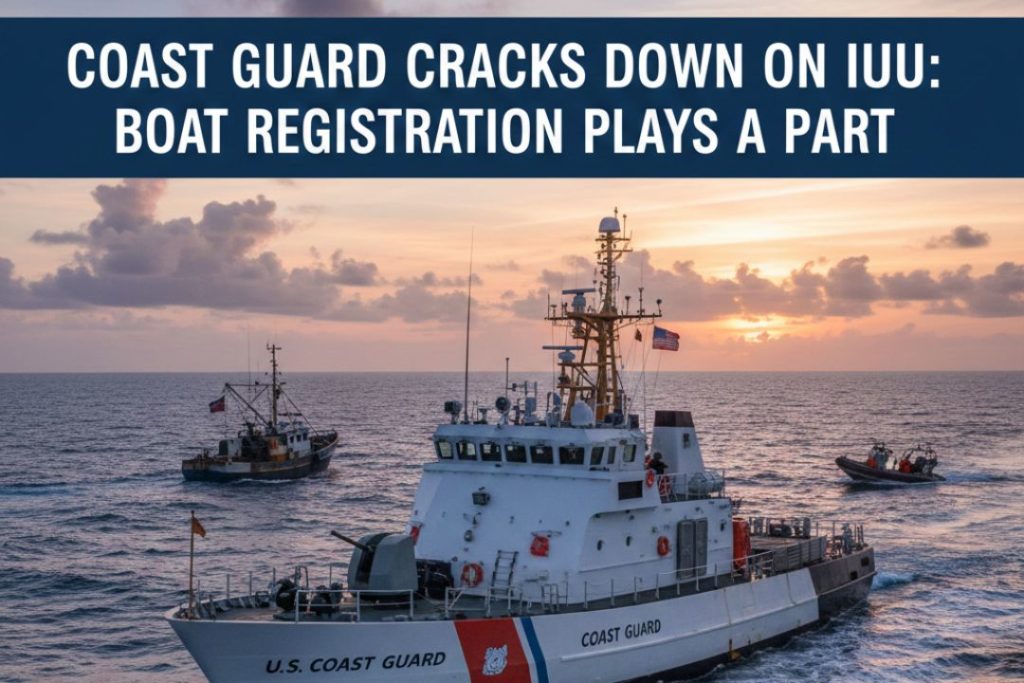
The global effort to stop illegal, unreported, and unregulated fishing has entered a more aggressive phase, and the United States Coast Guard is at the center of it. At the heart of this shift is something that often seems routine to American boat owners but carries international weight: Coast Guard boat registration.
As enforcement expands, documentation accuracy is no longer just administrative. It is part of how lawful mariners are distinguished from vessels engaged in criminal activity on the water.
Recent congressional testimony underscores how critical accurate documentation has become, not only for regulators but for legitimate U.S. vessel owners navigating a more closely monitored maritime environment.
The “Drugs, Thugs, and Fish” Hearing and What It Signals
On January 13, 2026, the U.S. House Coast Guard and Maritime Transportation Subcommittee convened a hearing titled “Drugs, Thugs, and Fish.” Lawmakers examined how IUU (“illegal, unreported, and unregulated”) fishing intersects with organized crime, narcotics trafficking, and transnational fraud.
Takeaways from the hearing included:
- IUU fishing drains an estimated $50 billion from the global economy every year.
- Criminal fishing fleets are often linked to labor abuse, smuggling, and sanctions evasion.
- Identification failures allow repeat offenders to reappear under new names and flags.
During the hearing, Coast Guard leadership emphasized that enforcement begins with identification. A clean, accurate, and verifiable vessel registry is the first checkpoint. Without it, interdiction, prosecution, and international cooperation all become more difficult.
This is where Coast Guard boat registration becomes foundational. Documentation is not merely proof of ownership. It is a vessel’s legal identity in international waters.
For additional context on the Coast Guard’s testimony and enforcement strategy, the full congressional debrief is available through SeafoodSource.
How a Clean Registry Supports Enforcement
Rear Admiral testimony highlighted that the Coast Guard relies heavily on registry data to identify bad actors before boarding even occurs. When a vessel’s name, number, or flag does not align with registry records, it raises immediate red flags.
A reliable registry allows enforcement agencies to:
- Cross-check vessel identities in real time
- Share verified data with international partners
- Track ownership changes and historical activity
- Separate compliant operators from suspected IUU participants
Our service supports this system by helping owners submit accurate documentation applications through a centralized online process. We focus on clarity and completeness, reducing the likelihood of errors that can complicate registry records.
Identifying the “Dark Fleet” Through Documentation
One of the most striking elements of the congressional hearing involved the scale of the so-called “dark fleet.” According to testimony, roughly 6,000 Chinese vessels are formally registered, while nearly 17,000 additional vessels operate under flags of convenience or questionable national affiliations while engaging in IUU fishing.
These vessels often rely on tactics such as:
- “Flag hopping” to avoid detection
- Fraudulent registration numbers
- Frequent name changes
- Inconsistent ownership records
The challenge for enforcement is not only stopping these vessels, but ensuring legitimate operators are never confused with them. Clear documentation plays a decisive role in that distinction.

Why Coast Guard Boat Registration Protects Lawful U.S. Mariners
For American vessel owners operating internationally, maintaining current documentation is a way to affirm legitimacy. A valid Certificate of Documentation establishes nationality, ownership, and compliance with U.S. maritime law. Coast Guard boat registration helps ensure that:
- A vessel’s identity is immediately verifiable
- Ownership records align with federal databases
- Port state authorities can confirm compliance without delay
Our portal is designed to make the application process more accessible, especially for owners navigating federal documentation requirements for the first time or returning after changes in ownership or vessel status.
The Shift Toward Prosecution Under the Lacey Act
A major policy change discussed during the hearing involves how the United States handles apprehended illegal fishers. Previously, many offenders were processed and released, particularly in cases involving cross-border poaching. That approach has changed.
Beginning in 2025 and continuing into 2026, the Coast Guard has expanded prosecutions under the Lacey Act. This law allows the government to pursue criminal charges for violations involving illegally sourced fish and wildlife.
This shift has several implications:
- Cases now require stronger evidentiary support
- Documentation errors can undermine prosecutions
- Accurate ownership records are essential
- Vessel histories are scrutinized more closely
In this environment, Coast Guard boat registration accuracy matters not only to regulators but to vessel owners themselves.

The Importance of a Verifiable Paper Trail
Prosecutions under the Lacey Act depend on documentation that clearly links a vessel to its activities. This includes ownership history, nationality, and registration status at the time of an alleged violation.
A strong paper trail typically includes:
- A valid Certificate of Documentation
- A clear abstract of title
- Consistent ownership records
- Alignment between physical markings and registry data
Digitization and Congressional Investment in Enforcement
Another major development discussed during the hearing is Congress’s authorization of a $25 billion investment into Coast Guard assets and technology. This funding includes new cutters, surveillance systems, and artificial intelligence tools designed to track illegal fishing more effectively.
A significant component of this investment is the digitization of vessel records, including modernization efforts tied to the National Vessel Documentation Center. As systems move toward greater data integration, inconsistencies become easier to detect.
For vessel owners, this means:
- Errors surface more quickly
- Outdated records are more visible
- Compliance expectations are higher
- Manual workarounds are less effective
Our online portal aligns with this digitized direction by allowing owners to submit documentation applications electronically, supporting the broader move toward accessible and standardized records.

How Coast Guard Boat Registration Fits Into a Digital Enforcement Future
As enforcement tools become more advanced, documentation accuracy becomes more critical. Digital systems rely on consistent data inputs. When vessel information is correct from the start, it supports smoother processing and fewer complications.
Coast Guard boat registration, done right, in a digital environment supports:
- Faster verification during inspections
- Improved data sharing with allied nations
- Reduced risk of misidentification
- Clearer ownership and nationality records
Our service exists to help owners navigate this digital shift without unnecessary friction, focusing solely on the application process itself.
Documentation, Financing, and Ownership Transparency
Beyond enforcement, federal documentation plays a role in ownership and financing structures. A documented vessel may be associated with instruments such as a preferred ship mortgage, which relies on accurate federal records. Additionally, documentation records support:
- Ownership transfers
- Title clarity
- Historical tracking of vessel status
- Public record searches through a vessel documentation search

Maintaining Compliance Through Proper Renewal
As enforcement scrutiny increases, maintaining current documentation is essential. A lapsed certificate can create unnecessary complications during inspections or port calls.
Documented vessel renewal ensures that:
- Federal records remain current
- Vessel nationality is continuously established
- Ownership information remains accurate
- Compliance gaps are avoided
Our portal supports the submission of renewal applications as part of the standard documentation lifecycle, helping owners keep their records aligned with federal expectations.
Coast Guard Boat Registration as a Line of Defense
The congressional hearing made clear that documentation is no longer viewed as passive paperwork. It is an active component of maritime security strategy. A clean registry allows enforcement agencies to focus resources on true bad actors rather than sorting through preventable discrepancies.
For lawful vessel owners, Coast Guard boat registration is part of demonstrating good faith and compliance in an environment where scrutiny is increasing.