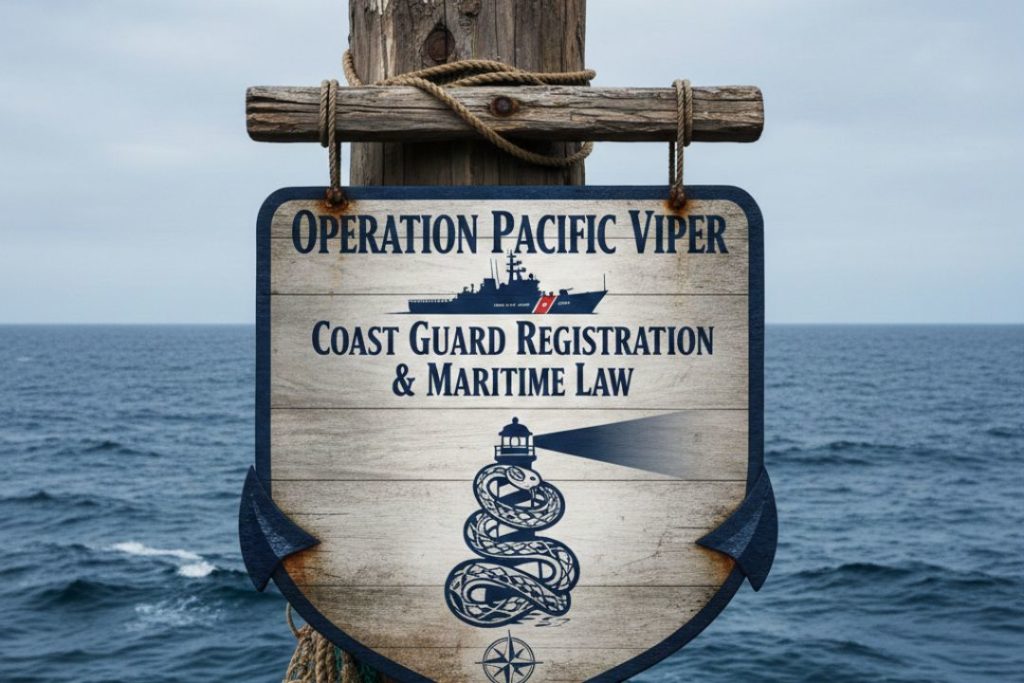
Operation Pacific Viper has reshaped how maritime enforcement operates across the Eastern Pacific and beyond. During heightened enforcement activity, having Coast Guard registration in place is not just administrative work. It is foundational to lawful navigation and smoother interactions at sea.
Operation Pacific Viper and Enforcement
Operation Pacific Viper, (described here in this news release), represents a coordinated, multinational effort focused on disrupting maritime narcotics trafficking.
Public reports surrounding the operation highlight the scale involved, including the seizure of roughly 200,000 pounds of illicit substances and the deployment of multiple Coast Guard cutters alongside international partners.
While the headlines focus on interdictions, the operation also underscores how modern maritime law enforcement functions behind the scenes.
For vessel owners, Pacific Viper matters because:
- It increases patrol density in commonly traveled waters
- It expands boarding authority during joint operations
- It places greater emphasis on clear vessel identity
- It relies heavily on verified databases of vessel information
Our service exists to help lawful mariners remain clearly identifiable within this enforcement environment, ensuring that vessels operating for recreation, commerce, or transport are distinguishable from those intentionally avoiding oversight.
The Infrastructure That Makes Maritime Policing Possible
Large-scale operations do not succeed on patrols alone. They depend on accurate, accessible vessel records that enforcement agencies can reference instantly. This infrastructure allows officers to differentiate between compliant vessels and those operating without nationality or documentation.
That system relies on:
- Verified vessel ownership records
- Accurate tonnage, dimensions, and identifying details
- Federally recognized vessel status
- Consistent documentation that aligns with maritime law
When a vessel is properly entered into the federal system, it becomes part of a transparent network that supports lawful navigation. Our role is to make access to that system easier, reducing friction between vessel owners and federal requirements.
How Coast Guard Registration Supports Sea Boardings
During high-activity enforcement periods like Pacific Viper, boardings become more frequent and more detailed. When officers approach a vessel, one of their first objectives is to establish nationality and legitimacy. Coast Guard registration allows that process to move forward without unnecessary delay.
Proper documentation helps by:
- Immediately identifying the vessel as federally documented
- Confirming lawful ownership and operational status
- Reducing uncertainty during inspections
- Allowing officers to focus on compliance verification rather than investigation
From our perspective, the goal is clarity. When documentation is current and accurate, lawful mariners are less likely to experience prolonged boardings or additional scrutiny during multi-agency operations.
Stateless Vessels and the Legal Divide
A defining element of Pacific Viper has been the identification of stateless vessels, including self-propelled semi-submersibles designed to evade detection. These vessels lack recognized nationality, making them subject to seizure under international maritime law.
Stateless vessels are characterized by:
- No recognized flag state
- No verifiable ownership records
- No federal or international protections
- Increased enforcement exposure
This reality highlights the value of formal documentation. A federally documented vessel carries U.S. flag status, which places it under the protection of the United States government in international waters. That legal recognition is the opposite of the anonymity enforcement agencies are targeting.
Coast Guard Registration as a Legal Safeguard
In contrast to vessels operating outside the system, Coast Guard registration establishes a vessel’s nationality, identity, and compliance. This status is not symbolic—it has real legal consequences during enforcement actions.
Documented vessels benefit from:
- Recognized nationality under international law
- Clear jurisdictional boundaries
- Reduced risk of misidentification
- Consistent treatment during joint operations
Our portal helps vessel owners complete and submit the required forms accurately, ensuring that documentation reflects the vessel’s true status without unnecessary complications.
Documentation: Not a One-Time Event
One of the key lessons from modern enforcement operations is that compliance must be maintained, not assumed. Expired certificates, outdated information, or incorrect details can complicate an otherwise routine boarding.
Common issues include:
- Lapsed federal documentation
- Incorrect hailing port entries
- Ownership changes not properly recorded
- Incomplete transfer records
We assist with updates and filings so that vessel records remain aligned with federal requirements, especially during periods of increased enforcement activity.
Handling Ownership Changes Correctly
Ownership transitions are a frequent source of documentation errors. A Coast Guard documentation transfer must be completed properly to ensure that federal records reflect the current owner and legal status of the vessel.
Accurate transfers help prevent:
- Discrepancies during boardings
- Questions regarding lawful possession
- Delays tied to outdated ownership data
Our service streamlines the filing process, helping owners submit required paperwork through a centralized online system without navigating multiple agencies independently.
The Role of Federal Vessel Records
Federal vessel documentation serves as more than proof of nationality. It creates a historical record tied to the vessel itself. A Coast Guard abstract of title provides a consolidated view of ownership history, recorded liens, and legal interests.
This record is important because it:
- Establishes transparency
- Supports lawful transactions
- Clarifies vessel status during enforcement checks
By facilitating proper filings, we help ensure that vessel records remain consistent and accessible when needed.
To learn about a boat’s particulars, dimensions, and when its COD was issued/will expire (but not about ownership), you can use our site for a vessel documentation search.
Financing and Maritime Law Considerations
For vessels involved in financing arrangements, federal documentation carries additional significance. A preferred ship mortgage can only be recorded against a federally documented vessel, linking maritime finance directly to documentation status.
This relationship reinforces:
- The legal importance of federal records
- The need for accurate and current filings
- The connection between documentation and enforceable rights
Our portal supports the documentation framework that makes these legal protections possible.
Preparing for a High-Enforcement Future
With the operational success of Pacific Viper, increased maritime patrols are expected across multiple regions. As enforcement activity expands, vessel owners who maintain Coast Guard registration place themselves in a stronger position during inspections and boardings.
Compliance in this environment means:
- Keeping documentation current
- Ensuring records match the vessel’s actual status
- Addressing changes promptly through proper filings
We focus on making federal vessel documentation accessible through a structured online process, helping lawful mariners remain clearly identified within an evolving enforcement landscape.
Staying Clearly Identifiable on the Water
Pacific Viper underscores a simple reality of modern maritime law: visibility matters. Vessels that are properly documented stand apart from those that enforcement agencies are actively targeting.
Through Coast Guard registration, lawful mariners establish their place within the federal system and reduce unnecessary complications during periods of heightened scrutiny.
Our service exists to support that clarity by simplifying how vessel owners access and maintain federal documentation, keeping legitimate operations firmly on the right side of maritime law.