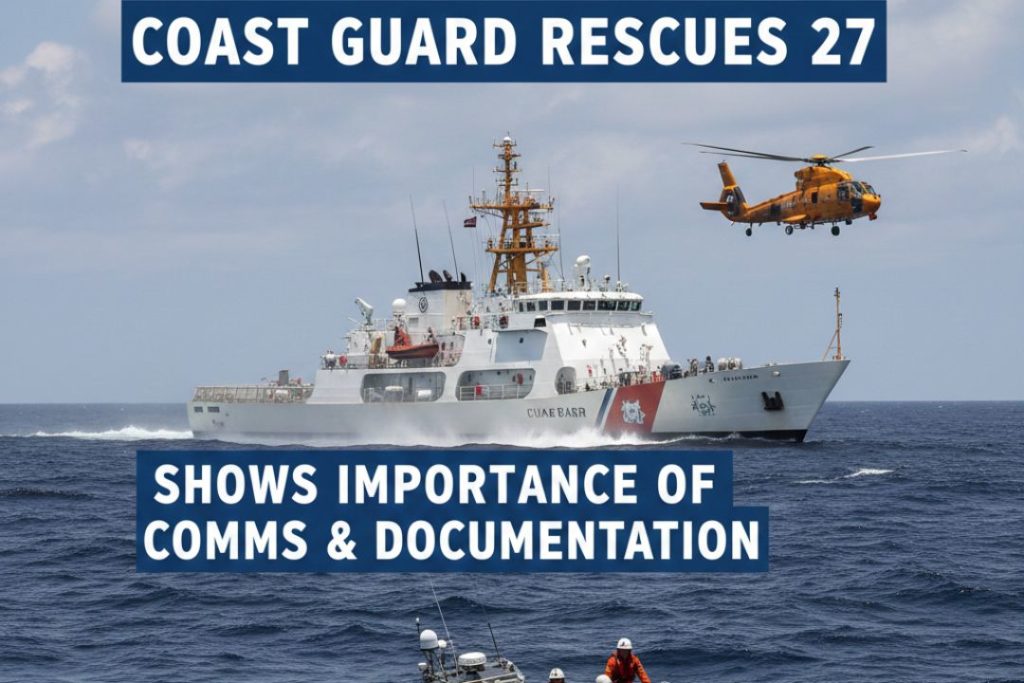
When 27 mariners abandoned a burning fishing vessel nearly 500 miles offshore, survival depended on clear communication, rapid coordination, and accurate vessel information. That rescue, coordinated by the U.S. Coast Guard, underscores how Coast Guard documentation supports search and rescue efforts.
The La Pena Incident and the Reality of Distance at Sea
The Coast Guard’s official release details how the Rescue Coordination Center in Alameda coordinated the response after receiving fragmented distress information from a lifeboat far from land.
A fire aboard the 240-foot fishing vessel La Pena forced all 27 people onboard into a lifeboat roughly 483 miles from the Galápagos Islands. Distance immediately shaped every decision.
Pertinent conditions reported by the Coast Guard included:
- No food supplies
- No potable water
- No life jackets
- One satellite communication device
- Approximately 37% battery life remaining on that device
- No immediate nearby assistance
At that range, there is no quick helicopter hoist, nor is there a nearby port to divert to. Everything depends on coordination, information sharing, and international cooperation.
From a safety standpoint, this incident highlights several realities of offshore operations:
- Fires can escalate faster than suppression systems can contain them
- Abandon-ship scenarios may unfold far beyond normal rescue ranges
- Survivors may have only one chance to transmit usable information
- Rescue planners must act on partial or unverified data
How Coast Guard Coordination Made the Rescue Possible
Rescue Coordination Center Alameda served as the coordinating authority for this case. Even though the La Pena was a Venezuelan-flagged vessel, international maritime law allows, and often requires, intervention when lives are at risk.
The Coast Guard described its role as “piecing together limited information,” which included:
- Approximate position data from the satellite device
- Vessel identity details
- Crew count estimates
- Weather and sea-state analysis
- Identification of commercial vessels in the region
Because RCC Alameda had authority to coordinate assets, they were able to:
- Divert the motor vessel Seaways Kenosha toward the survivors
- Launch an HC-130 Hercules to drop emergency supplies
- Maintain communication links across international boundaries
- Track survivor drift while awaiting surface assistance
When rescue teams are forced to estimate needs mid-operation, every confirmed data point reduces risk.
Where Coast Guard Documentation Fits Into Rescue Planning
For U.S.-flagged vessels, Coast Guard documentation ensures that core vessel data already exists inside federal systems before an emergency occurs. That matters when distress calls are incomplete or communications are fading.
Documented vessels have standardized records that can include:
- Official vessel name and hailing port
- Exact length, tonnage, and hull type
- Ownership structure
- Emergency contact information
- Flag state confirmation
When SAR coordinators are under pressure, they do not need to reconstruct a vessel profile from scratch. The information is already in the system.
This becomes especially important when:
- The distress call is brief or interrupted
- Survivors cannot confirm vessel specs
- Rescue planners must calculate capacity needs
- International partners request verification
Our service exists to help owners submit this documentation accurately and efficiently, so it is there when it matters.
Coast Guard Documentation and the AMVER System
The Automated Mutual-Assistance Vessel Rescue system is one of the most important global safety networks at sea. Sponsored by the U.S. Coast Guard, AMVER allows participating vessels to voluntarily report position and voyage data, making them available to rescue coordinators worldwide.
When Coast Guard documentation is in place, it becomes easier for SAR authorities to:
- Identify U.S.-flagged commercial vessels
- Confirm eligibility for AMVER participation
- Match nearby ships to rescue needs
- Coordinate diversions without delay
In the La Pena rescue, a commercial vessel was diverted to assist survivors. AMVER is often how those connections are made in real time.
Benefits of documentation within this system include:
- Faster vessel identification during emergencies
- Clear flag-state authority
- Reduced confusion when coordinating across borders
- Better integration with international rescue protocols
This is not about paperwork for its own sake. It is about visibility when lives depend on it.
Documentation as a Safety Registry, Not Just a Filing
A Certificate of Documentation functions as more than proof of nationality. It is a verified safety record that can be relied upon during emergencies. Federal documentation can include:
- Precise hull measurements
- Net and gross tonnage
- Vessel service designation
- Ownership and control data
In the La Pena case, the Coast Guard had to estimate survivor needs when deploying an HC-130 for supply drops. For a documented U.S. vessel, SAR teams can work from confirmed data rather than assumptions.
That translates into:
- More accurate supply calculations
- Better aircraft load planning
- Clear understanding of survival equipment capacity
- Reduced operational guesswork
This is one of the least visible benefits of Coast Guard documentation, but one of the most impactful during crisis response.
International Waters and U.S. Flag Authority
Although La Pena was not a U.S.-flagged vessel, the Coast Guard still coordinated the rescue due to international maritime obligations. For U.S. vessel owners, documentation strengthens that legal framework. When a vessel holds U.S. flag status:
- The U.S. government has a clear mandate to act
- Rescue coordination authority is immediately established
- Diplomatic delays are minimized
- Owner and crew interests are formally represented
In international waters, ambiguity costs time. Documentation removes that ambiguity. This matters in situations involving:
- Long-range offshore operations
- Foreign ports and transit corridors
- Multinational rescue efforts
- Limited survivor communication windows
Coast Guard Documentation and Emergency Information Access
During an emergency, responders may need to confirm vessel details quickly through a vessel documentation search. Having a federally documented profile means that information is standardized and accessible to authorized agencies.
At the risk of understatement, accurate submission is essential. Errors or omissions in documentation can create friction during moments when clarity is critical.
Financing, Ownership, and Documentation Structure
While safety is the focus here, documentation also intersects with ownership and financing structures that affect control during emergencies.
For example, a preferred ship mortgage must be recorded against a documented vessel. That record clarifies legal authority and ownership interests, which can matter when:
- A vessel is disabled overseas
- Salvage decisions must be made
- Insurance and liability questions arise
Similarly, an abstract of title provides a complete ownership history tied to the vessel’s federal record. While not used during rescues, it reinforces the integrity of the documentation system as a whole. Each of these elements depends on accurate initial filings.
Keeping Records Current Matters Offshore
A rescue response relies on what is already on file. That makes documented vessel renewal a safety issue, not just a compliance task.
Outdated documentation can mean:
- Incorrect ownership data
- Old contact information
- Mismatched vessel specifications
- Delays in verification
We focus on helping owners submit renewals correctly so the federal record remains current. When emergencies occur far from shore, there is no opportunity to correct mistakes.
How Our Portal Supports Preparedness
We exist to simplify the submission of Coast Guard documentation applications through an online portal. Our role is limited and focused:
- We help owners complete and submit required forms
- We streamline access to federal documentation processes
- We support initial filings and renewals through a single system
Incidents like the rescue of 27 mariners from La Pena show that when communication is fragile and distance is extreme, systems—not improvisation—carry the weight. Accurate documentation is one of those systems, quietly supporting decisions that save lives.