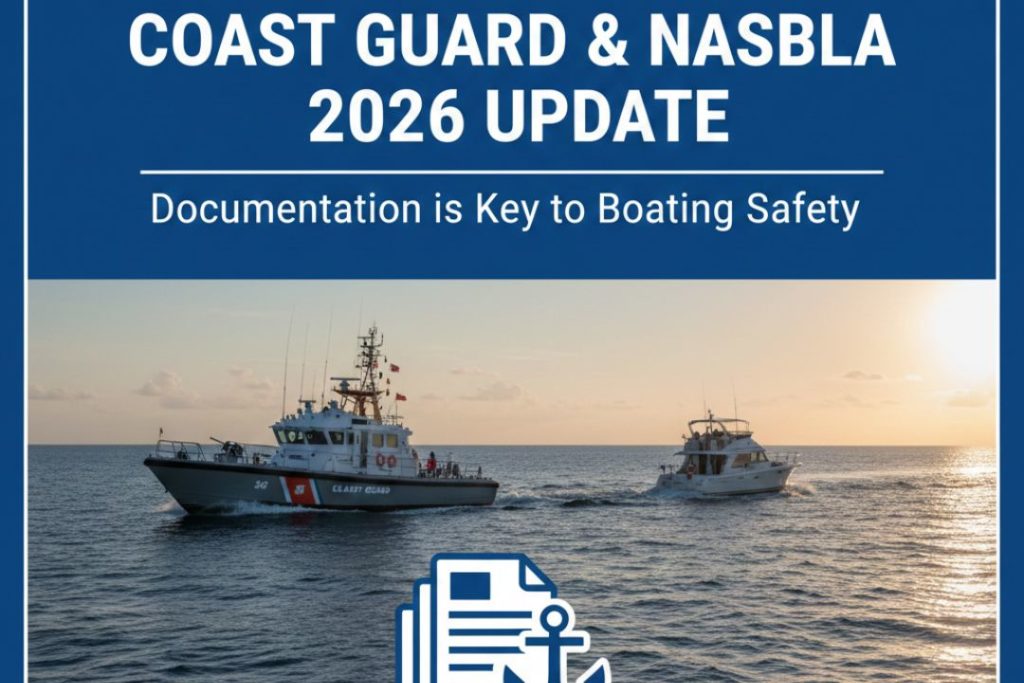
The safety of recreational boating in 2026 is being shaped by renewed coordination between federal and state authorities, and documentation plays a central role in that effort. The January 21, 2026 announcement from the U.S. Coast Guard and NASBLA underscores how Coast Guard documentation supports uniform enforcement, faster emergency response, and stronger national security across U.S. waters.
As an online portal dedicated to simplifying federal filing, our service closely follows policy changes that affect vessel owners nationwide.
Coast Guard documentation and the 2026 USCG/NASBLA agreement
According to a Coast Guard press release, the 2026 Memorandum of Agreement between the U.S. Coast Guard and NASBLA renews a long-standing commitment to uniformity and reciprocity in recreational boating oversight. This agreement is not symbolic. It directly affects how vessels are identified, verified, and assisted on the water.
Under the renewed agreement, federal and state administrators reaffirm shared priorities that include:
- Consistent recognition of federally documented vessels across state lines
- Reduced conflicts between state registration frameworks
- Improved coordination during safety checks and emergency situations
- Shared reliance on accurate, centralized vessel records
A federally documented vessel carries a recognized legal status that does not change when crossing state boundaries. That uniform recognition is a cornerstone of the 2026 agreement and helps prevent confusion for owners who operate in multiple jurisdictions.
From our perspective as a documentation portal, this agreement highlights why federal filing remains a foundational element of safe and compliant boating. Our service exists to help owners complete this process correctly and efficiently, so their vessels are aligned with the expectations outlined in the updated MOA.
How Coast Guard documentation supports uniform enforcement nationwide
Uniformity is more than a regulatory concept. It directly affects how vessel owners experience safety inspections, law enforcement interactions, and interstate navigation. When a vessel is federally documented, authorities rely on one consistent framework rather than a patchwork of local rules.
This consistency supports several practical outcomes:
- Law enforcement officers can immediately recognize federal status
- Vessel identity is confirmed without relying on varying state systems
- Owners avoid conflicting registration interpretations when traveling
- Compliance checks are streamlined and predictable
The 2026 agreement emphasizes reciprocity, meaning states agree to honor federal status without imposing overlapping requirements. That goal aligns with the purpose of Coast Guard documentation as a national standard rather than a regional one.
Our role is limited to making the federal application accessible. We do not interpret state rules or provide enforcement guidance. We focus on helping owners submit accurate filings so their vessels are properly reflected in federal records that states already agree to recognize.
Security and conclusive evidence of nationality
The Coast Guard’s mission extends far beyond recreational oversight. The agency is responsible for protecting approximately 95,000 miles of U.S. shoreline, conducting interdictions, and maintaining maritime security. In that context, vessel identification must be immediate and reliable.
Federal documentation provides conclusive evidence of nationality. It functions much like a passport for a vessel, allowing authorities to quickly confirm its legal standing without delay.
This is particularly relevant in 2026 due to:
- Heightened focus on maritime security
- Increased coordination between federal and territorial authorities
- High-profile interdictions that require rapid verification
- Greater scrutiny of vessel movement in coastal and territorial waters
Recent enforcement actions, including major seizures in U.S. territories, illustrate why clear nationality evidence matters. When a vessel’s Coast Guard documentation paperwork is in order, authorities can verify status quickly and focus on their operational priorities rather than administrative uncertainty.
Through our portal, owners submit information that becomes part of this national framework.
Search and rescue readiness in real-world emergencies
One of the most critical safety benefits highlighted by the 2026 MOA is improved data collection. Accurate vessel data saves time during emergencies, and time is often the most valuable resource in search and rescue operations.
When a vessel is federally documented, the National Vessel Documentation Center captures specific details, including:
- Vessel length and dimensions
- Hull material and construction type
- Propulsion and engine configuration
- Ownership and hailing port information
In a crisis, such as a capsizing or distress call, these details guide response decisions. Rescue teams use documentation data to understand what kind of vessel they are searching for and how it is likely to behave in water.
Incidents like the January 18, 2026 rescue near Ponce Inlet demonstrate how immediate access to vessel characteristics can influence outcomes. Knowing hull type and size helps responders deploy appropriate resources without delay.
You can learn this information through a vessel documentation search at our portal.
Ownership clarity and financial structure
Coast Guard documentation also plays a role in establishing clear ownership records. This is particularly relevant for owners who require formal recognition for legal or financial purposes.
A documented vessel may be associated with:
- A preferred ship mortgage recorded at the federal level
- An abstract of title that reflects historical ownership and encumbrances
- Clear evidence of ownership that is recognized nationwide
These records are maintained as part of the federal system and are distinct from state registration databases. While our portal does not analyze title history or provide legal interpretation, we assist owners with submitting the documentation required to establish or maintain federal status.
Clear ownership records support safety indirectly by reducing disputes, clarifying responsibility, and ensuring that the correct parties are identified in official records.
Coast Guard documentation and ongoing compliance in 2026
Federal status is not static. Maintaining it requires attention to renewal cycles and accurate filings. The 2026 agreement reinforces the importance of up-to-date records for both enforcement and safety coordination.
Owners should be aware that:
- Federal status must be kept current to remain valid
- Changes in ownership or vessel characteristics must be reflected accurately
- A documented vessel renewal ensures continuity in federal recognition
Our service is designed to help owners complete initial filings and renewals through an accessible online process. We do not provide reminders or follow-up services, and we do not track deadlines on behalf of customers. We provide the tools to submit required information correctly when owners are ready to file.

How we help owners align with national safety priorities
The renewed partnership between the Coast Guard and NASBLA makes it clear that federal documentation is integral to modern boating safety. From uniform enforcement to emergency response, accurate records support nearly every aspect of maritime oversight.
Our portal focuses on:
- Making federal application forms accessible online
- Guiding users through required fields and submission steps
- Supporting accurate filings that reflect current vessel information
Our role is in helping owners complete the federal documentation process so their vessels are properly represented within the national system.
As the 2026 agreement takes effect, vessel owners who prioritize clarity, safety alignment, and nationwide recognition continue to rely on Coast Guard documentation as a foundational element of responsible boating.