It is a regulated process to change a vessel’s official particulars. This has to be done with accuracy and proper documentation. A Change vessel hailing port is one of the more common updates requested by vessel owners. This refers to the home port that is displayed on the stern, the rear of the vessel in case you didn’t know. This specific isn’t for decoration. It links the boat to its official registration document and legal identity. It might create compliance issues during inspection or travelling internationally when a hailing port gets out of date.
This request can be made by owners after relocation, selling the vessel, or ownership restructuring. Often, the update changes the markings on the vessel to its operating base. Authorities expect physical markings to match the registry data. Any mismatch may create doubts during enforcement checks.
This handy guide provides information about the procedure. It explains the importance of the change, what documents are required, and how long approval normally takes. The material will aid new and experienced vessel owners to get informed. You will learn how to control the process so that there is no unnecessary delay.
What Are Vessel Hailing Ports and Their Importance
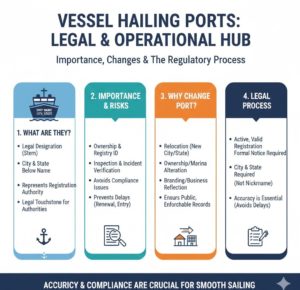
A vessel’s hailing port is the city and state shown on the stern below the vessel name. The port of record associated with the registration authority is represented. The ship doesn’t have to stay physically in port while having this designation. Rather, it serves as a legal touchstone.
The hailing port is used by authorities to determine ownership and registry. It also helps identify the vessel when it is inspected, involved in an incident or subject to enforcement action. Issues or old markings may give rise to compliance difficulties, irrespective of ownership.
The hailing port is different than the operational area. This distinction is lost on many owners. A vessel can go far all while being registered to one port. When ownership or home base changes permanently, changing the hailing port is advised.
Not updating this information might cause administrative problems. This can be delays in the inspection, complications in the renewal, and doubts in the international entry. Keeping records aligned avoids these risks and ensures regulatory clarity.
The main reasons owners change hailing ports
Often people have to relocate to a new state or city. Another cause is alteration of ownership structure or home marina. Some owners edit the hailing port to better reflect their branding or business.
Despite its apparently minor nature, registration authorities take the change seriously. The update makes sure that records are public and enforceable.
Requirements of Documentation and Legal Process
The formal process of Change vessel hailing port as per guidelines. Though the steps are simple accuracy is essential A mistake can delay or cause rejection.
Your vessel’s registration must be active and valid. Registration that has expired must be renewed before the changes are carried out. Officials will not change records related to non-existent registrations.
Next, the owner provides a formal notice of the new hailing port. The port must receive designation from a city and state. We do not accept nicknames or marina names.
Documents required for submission
Documentation generally involves your proof of ownership, and identification. Some authorities ask for assurance that the new port represents a genuine trading or residential base. Supporting documents help validate the request.
| Requirement Category | Recreational Vessel | Commercial Vessel |
|---|---|---|
| Active Registration | Required: Must be current to avoid penalties. | Required: Essential for legal commercial operation. |
| Owner Identification | Govt-issued ID: Standard verification (e.g., Driver’s License). | Govt-issued ID: Often requires additional business entity ID if corporate-owned. |
| Proof of Ownership | Registration Certificate: Standard title or state registration. | Registration & License: Requires both ownership proof and specific trade licensing. |
| Port Designation | City and State: Must be clearly marked on the hull. | City and State: Must follow specific size and placement regulations for visibility. |
| Processing Time | Moderate: Typically standard administrative turnaround. | Slightly Longer: Extended due to enhanced document and safety verification. |
All authorities check the submission completeness. Delays occur most commonly due to lack of information. Owners must check the spelling, formatting and consistency.
Revisions and updates approved
The registry updates the official record once approved Change of Endorsement/Trade Indicator. The owner must then change the vessel’s physical marks. It is required and needs to be completed quickly. The new port of call must be displayed clearly and permanently.
An updated marking without a prior verification process will be seen as non-compliant. During inspections authorities can issue warnings or fines. Finishing on time prevents this.
A comparison of outcomes preceding and following a hailing port change
By recognizing how updating a hailing port can affect an owner, they can better value its significance. The differences seem small but actually have meaningful compliance effects.
Before the update, vessels frequently have stale dor. This causes a discrepancy between how marking is physically done and what the registry says. Officers may seek further confirmation on inspections.
Get your records and markings streamlined now. It leads to fewer questions and quicker inspections. It also enhances transparency when reselling or transferring.
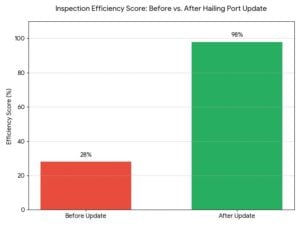
- Near-Total Efficiency Gains: By changing the hailing port, efficiency score crossed 250% mark with 28% rising to near completion 98% efficiency score.
- Reduced Inspection Friction: The After Update status creates a situation where the Inspectors can verify the vessel records against standardized real-time port data without any friction. Thus, the manual research phase which was delaying the inspection is eliminated.
- Operational Downtime Minimization: How can we minimize operational downtime? The vessel-owner will have a much quicker turnaround during vassal audits if the score is 98%. Thus the ship will remain operational rather than berthing for paperwork.
- Data Accuracy as a Catalyst: The data shows that being administratively accurate is the main factor in whether inspections are successfully completed. When the physical hailing port matches the digital registration, the inspection becomes a mere formality rather than an in-depth investigation.
After the records are aligned, inspection efficiency is higher. Though illustrative, it mirrors typical enforcement experiences revealed by vessel owners.
Real World Example
A ship mortgage that moves from Florida to California. The stern still carries the old city, as there is no update. The authorities question the inconsistency during inspection. More checking is done for that.
Inspections proceed without further issue after changing hailing port. It is immediately obvious what the vessel is. This cuts down on the time and stress.
Instructions for Vessel Owners
With preparation, this process can be managed efficiently. Owners ought to see it as an update to comply, not to beautify.
First check if registered Make sure all renewals are up to date. Changes associated with expired records will not be processed by the authorities.
Next, opt for the proper hailing port format. Utilize a verifiable city and state. Don’t use abbreviations unless they are officially recognized. Consistency is vital.
Send the request along with documents. Verify the spelling and numbers. Typically, small errors cause hiccups.
As soon as approval is received, promptly update the vessel markings. Use durable lettering that meets size and visibility requirements. Markings is not acceptable.
At last, save all confirmation duplicates. These documents help during inspections or future modifications. Documentation shows organized responsibility.
Final Thoughts Regarding Updating Vessel Records
The alteration of the Change Vessel Hailing Port is a straightforward change but an important one. It guarantees that registry documentation corresponds with the displayed vessel identity. The alignment allows for easier compliance, inspection and long-term ownership.
The process should be handled the same way as registration or renewal by owners. National Documentation E-Portal Presenting accurate submissions, timely updates and proper markings prevents avoidable problems only. Although the modification may appear administrative, it has a practical and legal effect.
It is essential for the vessel owners to understand the requirement and follow the process smoothly. By planning at the appropriate time, there are fewer delays which in turn allow smooth operations on the water.