The documents of a registered vessel must be changed officially through the process of a Change of Vessel Name. Vessel owners frequently ask for a Change of Vessel Name after purchase, rebranding, or choice. Though cosmetic, the change has legal and administrative implications. To remain compliant, the vessel’s federal documentation must reflect its current name.
The vessel’s name is a name used to refer to the ship during inspection, transaction or record. A name that is no longer current can cause problems or delays. It keeps the vessel and the markings aligned to what is written. It helps the owner and the authority to avoid misunderstandings.
The Change of Vessel Name is explained in this guide. The article talks about name changes, what they mean, how to get them done and how they are different from other documentation actions. There are practical tips to help owners during the process. With this, you will understand how a name change correctly supports compliance and identification in a vessel.
Understanding the Change of Vessel Name and Its Importance
Changing the vessel name updates the name that is shown on a vessels Certificate of Documentation. It is a good change because it keeps federal records consistent with the vessels identity that is displayed. Having accurate records is very important to ensure compliance and also for verification purposes.
The vessel name is combined with the official number and together they serve as an identification of the documented vessels. This information is used by inspectors and authorities. Having mismatched records can be a source of suspicion during inspections or even when trying to carry out transactions
Name changing is one of the things that happen very often after ownership transfers. It is common that a new owner would want a different name. Another common reason for rebranding is when the vessel is being used commercially. Anyhow, in all the above situations, it is necessary to make the changes official.
| Endorsement Type | Permitted Use |
|---|---|
| Recreational | Pleasure use only |
| Coastwise | Domestic commercial trade |
| Fishery | Fishing activities |
| Registry | Foreign trade |
Comprehending why one’s name must be accurate is crucial to avoid any trouble with compliance. Changing one’s name correctly can simplify things in all the records.
How the Vessel Name Change Process Works
Changing the Vessel Name is part of a well, organized administrative procedure. Every stage guarantees correctness and uniformity. Being ready helps to make the process go faster.
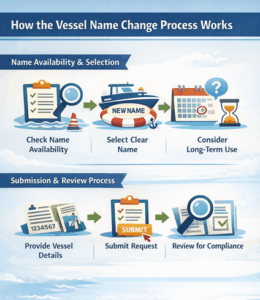
Name Availability and Selection
A new vessel name can only be accepted if it is in accordance with the documentation standards. The imposition of prohibition may be necessary to prevent confusion. A choice of a sharp and unique name is advisable.
When selecting a name, owners should take into account if they are going to use it for a long time. Changing names repeatedly can create a mess with records. By carefully picking a name, one can minimize the need for different administrative tasks in the future.
Submission and Review Process
The request requires accurate detailing of vessels. It consists of the official number and present name. It is necessary to be consistent with existing records
After submission, it shall be deemed compliant. The speed of processing will depend on accuracy and volume. Requests that are incomplete may be returned for correction.
Updating Physical Markings
After approved, the vessel’s name must be correctly shown. Markings must comply with the latest documentation. It is necessary to have record and physical display consistency.
If the markings are not updated, then it can create inspection problems. Regular updates guarantee compliance and resolve confusion.
Common Challenges during Name Changes
- Selecting a non-compliant vessel name
- Submitting incorrect vessel identification
- Delaying physical marking updates
- Confusing name change with ownership transfer
One can make the processing a lot easier by avoiding these problems. One cannot be too careful with paperwork when it comes to this matter.
Change of Vessel Name Compared to Other Documentation Actions
Change of vessel name is often confused with exchange and transfer. But, each one fulfills a different purpose. Recognizing differences avoids mistakes.
A name change is done to alter the name of the vessel but not the ownership. When vessel details are updated via exchange action, ownership is also not impacted. Nonetheless, a Transfer involves an ownership change, which means that this vessel is being “passed” to a new owner. Thus, it is the only action that affects ownership.
Only the identity of the ship changes with a name change. Exchanges modify the information. Involves transferring ownership. When you choose correctly you are not delayed.
Documentation Update Impact Graph
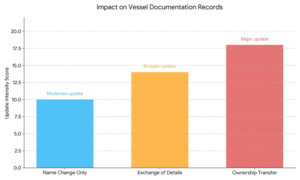
- Primary Identity Updates: A name change is labeled as a “Moderate update” since it changes the vessel’s public identity and a new certificate is needed, but it does not really affect the legal or physical structure which remains the same.
- Technical Data Accuracy: A Change of Details is a “Broader update”, meaning that a more thorough review of the technical specifications (such as tonnage or dimensions) will probably take place in order to confirm that the federal records are accurate to the physical changes.
- Highest Legal Complexity: An Ownership Transfer is at the top level of impacts (“Major update”) as it introduces a completely new legal person responsible for the vessel, thus requiring the verification of the chain, of, title and recording of new financial interests.
- Certificate Substitution: No matter what the level of update is, all three Name Change, Exchange, and Transfer actions share the removal of the old document and the issuing of a new federal certificate as a common requirement.
- Steady Identifier: The vessel’s Official Number does not get changed as a result of these updates. It remains a stable point of reference for the ship’s entire record of history through various owners, names, and physical changes.
This comparison highlights why correct classification matters. Each action affects records differently. Proper selection ensures efficient processing.
Practical Tips for a Smooth Vessel Name Change
Make sure you plan the name changes carefully before submitting them. Verify that the selected name meets criteria. Prevent rework by preparing. Please see existing documentation first. Confirm that vessel details are accurate and current. Steady schedule limits review. As soon as approval is obtained update the markings on the vessel. It is crucial to pair records with display. Maintain secure confirmation records.
Best Practices to Follow
- Choose a compliant and distinct vessel name
- Verify all vessel identification details
- Submit the request promptly
- Update vessel markings after approval
Following these practices ensures compliance. Proper planning minimizes delays and confusion.
Ensuring Compliance through Proper Name Change
Changing the name of a vessel covers more than cosmetics. National Documentation E‑Portal makes certain that Federal Records reflect a vessel’s identity. When handled properly, ensures compliance and clarity.
This guide explained: What is a name change, why it matters and how it works. This was said through a comparison and practical tips. Having knowledge gives vessel owner more confidence.
By preparing a Change of Vessel Name correctly and on time, owners keep up-to-date records. Easily accessible records assure inspections, transactions and operations. Updates that you run yourself prove your product is present.