The Maritime Small Vessel Waiver Application is a procedure for owners of foreign-built vessels wishing to conduct certain commercial operations in the United State. Federal maritime law governs the participation of vessels in the coastwise trade and passenger service. Since many recreational and commercial vessels are manufactured overseas, vessel owners sometimes need waivers to use the vessels for approved commercial purposes.
A small vessel waiver is Authorization issued to qualified foreign-built vessels to perform limited passenger-related activities. Tour boat operators, sightseeing businesses, travel agents or tour operators and water-based recreation services commonly require waiver approval to commence lawful operation. Using a foreign-built vessel without authorization is a violation of the federal maritime laws if done for commercial purposes.
Vessel flexibility now becoming critical to maritime businesses of all types. Owners often buy foreign boats to take advantage of price, design or availability. Nevertheless, commercial use imposes additional legal obligations that many novice operators do not understand until planning starts.
When marine small vessel owners understand the waiver application process, they can avoid compliance issues and make better operational decisions. This guide lays out how waivers operate, who may qualify, how the application process differs from ordinary documentation, as well as practical techniques for successful waiver-related operation of a vessel.
Understanding a waiver for a maritime small vessel
Federal maritime laws protect the construction of domestic vessels and the operation of coastwise trade. As per these regulations, various commercial ships which operate in the US must adhere to domestic build requirements. Because of their origin, foreign-built boats may get restrictions involving passenger services and commercial activities.
The waiver provides a narrow exemption for qualifying small vessels. Certain foreign-built boats are allowed by the government to engage in approved passenger operations.
| Operational Factor | Waiver Approved Vessel | Non-Waiver Foreign Vessel |
| Commercial Passenger Use | Conditionally allowed | Restricted |
| Foreign Construction | Eligible with waiver | Commercial limits apply |
| Federal Compliance | Still required | Still required |
| Passenger Operations | Limited authorization | Often prohibited |
The term ‘foreign-built vessel waiver’ comes up often in charter planning. There are a lot of imported vessels that are ideal for recreational passenger operations.
Many operators often request waivers.
- Wellness Retreats, Luxury Camping.
- Operator of coastal sightseeing.
- Providers recreational excursions.
- Companies engaged in tourism vessels.
The Maritime Small Vessel Waiver Application creates lawful pathways to operate certain foreign-built vessels while maintaining broader federal protections for coastwise trade.
Waivers able to commercial passenger operations will help tourism and charter sectors as they regularly use smaller imported recreational boats.
Boat owners must also understand that waivers do not relieve all federal compliance obligations. Although it is approved, safety inspections, licensing requirements, and operational rules still apply.
Keeping operational records in order enables owners to show ongoing compliance with marine standards.
Criteria for Qualification and Functioning
A waiver will not necessarily be granted if a vessel was built outside the United States. Federal authorities examine applications with care and attention to the size, use, and ownership of the vessel at issue.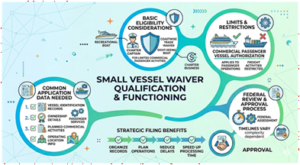
Eligibility Considerations Basic
Small vessel waivers apply to vessels that conduct certain limited commercial passenger activities. These approvals are often sought for charter or sight-seeing conversion of recreational boats.
The planned operation will affect eligibility significantly. Despite being granted waivers, some commercial cargo operations are prohibited as they are protected under federal statutes.
The phrase “coastwise trade waiver” commonly shows up in maritime litigation because waivers are granted as exceptions to federal maritime law.
Data needed to run
During application, owners generally supply details about the vessel, operational plans and ownership. The accuracy of the records submitted will assist reviewers in determining if the vessel can be approved.
Information Regarding Common Application
There might be applications.
- Record of identification of vessels.
- Details regarding ownership.
- Commercial Activities Planned
- Operating location information.
Organized paperwork will ultimately speed up processing time and reduce delays.
Limits of Commercial Passengers
Waivers usually apply to passenger operations only. Some freight activities might continue being restricted even with a waiver approval.
The phrase “commercial passenger vessel authorization” appears frequently in connection with charter planning as services to passengers represent a top waiver category.
Review and Approval by Federal Government
Federal authorities assess whether the operations proposed qualify for a waiver. The timelines for processing will vary depending on the complexity of application and correctness of documentation.
Companies dealing in charter business must schedule their operation from very early on. This is because the seasonal charter business is predominantly time-based.
If vessel owners file the Maritime Small Vessel Waiver Application strategically, it becomes a lot easier. Organizing records and operational plans beforehand helps.
Contrasting Waiver Operations With Fully Qualified Commercial Vessels
Vessels that are authorized for the waiver and fully coastwise qualified commercial boats are compared by many operators. Despite performing some passenger operations, there are legal differences.
Ships made in the U.S. generally get more coastwise rights. Vessels using waivers operate under a narrower scope of authorization for limited commercial passenger use.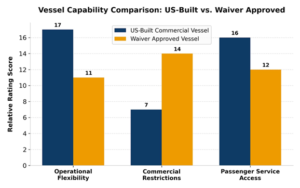
- US-built commercial vessels are offered a lot of operational flexibility. They score high on operational flexibility (17 as compared to 11), since they operate under Federal coastwise trade law and do not require special geographic or structural exemption.
- Elevated Regulatory Boundaries: Foreign-built vessels operating under an approved waiver face exactly double the commercial restrictions (14 vs. 7) of domestic vessels, as a small passenger vessel waiver does not grant unrestricted commercial use and often bounds operations to specific activities or locations.
- Even though the MARAD waiver gives legal access to imported vessels to perform tourism activity, it does not block US-built hulls from getting broader baseline passenger service access with a scoring of 16 vs. 12 to ensure the ability of the fleet to scale up in the long run.
Waivers for Small Vessels
Owners of foreign-built vessels seeking approved commercial passenger operations within the United States may use the Maritime Small Vessel Waiver Application. Waivers create limited exemptions to federal coastwise trade restrictions which help support tourism businesses, charter operators, and recreational passenger services.
When owners understand waiver eligibility, operational limits, compliance problems can be avoided and informed decisions made. Appropriately organized documentation, accurately described operations and proactively planned operations enhance approvals and long-term operational stability.
Laws governing federal maritime activities are still playing a vital role in commercial vessel operations in the United States because they establish standards for domestic shipping and facilitate organized marine commerce. Accurate documentation and operational transparency are important for buyers, insurers, lenders, and regulators.
Organized waiver records help commercial operators because documented verifications occur often during inspections, financing reviews, and licensing processes.
The marine tourism sector keeps expanding with operators looking towards passenger charter opportunities and leisure excursion services. Business owners who have a sound understanding of waiver requirements position themselves better for success.
National Documentation E-Portal helps with clearer documentation steps to reduce errors and keep vessel operations moving smoothly.