The first and foremost, which is also one of the most important documents a federal vessel documentation owner would require,. This form creates an official record with the Coast Guard to establish ownership when purchasing a new yacht, registering a commercial vessel, or switching from state. Many boat owners do not realize its importance until paperwork delays halt financing, travels or vessel operations.
Documentation from Federal gives various legal and operational advantages. This certifies nationality, assists financing of marine, and simplifies international travel of vessels. Often, commercial operators of regulated activities require federal documentation before trading. Deeds of Recreational Owners have stronger ownership verification and greater recognition
It is important to submit the form accurately as mistakes can result in delays or rejection notices. If the ownership details are incorrect or signatures are missing, or wrong vessel information is provided, the review process will be delayed. Learning about application requirements before filing prevents complications for owners.
In this guide, learn how the Initial Vessel Documentation Form works, what information possesses applicants, common filing errors, and practical tips for getting approved. This comparison of federal documentation and state registration systems is intended to demystify these documents for owners.
Purpose of Initial Vessel Documentation Form Explained
The United States Coast Guard keeps an ownership record on file through federal vessel documentation. Commercial and recreational vessels that meet federal requirements must follow the documentation process. The initial application is the first to document the vessel in the federal documentation system.
Federal documentation is chosen by many owners as it offers better protection than state registration. International ports and marine lenders often favor federally documented ships for their centralized ownership records, which are easier to verify.
| Feature | Federal Documentation | State Registration |
| Ownership Recognition | Nationally recognized | State-level only |
| International Travel | Widely accepted | Limited recognition |
| Marine Financing | Preferred by lenders | Less preferred |
| Commercial Eligibility | Often required | Limited use |
The term “federal vessel registration application” often pops up in discussions of initial documentation filings. Despite wordings which change, the process aims to create legal records of vessel ownership at federal level.
Several types of vessels usually require documentation.
- Fishing boats used in tourism.
- Large leisure vessels measuring over standards.
- Trade vessels operating on the coast.
- boat financing
Boat owners often inquire if the state registration is totally replaced by federal documentation. Each state has different prerequisites. Even when federally approved, some states require local registration or tax compliance.
The Initial Vessel Documentation Form is also a form of documented ownership history. This history becomes significant in transfer, finance agreements and sales of vessel. Vessels which have complete paperwork often attract buyers and lenders.
Organized documentation especially benefits commercial operators as inspections and licencing processes often require evidence of active federal status. When you document things properly administratively, you reduce issues with them over time.
The data necessary for brochure approval
Providing correct information is an important part of documentation. Before approving federal documentation, the Coast Guard carefully scrutinizes all details of the application.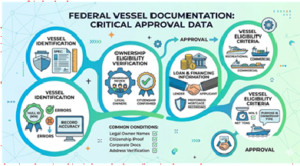
Details of the Vessel Identification
The application needs detailed vessel specs. The owner must give the vessel name, hull identification number, dimensions and manufacture information. This information will help create accurate federal records and distinguish the vessel from similar vessels.
Errors in hull numbers cause serious issues due to mismatched identification which may delay approval significantly. Before filing, an applicant should compare the information against that of the manufacturer.
The term “documented vessel application” usually refers to the larger filing process related to federal ownership registration. One of the important factors during review is identification accuracy.
Verification of Ownership and Citizenship
Federal documentation requests confirmation of ownership eligibility. Upon application, all citizenship and ownership will be checked. Then, approval process will take place. Other supporting records may be needed for partners and corporations.
Ownership Conditions Common
Ownership assessments frequently consist of.
- Names of legal owners.
- Verification of citizenship.
- Corporate action document.
- Records of address verification.
Commercial entities often offer additional documentation that proves their operational authority and business registration. Incomplete submissions often result in delays in ownership review.
Loan and Credit Information
Marine lenders typically ask for federal documentation to permit preferred mortgage recording. During filing, applicants financing vessels may need to provide lender details.
Legal protections for lenders are stronger with preferred mortgages. The financing agreements approach on larger vessels and commercial operations is simplified.
Criteria for Vessels
No every vessel is eligible for federal documentation. The eligibility requirements are impacted by vessel size, purpose, and ownership structure. Recreational vessels generally must have a minimum of five net tons.
Commercial vessels operating on regulated activities may face additional requirements based on their operational categories. Owners must review eligibility before submitting applications.
The words “USCG vessel documentation” often come up in discussions about commercial compliance and federal ownership registration. Understanding these requirements early can help prevent complications when filing later.
Supporting records must also match exactly what the applicants submitted. Inconsistent ownership names, incorrect addresses or conflicting details of vessel will trigger follow up.
Reviewing Federal Docs with State Registration
A lot of first-time owners get confused by federal documentation versus state registration. The two registries provide evidence of ownership of vessels which are subject to different laws.
State registration is mainly about local taxes and running laws. Federal documentation provides for a wider range of ownership recognition and greater ability to operate internationally.
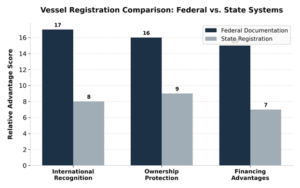
- Federal Documentation delivers over double the international recognition score as State Registration (17 versus 8). Thus, Federal Documentation is essentially a must-have for ships undertaking foreign voyages or seamless clearance at international ports.
- Marine lenders generally have a strong preference for federally documented vessels because this type of vessel scores significantly above state-units in vessel financing advantages. Specific scores are 15 vs. 7.
- The greater the ownership protection of a title, the easier it will be to confirm ownership. This, in turn, helps maintain a more favorable resale value perception in upcoming commercial deals. Federal documentation provides significantly higher ownership protection (16) than local state titles (9).
Federal ship paperwork
A federal vessel ownership record in the United States is created using the Initial Vessel Documentation Form. Accurate documenting of vessels supports financing, ownership verification, commercial operations, and international travel.
Knowing the application process prevents owners from making common filing errors. The accuracy of vessel particulars, order of ownership proof and scrutiny significantly improves approval success. When it comes to documenting a recreational yacht or commercial vessel, preparation is key.
Vessel owners also derive long-term value from federal documentation. The ownership history is organized to facilitate transparency for future sales, refinancing and litigation verification. It is easier to confirm ownership for vessels with complete documentation records according to buyers and lenders.
With increased vessel values and financing activity, the marine industry is placing greater emphasis on accurate documentation. The reliance on active federal records is of particular importance to commercial operators.
Completing the Initial Vessel Documentation Form properly helps boat owners gain stronger ownership protection and smoother vessel operation over time. National Documentation E-Portal supports owners with clearer documentation steps to avoid delays, errors, and incomplete applications.