USCG exchange and transfer form is a vital document to maintain the documentation of federal vessels. The Coast Guard Owner Update Form may be required for ownership changes, alteration of endorsements, or corrections to Certificate details of a vessel. Vessels that are documented are authorized at the federal level so any change, no matter how minimal, has to be entered formally.
Whether exchanges or transfers, such alterations are more than yearly renewals but structural changes. This entails modifications of ownership, release of mortgage or endorsement. When your paperwork is not complete, it can get delay. Proper documentation safeguards legality and resale price.
This form is needed in certain situations. More on when the form is needed and how the process works. Common mistakes and how to avoid them. It also compares practices for submitting on time with those for submitting late. When vessel owners have a strong understanding of the documentation requirements, their confidence increases and communication and administration updates happen smoothly.
What is the USCG Exchange and Transfer form?
The USCG exchange and transfer form is a federal application typed to update documentation record on a vessel. Owners can report changes in ownership, alter endorsements, or request replacement certificates for changed details.
An “exchange” often means amending information with the same owner. Such as changing the name of a vessel or changing an endorsement. A transfer includes the transfer of ownership interests. At the National Vessel Documentation Centre, both need formal review.
| Action Type | Ownership Change | Endorsement Update | Certificate Reissued | Review Level |
| Certificate Renewal | No | No | No | Administrative |
| Documentation Exchange | No | Yes or Minor Edit | Yes | Compliance Review |
| Documentation Transfer | Yes | Possible | Yes | Full Legal Review |
| Mortgage Record Update | No | No | No | Lien Verification |
Often, bills of sale and proof of citizenship are needed for transfers. Exchanges may call for supporting documentation, depending on your modification.
Properly filling of form will ensure the continuity of documentation. Mistakes might delay issuing a new certificate.
When and Why Is the Form Required
The accuracy of vessel documentation must be maintained at all times. Federal documentation serves as evidence of ownership and eligibility.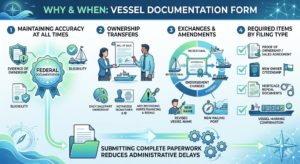
Ownership Transfers
Each time a conveyance is sold or part ownership transferred, the Coast Guard must record the ownership. A bill of sale must be duly executed and submitted.
Ownership transfers usually need notarized signatures and identification. Not recording a transfer could hurt financing or resale.
Exchanges of Endorsements and Certificates
Endorsements determine operational privileges. Recreational, coastwise, and fishery endorsements have varying eligibilities.
Will amend its endorsement category. Exchanging certificates is mandatory for name changes or hailing port revisions.
You might be required depending on the filing type
- You can file a copy of the sales agreement or proof of ownership.
- New owners need proof of citizenship.
- Documents for repealing mortgages.
- Confirmation of vessel markings update.
Submitting Complete Paperwork Reduces Administrative Delays
Comparison Of Timely Filing And Delayed Filing Documentation
The timing of actions affects the clarity of federal record-keeping.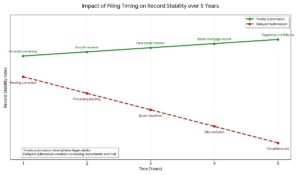
- Timely Submissions are of high legal clarity that strengthens towards the regulatory confidence over time whereas Delayed Submissions show a sharp decline in stability.
- By year 3, the problem changes from internal management (backlog) to external market (buyers’ reluctance).
- Graphic displays delays aren’t static. By Year 4 and Year 5, Record Stability (the light blue line) plummets. The Registry processes record instabilities as they impossibly pending (the light blue line) but they soon escalate to their titles confuse and compliance risk (the two red lines).
Properly Completing the USCG Transfer and Exchange procedure
When we take care in the preparation attention to detail, we reduce errors and delays in processing.
Check the Vessel Information
Verify official number, hull identification number and current endorsement. Minor Discrepancies Can Trigger Review Delays.
Collect essential paperwork
You won’t encounter sophistication in documents here. Mortgage releases must show right legal descriptions.
Fill out the application form carefully
Make sure that the information is clear and consistent throughout the form. Make sure spelling and ID numbers are correct.
Check signatures prior to submission
- Involve in preparations.
- Make sure required signatures are on.
- Include every document described in instructions.
- Keep copies of the application submitted.
Clear documentation and transparent information will result in reduced chances of rejection.
Check the process
- After submission, check the status. Correct requested changes rapidly.
- Quick communication keeps things moving along well.
To keep accurate federal vessel records
The USCG exchange and transfer form allows vessel documentation to show the current owner and operation status. Federal records help to protect resale value and eligibility for financing.
Changing ownership, endorsements, and certificate transfers require proper documentation, as simple renewal does not reflect structural changes. Filing accurate paperwork helps prevent unnecessary delays, and the National Documentation E-Portal supports smooth processing and record management.
If vessel owners carefully review documentation details, gather supporting materials in advance, and submit applications on time, they can maintain clean records. Comprehensive documentation ensures a smooth transaction and maritime stability over time.
A complete understanding and execution of the exchange and transfer process ensures the integrity of federal paperwork from shore to sea.