It is essential for vessel owners to understand the documentation requirement for maritime vessels to comply with the law and protect ownership rights. Documentation of vessels is also an act of registration. The procedure whereby a vessel is given a name and other particulars whereby it becomes identifiable as to a flag and its condition in the maritime system, is called registration. Failure to meet documentation requirements can create a snag in normal operations.
Owners overlook the extent of these requirements until facing inspections, financing checks, or transfer of ownership. Not having the correct document in place may lead to a delay or further questioning. Effective documentation guarantees that records correctly reflect a vessel’s ownership and operational purpose.
A clear and practical guide explaining maritime vessel documentation requirements. It includes the key elements, compliance requirements and ongoing obligations. Whether you are the owner of a recreational boat or deal with commercial operations, this article provides a solid picture of the documentation.
Guide to Maritime Vessel Documentation Requirements
Maritime vessel documentation requirements show how a vessel is recorded and recognized under the law. Documents establish nationality of vessel and confirm legal ownership. With this recognition the vessel can operate under national flag
Vessel size, type, and operational scope determine the application of these requirements. Larger vessels, or those engaged in commercial activities, face stricter documentation requirements. Depending on the circumstances, smaller or recreational vessels may have different obligations.
Documentation helps ensure consistency and transparency. Authorities count on official records to enforce fair ship regulation. The right documentation supports inspections, trade eligibility and ownership.
Documentation provides legal protection for owners. It helps to have a benchmark to refer with other clients and service providers. It lowers uncertainty and administrative hurdles.
| Aspect | Documented Vessel | Undocumented Vessel |
|---|---|---|
| Legal Recognition | National – Recognized by the U.S. Federal Government and internationally under the U.S. flag. | Limited – Primarily recognized at the state level; restricted international standing. |
| Ownership Clarity | High – Centralized title management through the National Vessel Documentation Center (NVDC). | Reduced – Titles are managed by individual states; records can be fragmented or less rigorous. |
| Financing Acceptance | Broad – Preferred by major lenders as the vessel can be secured with a Preferred Ship Mortgage. | Restricted – Limited to personal or small-scale loans; lacks the security of federal maritime liens. |
| Compliance Confidence | Strong – Rigorous federal standards for citizenship and tonnage ensure high regulatory integrity. | Lower – Variable state requirements lead to less consistency in compliance and oversight. |
This comparison illustrates the importance of documentation rules.
Key Components of Shipping Documentation Compliance
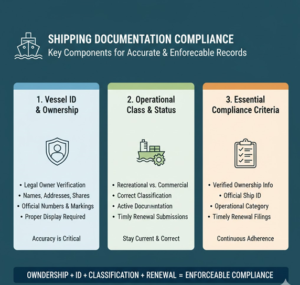
To meet maritime vessel documentation requirements, several core elements must be managed. All component leads to a record that is accurate and enforceable.
Identification and ownership of vessel
It confirms who owns the vessel legally. The names, addresses, and ownership shares must be true and up to date. Inconsistencies create common compliance problems.
Identification of vessels includes numbers and markings. These identifiers connect the vessel to its documentation record.
Classifying operations and current status
The data shows the operation of a ship. The rules depend on whether it is recreational or commercial. Mistaken classification can set off enforcement actions
Documentation ought to be live. Renewal are evidence of up-to-date records. When documentation lapses, it can impede compliance and operations. essential compliance criteria are
- Ownership Information Verified.
- Correct ship identification.
- Proper operational category.
- Submissions of Timely renewal.
Every component facilitates continuous adherence.
Evaluating Compliance Outcomes in Reality
The significance of ship documentation requirements can be understood with a compliant and non-compliant comparison. Vessels that comply undergo smooth inspection and transaction process. No additional verification of records required
Vessels that are non-compliant often be in receipt of delays. Transactions may be delayed until problems are resolved.
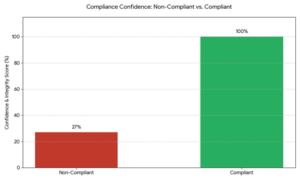
- Achieving a Compliant status delivers a 100% confidence score to vessel owners, increasing legal protection while granting them the maximum degree of federal recognition.
- By fully complying with regulations, you secure access to international waters and obtain beneficial federal documentation, while non-compliant (27%) operations risk fines, inspections, or vessel arrest.
- The Lender-Ready Standard: High compliance is a mandatory prerequisite for obtaining a Preferred Ship Mortgage because the banks demand the certainty that only a federally documented, compliant boat can provide.
The graph indicates greater assurance with adherence. Though simplified, it depicts operational experiences common in many fields.
Real life example
A compliant owner renews documentation on-time and updates the ownership records without much delay. During sale transfer, everything goes on smoothly. Another owner delays reviews for more updates.
Ways to Meet Documentation Requirement Years
Meeting documentation requirements of a maritime vessel: planning and consistency Owners should start off by regularly assessing documentation status. Identifying problems early can avert them.
Keep ownership records and confirmation documents organized and orderly. Records should be clear so that any inspections or reviews can be done faster. Staying organized limits stress and procrastination.
Keep a close watch on renewal dates. Renewal guarantees continuity of compliance Missing deadlines cause problems that do not have to happen.
Communicate modifications swiftly. Changes in ownership, operations or the Pressure vessel itself need to be updated without delay. Records support your legal status.
Helpful best practices include
- Review relevant documents every year.
- Revise records whenever there is a change.
- Keep an eye on renewals.
- Keep records of confirmations.
These steps would simplify long-term compliance.
Why you should take vessel documentation seriously
In essence, the documents required by maritime vessels are the foundation of legal ownership and operation of vessels. National Documentation E‑Portal help a company to become legally recognized and thus compliant. Comprehending these requirements helps the owners avoid delays and disputes.
Documentation owners have fewer administrative issues. A vessel’s records must be accurate and updated on time to preserve the value of the vessel and ensure optimal operational flexibility. Maintaining compliance aids in seamless inspections and transactions.
With proper method and documentation, vessel owners will be able to follow the maritime requirements. Proper compliance helps improve operational efficiency, profitability, and peace of mind all around.