The Maritime Small Vessel Waiver Application is useful for owners of eligible vessels that are under a specific size and trade. Some maritime laws have construction, ownership, and operational requirements that don’t always suit smaller boats. A waiver provides a lawful alternative allowing eligible vessels to operate without meeting all standard requirements in such cases.
Many small boat owners have trouble obeying regulations made for larger commercial vessels. Non waiver compliance cost and operational constraints may undermine the economic viability of the vessel. The process for applying for a waiver aims to reconcile regulatory intent with practical reality. The process intends to achieve safety and fairness without placing any unnecessary burden on the waiver applicant.
This guide explains how the waiver application process works, who is eligible for it, and why it is relevant. It describes how to carry out the evaluation efficiently. If vessel owners can identify early on what is required to comply, it can help them make better decisions, reduce delays, and comply while operating efficiently.
Know More about The Maritime Small Vessel Waiver
The Maritime Small Vessel Waiver is an exemption for the act under certain circumstances. The relevant part of the bill permits certain qualified vessels to operate. When compliance is impracticable or unreasonable, these waivers are usually applied.
The waiver does not fully absolve us. On the other hand, it allows flexibility but maintains safety. Each request is approved by the Authorities on a case-by-case basis to ensure that public interest and safety at sea are not compromised.
Owners of smaller vessels engaged in limited trade or specialized operations typically use the Maritime Small Vessel Waiver Application. Regulators designed the full requirements for larger commercial ships, and these vessels may not need to meet them. The waiver recognizes this distinction.
They don’t come automatically. The vessel size, application, ownership, and operational extent determine approval. Authorities examine whether the waiver is consistent with policy objectives.
| Compliance Aspect | Standard Requirements | Waiver-Based Operation |
|---|---|---|
| Regulatory Burden | Higher – Requires full-scale reporting, frequent audits, and detailed technical certifications. | Reduced – Streamlined paperwork and simplified reporting cycles for eligible operators. |
| Eligibility Scope | Broad vessels – Applies to the majority of the fleet regardless of size or specific use case. | Limited to small vessels – Restricted to specific tonnage, age, or usage categories. |
| Approval Process | Automatic if compliant – Clear “yes/no” benchmarks where approval is granted upon meeting metrics. | Case-by-case review – Requires a qualitative assessment by regulators to ensure the waiver is appropriate. |
| Operational Flexibility | Moderate – Operations must fit strictly within standardized regulatory “boxes.” | Increased – Operators can tailor their procedures to specific regional or seasonal needs. |
This comparison highlights that waivers have benefits for qualified owners.
Criteria and Review Process of Eligibility
The process for a waiver application is intense. The authorities evaluate if the ship, and the operation, merits an exemption.
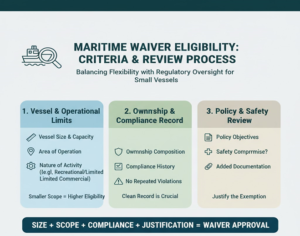
Size of the vessel and limits of operation
Vessel size and trade scope often determine eligibility. More likely to qualify are smaller vessels operating in limited service areas. Authorities are checking the place and operations of the vessel.
The intention of operations is important. In the event of recreational or limited commercial use; the eligibility may strengthen. Operations categorized as high risk or unrestricted will face closer scrutiny.
Record of ownership and compliance
The shareholding composition also impacts review outcomes. Authorities can rely on checks of compliance history. Repeated violations complicate vessels’ lives.
The Maritime Small Vessel Waiver Application must size up the safety or policy objectives that will be compromised if the waiver is granted. Added documentation supports the request.
What does it mean?
- Dimensions of Vessel and Capacity
- Nature of activity
- Area of operation.
- History of prior compliance.
Every factor assists authorities in balancing flexibility with regulatory obligation.
Operations Comparison – With and Without Waiver
A waiver’s impact gets easy to understand through comparison. Small vessels without a waiver must meet full statutory requirements. This limits operation while costing more to implement.
The waiver enables eligible vessels to operate under standards. It reduces a supervisory burden but maintains oversight. Owners attain flexibility without compromising compliance.
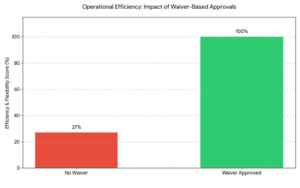
- Maximizing Operational Agility: Enhancing the efficiency to 100% by granting a Waiver Approved status. Get rid of redundant administrators of ship owners on Board.
- Proportionate Regulation: While No Waiver (27%) applies heavy-duty standards to everything, the waiver system recognizes these vessels are lower risk and therefore can comply in a more efficient manner (less paper) and with a smaller set of measures.
- Cost-Effectiveness: Small operators can transfer capital away from admin overhead to safety upgrades for the vessel and modern harvesting equipment through Regulatory Burden reduction which is cost-effective.
- Regional Flexibility: Operators will be able to adopt simply to local operating conditions and seasonal variation that cannot be dealt with through national standard requirement for similar circumstance.
The graph shows efficiency improves when waivers apply.
Sample situation
A small ship engaged with regional trade finds full compliance costs tough. Permit operations and operations continue based on waiver approval. Inspections are for safety not structural compliance.
We have an example to show how waivers allow for sustainable operations.
A Complete Guide to Applying
To successfully submit a waiver request, proper preparation is important. Review eligibility criteria carefully say the rule. Knowing the requirements reduces rejection risk.
Obtain precise vessel paperwork. Make certain records reflect present status. Things don’t always match up, which delays reviews.
Ease of understanding by analysis Authorities want transparency. The waiver is necessary and appropriate; explain why.
Provide application with complete supporting materials. Track the developments and reply to responses. Improved outcomes come from engagement.
Get prepared and start preparing
- Check on vessel size and use.
- Keep your compliance documentation
- Give clear operational justifications.
- Get back to authority request fast
Essential Points on Small Vessel Waivers
The Maritime Small Vessel Waiver Application provides a practical solution for vessel owners who face complex compliance requirements. National Documentation E‑Portal initiative attempts to balance government objectives with practical, real-world considerations.
It’s vital to know eligibility, paperwork and criteria for review. Applications that are prepared well actually cut down the delay and improve the chances of approval. Waivers lack guarantees but offer important flexibility when appropriate. By being mindful of better practices and maintaining compliance standards, owners can be confident in their regulation operations.