A documented vessel is a vessel that has been federally registered with the United States Coast Guard (USCG) through the National Vessel Documentation Center (NVDC).
This type of registration provides the vessel with a Certificate of Documentation (COD), a national form of identification that verifies ownership and establishes the vessel’s nationality.
Documentation is not the same as state registration; it is a federal process governed by specific laws and regulations under Title 46 of the Code of Federal Regulations.
For many vessel owners, documentation offers benefits that go beyond state-level registration, including proof of citizenship, easier transfer of ownership, and eligibility for certain types of commercial use.
At the National Documentation E-Portal, we help vessel owners complete and submit their Coast Guard documentation applications online.
What It Means to Have a Documented Vessel
Vessel documentation is one of the oldest forms of vessel registration in the United States. A documented vessel is a federally recognized vessel, issued a Certificate of Documentation that serves as its official title.
The documentation establishes the vessel’s nationality, verifies legal ownership, and grants the right to operate under the U.S. flag in domestic and international waters.
This process is distinct from state registration, which applies primarily to smaller, locally operated vessels.
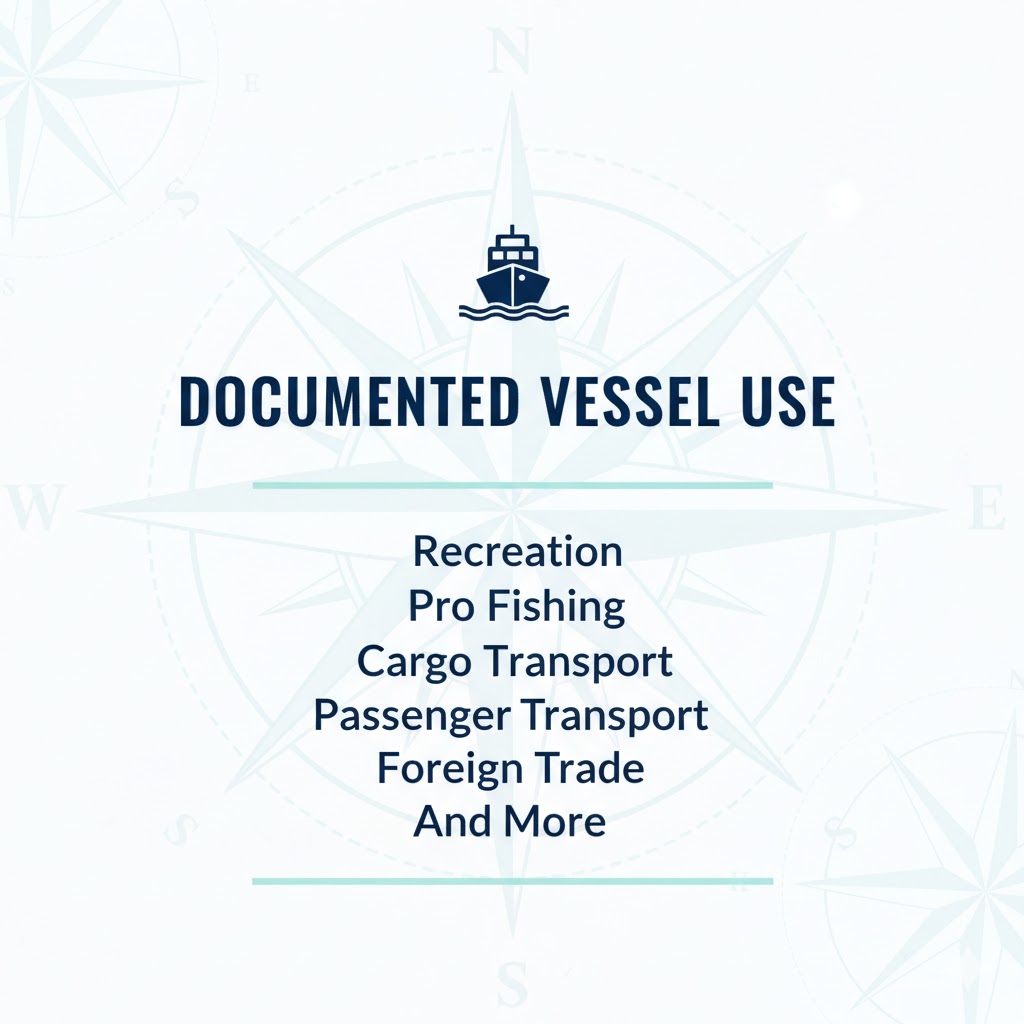
Documentation applies to larger recreational boats and commercial vessels engaged in activities such as fishing, freight, or passenger transport on navigable waters or within the Exclusive Economic Zone (EEZ).
To qualify, a vessel must meet specific requirements established by the Coast Guard, including ownership, measurement, and purpose of use.
Documentation ensures that each vessel meets the standards for operation under federal law and provides legal protection for both owners and lenders.
The Legal Foundation of Vessel Documentation
The documentation process and requirements are defined by federal law under 46 CFR §67.5. This regulation outlines who can apply for documentation, the criteria that must be met, and the circumstances under which a Certificate of Documentation may be issued or renewed.
Federal documentation provides:
- Legal proof of ownership and nationality
- A single federal title recognized nationwide
- The ability to engage in certain commercial trades
- Eligibility for preferred mortgages recognized by the federal government
Because the system is governed by the Coast Guard, documented vessels are not subject to state titling laws, though they may still need to comply with state operational regulations, such as safety or taxation requirements.
Citizenship Requirements for Vessel Documentation
To qualify as a documented vessel, the owner must be a U.S. citizen. This requirement is strictly enforced and applies to both individuals and entities.
For individual ownership, the applicant must be a U.S. citizen who can provide the required identification and proof of citizenship as part of the application. For corporate ownership, the company must meet additional conditions to qualify as a U.S. citizen under documentation law:
- The corporation must be incorporated within the United States.
- The number of non-citizen directors must be fewer than what is required to constitute a quorum.
- The corporation’s chief executive officer, president, and managing officers must be U.S. citizens.
These requirements help ensure that vessels operating under the U.S. flag maintain compliance with federal ownership and trade laws.
Measurement and Eligibility Standards
Eligibility for documentation is determined not only by ownership but also by vessel size. The vessel must measure at least five net tons—a unit of volume rather than weight.
A vessel measuring five net tons or more typically has an internal volume of approximately 10,000 cubic feet.
While the calculation is technical, it generally means that most vessels 26 feet in length or longer qualify for documentation. However, not all vessels that meet this size automatically require documentation. The need for documentation depends on how the vessel is used.
Recreational vessels can be documented voluntarily, while commercial vessels—those engaged in coastwise trade or commercial fishing—must be documented under federal law.
Uses of Documented Vessels
Vessel documentation applies to both recreational and commercial operations, though the requirements and endorsements differ based on use.
Many private boat owners choose to document their recreational vessels voluntarily. Doing so provides a single national title recognized across all states and territories, which can make travel, financing, and ownership transfers easier.
Documentation also provides additional proof of ownership, which can be helpful when entering foreign ports or dealing with maritime lenders.
Commercial Use
Vessels used in commercial activities must hold a valid Certificate of Documentation if they operate on navigable U.S. waters or in the Exclusive Economic Zone. Examples of these activities include:
- Commercial fishing operations
- Passenger or cargo transport
- Charter services operating for hire
- Offshore trade or support vessels
The specific endorsement granted on the Certificate of Documentation—such as “Coastwise,” “Fishery,” or “Registry”—determines the type of operations the vessel may legally conduct.
The Benefits of Vessel Documentation
There are several advantages to maintaining a documented vessel:
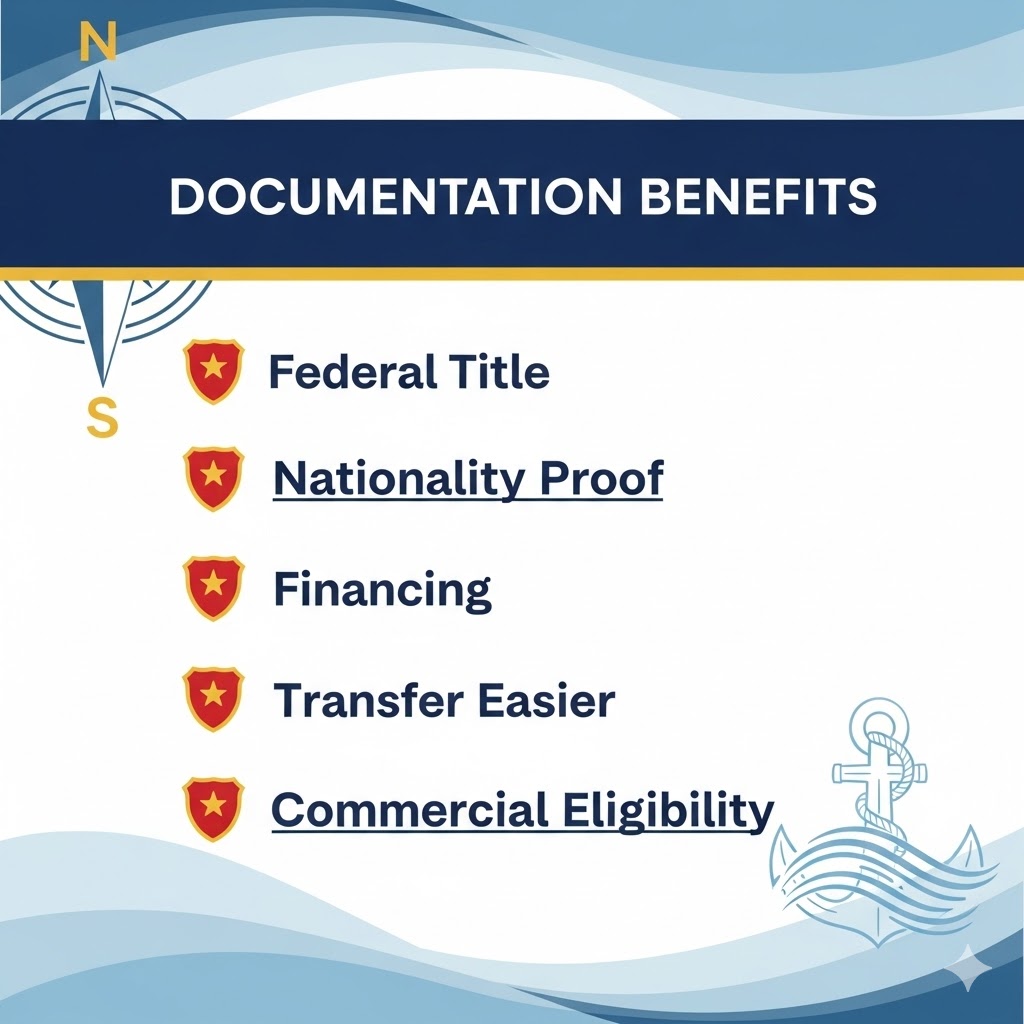
- Federal Title: Documentation serves as a single, federally recognized title that replaces the need for state registration.
- Proof of Nationality: The Certificate of Documentation verifies that the vessel is a U.S. vessel entitled to operate under the U.S. flag internationally.
- Financing Advantages: Many maritime lenders prefer or require documentation before issuing a mortgage, as it allows for a “preferred ship mortgage” under federal law.
- Ease of Transfer: Documentation streamlines ownership transfers, inheritance, or sale of the vessel.
- Commercial Eligibility: Certain trades and fisheries require documented status to operate legally.
Documented Vessel Renewal and Maintenance
A Certificate of Documentation must be renewed annually to remain valid. Failure to renew can result in the vessel losing its documented status, which could affect its ability to operate or be sold.
The renewal process confirms that ownership and citizenship remain consistent with the requirements set by the Coast Guard. Renewal ensures the vessel’s record remains active within the USCG database.
Through our portal, vessel owners can easily complete their documented vessel renewal online, saving time and avoiding unnecessary delays. Our streamlined interface allows users to fill out the renewal form, verify their vessel’s information, and submit everything directly for processing.
Performing a Vessel Documentation Search
A vessel documentation search allows vessel owners, buyers, or maritime professionals to verify whether a vessel is currently documented and whether its status is active.
This search is conducted through the Coast Guard database, which holds public records of all documented vessels.
The search results display details such as the vessel’s official number, name, and ownership information.
Although our portal does not conduct searches for users, understanding how to perform one can be useful for confirming vessel details before applying for documentation or completing a transaction.
Applying for Documentation Through the National Documentation E-Portal
Applying for vessel documentation can involve multiple forms, depending on the vessel’s use and ownership status. Our service provides a direct, digital method for completing and submitting these applications online.
We assist with:
- Initial documentation for qualifying vessels
- Renewals to maintain valid status
- Transfers of ownership or reinstatement when applicable
Each form we provide is designed to comply with Coast Guard requirements. They can be completed entirely through our secure online system. Our goal is to simplify the process of obtaining or maintaining your documented vessel, allowing you to focus on operating your vessel rather than navigating complex paperwork.
Help With Your Documented Vessel and More
A documented vessel represents more than a registered boat—it is a federally recognized maritime asset. It carries the privileges and responsibilities of operating under the U.S. flag. Through the National Documentation E-Portal, you can handle every part of the process online. Everything. From your initial filing to annual renewal, we can hep ensure your vessel remains compliant. That way, you’ll be ready for operation wherever your travels may take you.