A certified copy of the vessel documentation is official proof of federal vessel records for boat owners, buyers, lenders, and attorneys. They can verify who owns the documentation, if there are any encumbrances, oppositions, or registrations against a vessel. A certified copy differs from a regular copy. It is useful to finance, sell, insurance reviews, and legal activities.
Owning a vessel often means much more than just a bill of sale or registration with the state. National documentation systems maintain records of federally documented boats. The records may be examined when a ship is sold, refinanced, insured, or involved in a court dispute.
Many owners do not consider getting certified records until a lender, buyer, attorney, or insurer asks for them. Waiting until the last minute impacts closing deals, loan approvals or policy updates. When and why certified copies are needed helps owners avoid any surprises.
This guide explains how certified copies of documents work, when they can be useful, how they differ from regular documents, and how vessel owners can better manage their paperwork through Certified Copy of Vessel Documentation.
Importance of Certified Vessel Records
An authentic information on the official record of a vessel. Since it’s signed, this make it more authentic than an informal photocopy, screenshot, or personal record. When it is necessary to prove ownership or financial status, it adds authority to a letter through certification.
Documented vessels often engage in high-value transactions, making their federal vessel records vital. The seller must prove that they own the property. Lenders want to check existing mortgage claims if they exist. Insurance companies could also require proof that the details of the ship match your policy.
| Feature | Certified Copy | Regular Copy |
| Official Validation | Included | Not included |
| Legal Reliability | Strong | Limited |
| Lender Acceptance | Commonly preferred | May be rejected |
| Ownership Verification | Official record support | Informational only |
An official vessel documentation record can prevent errors in ownership checks. The vessel name, official number, current owner, and recorded financial interests may be shown. In the event questions are raised before a sale or a loan is approved, then this information can be important.
Having a certified document protects the owners from disputes. If someone disputes ownership or a monetary claim, verified records support the owner. Time and uncertainty in legal or administrative reviews can be reduced.
Certified copies are not to be considered replacement certificates, owner must also understand this. A replacement certificate usually reactivates a lost or damaged certificate. A certified copy is document that can be used to review, verify, proof or transacts business.
When Owners Require Copies of Certified Documents
In several instances, owners of vessels require certified records. Formal transactions, money transactions, and administrative requests often give rise to these needs. Preparedness of records can eliminate delays and bring in confidence.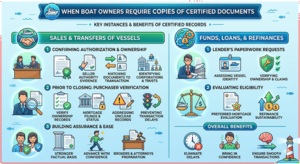
Sales and Transfers of Vessels
During the sale of a vessel, buyers usually require evidence that the seller is authorized to sell the vessel. A certified copy of vessel documentation can help confirm that the documents relating to a vessel and the ownership parties match the transaction documents. When a vessel is owned by a corporation, trust, partnership, or estate.
Documented vessels often require scrutiny on a sale. Prior to closing, purchasers can verify ownership records, mortgage filings and document status. If a record looks unclear, the transaction will slow down until the problem is fixed.
Having a certified copy gives both parties a stronger factual basis. Сeller can display certified documentation Purchasers can advance with greater assurance. The copy can also be used by brokers and attorneys preparing closing documents.
Funds, Loans, and Refinances
Often, marine lenders request paperwork before making loans. To assess the veracity of the vessel’s identity, ownership and other claims. Certified documentation assists lenders in evaluating whether the ship can sustain a preferred mortgage/refinance.
A lender may refuse the informal copies if the official copy is needed. Funding may get delayed when there are already scheduled closing dates. When you get certified records early, it avoids problems.
Certified records may also be needed by owners refinancing an existing vessel loan. The new lender might look into previous mortgage filings and releases. Having clear documentation can enhance the review process.
Evaluation of Insurance, Legal, and Administrative matters
Insurers may ask for official vessel records for a new or updated policy. This helps them confirm ownership, vessel details, and document status. Legal professionals may also request certified copies for disputes, estate matters, or ownership claims.
An official investigation of a ship’s title can uncovers facts that affect a case. The findings can be substantiated by certified copies This makes them handy whenever such proof is required.
Requests for certified records commonly arise due to
- Preparing for a vessel sale.
- Seeking finance for boating expenses
- Examining mortgage or lien records.
- Insurance or legal paperwork support.
Certified records eliminate uncertainty in every case. They help decision-makers not to rely on unofficial documents.
Cross-Examination of Given Copies of Other Vessel Files
Various records of vessels serve varying objectives. A certified copy, an abstract of title, a certificate of documentation, and state registration is different. By knowing the difference, the owner can request the correct document.
A Certificate of Documentation shows that a vessel is federally documented. It is typically stored alongside the vessel and employs to prove operational use. A certified copy, however, authenticates official records for examination or proof.
In-depth history is provided with an abstract of title There could be ownership transfers, mortgages as well as releases. A copy that is certified may deal with documentation records rather than the timeline.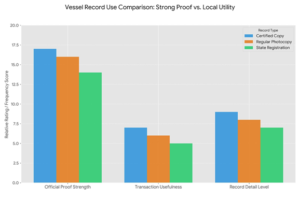
- The chart provides certified copies; there is no better option for important legal and financial events; certified copies give the greatest official proof strength in that the information can be verified from federal files.
- Certified Copies are highly useful when any party to the transaction will involve a lender, attorney or insurer. This is because they effectively eliminate the risk of a third party refusing to accept the documents on the basis that they have been altered, are incomplete or are out of date.
- A Regular Photocopy is not strong, useful, or detailed enough to prove ownership or financial history when reselling, refinancing or closing. Further, it is also the least expensive option.
Final thoughts, Certified Vessel Records
Using a certified copy of vessel documentation can help protect your ownership, assist in transactions, and verify official vessel records. It provides greater assurance to purchasers, lenders, insurers, and legal practitioners as to the information.
Certified records are necessary for vessel sales, financing, refinancing, insuring, and legal reviews. They offer certified proof that ordinary copies may not. It can avoid delays and confusion in important decision-making.
Real estate owners who manage their documentation carefully experience smoother transactions. Whenever certified proof is requested, it is easier to respond if you have accurate records, and current addresses, and organised files to support your statement.
It is important to have federal vessel documentation because verified ownership and financial history are key to many marine transactions. An effective record can enhance resale value confidence for financing and long-term compliance.
Organizing documentation today can help save time during tomorrow’s sale, loan review, or legal request through the support provided by National Documentation E-Portal.