The USCG Documentation Deletion Form is an essential filing for boat owners wishing to remove a vessel from federal documentation. In case of sale overseas, permanent retirement, destruction, or transfer to state registration of a vessel, deletion from Coast Guard records ensures the accuracy of ownership status and compliance with law. Owners tend to neglect this process until paperwork issues slow down future deals or registration issues arise.
Vessels who qualify can obtain legal recognition through federal documentation. There are times when it no longer makes sense to keep active federal documentation. The owner of the vessel shall apply for deletion in proper form in such cases. If deletion is done improperly, it may lead to incorrect ownership details, renewal reminders, and administrative complications.
Inaccurate documentation and supporting records require the deletion process. The owners must explain the reason for deletion and confirm the details of the vessel before the approval takes place. Depending on your vessel’s use and ownership status, different situations require different documents.
After a vessel has sunk or seems lost, the USCG Documentation Deletion Form may be useful. This guide explains how to delete, the main reasons for deletion, what papers are needed, practical filing tips, and the differences between delete and renew.
What is the purpose of the USCG Documentation Deletion Form?
The Coast Guard keeps a record of a federal vessel documentation for ownership purposes. If federal documentation of a vessel is no longer needed, the owner must formally request deletion.
The removal does not obliterate ownership history It is therefore an update to federal records that the vessel is no longer registered under the documentation of the Coast Guard. The system discourages misunderstandings in ownership status or renewal duties.
| Situation | Deletion Required | Reason |
| Foreign Sale | Yes | Ownership transferred internationally |
| State Registration Only | Usually | Federal documentation no longer needed |
| Vessel Destruction | Yes | Record closure required |
| Ownership Transfer | Depends | Based on documentation status |
The phrase “vessel deletion request” is often used in reference to federal documentation removal. The phrase improves Coast Guard ownership documentation can vary, but the process is consistent.
There are many situations that require deletion filings.
- A ship sent to a foreign nation.
- Irreversible suspension from duties.
- Switch to state utilization.
- Loss or destruction of vessel.
Many owners think documents automatically expire without issues. Expired documentation may no longer be valid but the federal records may still show old ownership. Proper deletion paperwork makes for a cleaner record.
Documenting records are more critical for a commercial operator. We look up documentation histories during inspections or financing evaluations by regulatory agencies and lenders.
The USCG Documentation Deletion Form protects future owners too. Having your records updated lessens any confusion that may arise at the time of the resale or ownership verification procedure. Buyers prefer vessels in organized documentation history to ease registration.
Owners must also know that deletion is different from renewal cancellation. The process removes the vessel from formal documents more completely than simply letting the documents expire.
Common reasons vessel owners delete documentation
Boat owners make deletion requests for many practical and legal reasons. By understanding these scenarios, owners will know if deletion is appropriate for them.
Offering a Boat to the World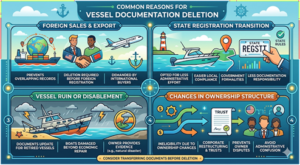
One of the most common deletion reasons is foreign sales. Federal documentation often becomes invalid when a documented vessel transfers to a foreign owner under Coast Guard eligibility standards.
Before the vessel gets foreign registration, deletion has to be requested by the seller usually. The mechanism prevents overlapping ownership records across global databases.
The expression “federal vessel deletion” is often used at the time of export-related marine transactions. International buyers often demand evidence of deletion before foreign registration can proceed.
Shifting to state registration
Some recreational vessel owners find federal documentation does not meet their needs. Owners who operate exclusively in local waters may choose state registration due to its lesser annual administrative requirements.
- State registration may be chosen by owners.
- Local compliance made easier.
- Reduce government formality.
- Less documentation responsibility
The management of recreation operations is easier.
Nevertheless, owners must carefully check state specifications before deleting members. After federal removal, some states require an extra tax or registration.
Vessel Ruin or Permanent Disablement
Documentation updates are also required for destroyed or retired vessels. Unless owners submit a proper request for deletion, boats damaged beyond economic repair will remain on federal record.
The filing for deletion concerning retirement is usually due to incidents like natural disasters. Supporting evidence is usually offered by Owners confirming the vessel can no longer operate.
Changes in Ownership Structure
In some cases when ownership changes, deletion may be required. Corporate restructurings or changes to trusts or involvement of a foreign owner can sometimes impact who is eligible for documentation.
People often informally refer to these changes as “Coast Guard documentation cancellation.” Accurate filings help avoid owner dispute or administrative confusion later on.
Documentation requirements should be reviewed before deletion requests. In some cases, transferring documents may solve the need for removal of records.
Comparison of Document Deletion with Renewal Transfer Process
Numerous vessel owners mix up deletion requests with documentation renewal and ownership transfer. While these processes may use similar records, they are for legal purposes that are fundamentally different.
Renewal preserves documentation ownership structure; thus, documentary remains active. Ownership is transferred while federal documentation status is maintained. Deletion officially eliminates the vessel from the logs.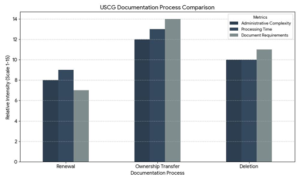
- The procedure of Ownership Transfer requires the most administration, takes the longest to complete and has the most document requirements of the three procedures because the change in title is a complex act.
- Due to minimal administrative effort and the need for not many documents, renewal is the easiest process as compared to transfer or deletion.
- Deletion Requests are more complex than Update Requests but are less complex than other requests. However, they are still important. In particular, Deletion Requests must be submitted when a vessel is to be exported or permanently deleted from federal records.
- Commercial operators must plan well during the documentation transition to avoid disruptions in licensing, financing or inspections transfer.
How to File a Documentation Deletion Request?
Deletion is much easier when preparation is done well. Delays in filing happen because owners come up with missing information or incorrect documents.
Before beginning the paperwork, the owners should confirm the reason for deletion. Not all supporting documents will be accepted for similar deletion reasons. Administrative review accelerates accurate explanation.
The below steps aid in streamlining the filing:
- Do a careful check of your their vessel documentation numbers.
- Double check ownership info.
- Assemble documentation prior to submission.
- Make a copy of every form.
The administrative procedures for deletion of federal records, as described by some, is a documented vessel removal process. While filing, organization still remains an important factor.
Before seeking deletion, owners ought to check their pending dues. The approval might take time due to unsatisfied mortgage. Banks typically require an official release in order for Coast Guard records to close.
Timing is crucial in vessel transactions A vessel owner should initiate preparations for deletion as soon as the vessel is intended for global export. Holds may affect customs clearances or foreign registrations.
Expert documentation services can help owners establish complex ownership structures or financing arrangements. Experienced review provides particular benefit to commercial operators where compliance depends on accurate records transitions.
Review state registration requirements before deletion approval is another useful strategy. Due to misunderstanding, some owners don’t register with the city after federal removal. Many jurisdictions have separate state compliance rules.
Following approval, owners should also store deletion confirmation records securely. Future purchasers, insurance providers, or marine authorities may want proof federal documentation ended appropriately.
Final thoughts Regarding the Deletion of Vessel Documentation
The USCG Documentation Deletion Form is pivotal in ensuring accurate federal documentation of vessel ownership. The deletion of a vessel is important for the owner in order to avoid maritime administrative confusion or legal complications in the future.
The demise process provides alternative to owners for better inconveniences. Streamlining the approval process through accurate documentation numbers, organized support records, and factual explanations. A delay can be avoided by careful preparation that will keep the ownership history accurate.
Many recreational and commercial operators continue to find federal vessel documentation useful. Eventually though, situations arise where keeping documents active no longer meets the owner’s needs. In these cases, formal deletion enables a smooth and legally acknowledged cessation.
The marine industry relies on accurate ownership and document history information. Keeping the vessel records updated and organized benefits the buyers, lenders, insurers, and regulatory agency.
National Documentation E-Portal supports boat owners with organized filing assistance, documentation updates, and record management for smoother vessel transactions.