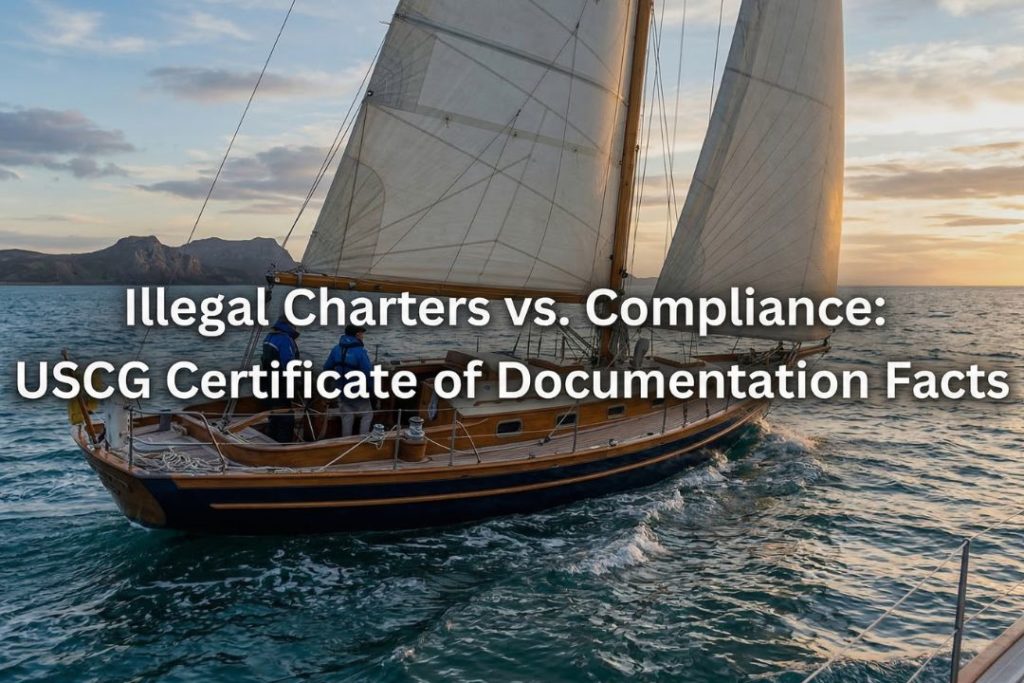
A charter can be a great way to make money, but you always want to make certain that you’re legally compliant. Recent enforcement activity highlights how closely federal and local authorities monitor vessels operating for hire. We can help you secure and maintain the USCG Certificate of Documentation required to stay compliant.
The difference between operating legally and facing penalties can come down to a handful of critical details.
Compliance and the USCG Certificate of Documentation
Operating legally in U.S. waters requires more than simply owning a vessel and taking passengers out on the water.
The USCG Certificate of Documentation is a federal registration that establishes nationality, ownership, and operational authority for vessels. When used correctly, it allows vessels to engage in specific trades, including commercial charter operations.
When used incorrectly—or when details are missing—it becomes one of the first issues identified during enforcement boardings. For a recent example, check out this Coast Guard press release.
In enforcement actions like those seen in Miami, authorities often identify multiple violations at once, but documentation errors frequently serve as the starting point. That is why maintaining valid, accurate paperwork is not optional for anyone operating a charter business.
The USCG Certificate of Documentation and Coastwise Endorsements
One of the most common issues seen in illegal charters is the misuse of endorsements. A vessel may be documented, but that alone does not grant permission to carry passengers for hire.
Why endorsement type matters
A recreational endorsement only permits private use. It does not allow:
- Carrying paying passengers
- Conducting charter operations
- Advertising commercial services
To operate legally as a charter, the documentation must include a coastwise endorsement. Without it, even a fully documented vessel is considered non-compliant when engaged in commercial activity.
What happens during enforcement
During a boarding, officials review:
- The endorsement listed on the certificate
- The vessel’s current use
- Any evidence of commercial activity
If there is a mismatch, the voyage can be terminated immediately.
How we help you stay aligned
Through our service, vessel owners can apply for:
- Exchange of Certificate of Documentation
- A Change of Endorsement/Trade Indicator
These filings ensure that your vessel’s paperwork reflects its intended use, which is a foundational requirement for lawful charter operations.
Physical Documentation Requirements Onboard
Another frequent mistake is assuming that a copy—whether printed or digital—is sufficient during an inspection. It is not.
The requirement is straightforward
The original Certificate of Documentation must be physically present on the vessel at all times during operation. This applies regardless of:
- Distance from shore
- Duration of the trip
- Type of charter
Common misconceptions that lead to violations
Many operators believe the following are acceptable substitutes:
- Photocopies
- Digital files stored on phones or tablets
- Expired certificates awaiting renewal
None of these meet federal requirements.
What enforcement officers look for
When boarding a vessel, officials will typically request:
- The original certificate
- Verification that it is valid and current
- Confirmation that the endorsement matches the activity
If the document is missing or invalid, the vessel may be cited or removed from service.
Keeping documentation current and accessible
Our service supports vessel documentation renewal so that operators maintain valid credentials. Ensuring that the original document onboard reflects an active status is one of the simplest ways to avoid unnecessary complications during an inspection.
Tonnage and Passenger Capacity Rules
Documentation is only one part of compliance. Vessel classification and passenger limits also play a significant role in determining whether operations are lawful.
Understanding vessel classification
The Coast Guard evaluates vessels based on:
- Gross tonnage
- Passenger capacity
- Intended use
A key distinction is whether a vessel qualifies as a Small Passenger Vessel, typically under 100 gross tons.
Why documentation matters here
Accurate documentation is the starting point for determining eligibility for additional certifications. Without proper federal documentation in place, progressing to inspections or expanded operations becomes significantly more difficult.
Compliance considerations
Operators should ensure:
- Passenger counts are always within allowed limits
- Documentation aligns with vessel use
- Any required inspections are pursued when scaling operations
Our service focuses on helping vessel owners establish the proper documentation foundation needed for these next steps.
An Expired USCG Certificate of Documentation and Commercial Status
Another major compliance issue arises when documentation lapses. Many operators underestimate how quickly an expired certificate affects their legal standing.
What expiration actually means
Once a Certificate of Documentation expires:
- Commercial privileges are immediately suspended
- The vessel may be treated as undocumented
- Any charter activity becomes non-compliant
There is no grace period that allows continued commercial operation.
How this leads to enforcement issues
Expired documentation is often discovered during routine inspections. In many cases, operators are unaware their certificate has lapsed until they are boarded.
This can result in:
- Fines
- Voyage termination
- Additional scrutiny in future operations
Maintaining active status
Through our service, vessel owners can complete filings related to:
- Renewal
- Reinstatement
These processes ensure that vessels remain eligible for lawful commercial use. Keeping documentation active is one of the most effective ways to avoid disruptions.
Foreign-Built Vessels and the MARAD Waiver
Not all vessels are automatically eligible for commercial use in the United States. The origin of the vessel plays a significant role.
The restriction on foreign-built vessels
In general, vessels built outside the U.S. are not permitted to engage in coastwise trade, which includes carrying passengers for hire.
The role of the MARAD waiver
A MARAD waiver allows certain foreign-built vessels to participate in limited commercial activities under specific conditions.
Without this waiver:
- Charter operations are prohibited
- Enforcement actions are likely if violations occur
Many vessel owners are unaware of this requirement, particularly if they purchased a vessel without considering its build origin.
Our service provides access to the filings necessary to pursue a MARAD waiver, helping vessel owners address this critical requirement before beginning charter operations.
Enforcement Trends and Industry Protection
The Miami enforcement activity referenced earlier demonstrates how coordinated efforts between federal and local agencies are used to identify illegal charters.
What these operations reveal
Authorities are actively monitoring:
- Social media advertisements
- Charter booking platforms
- On-the-water activity
When violations are found, multiple agencies may be involved in stopping operations.
Why compliance benefits legitimate operators
Staying compliant does more than avoid penalties. It also:
- Protects your business reputation
- Builds trust with customers
- Supports a fair marketplace
Illegal operators undercut legitimate businesses, which is why enforcement efforts are designed to level the playing field.
Getting and Hanging Onto a USCG Certificate of Documentation With Us
At the National Documentation E-Portal, our service focuses on making federal documentation accessible and manageable for vessel owners.
We provide access to forms and filings related to:
- Initial documentation
- Endorsement updates
- Renewal and reinstatement
- Ownership changes
Each of these plays a role in ensuring that your vessel meets federal requirements for its intended use.
Maintaining a valid USCG Certificate of Documentation is not just a regulatory requirement—it is the foundation of lawful charter operations. Whether you are starting a new venture or maintaining an existing one, accurate and current documentation helps prevent costly disruptions.
For vessel owners navigating these requirements, understanding and maintaining compliance is essential to staying operational and protected in an increasingly regulated environment.