In commercial maritime operations, compliance is an active, ongoing responsibility. A recent enforcement action in Alaska underscores how even a single discrepancy can escalate into a broader investigation with lasting consequences. Maritime accountability is not just about avoiding penalties, but about preserving long-term operational viability in a highly regulated environment.
The Case That Teaches a Lesson
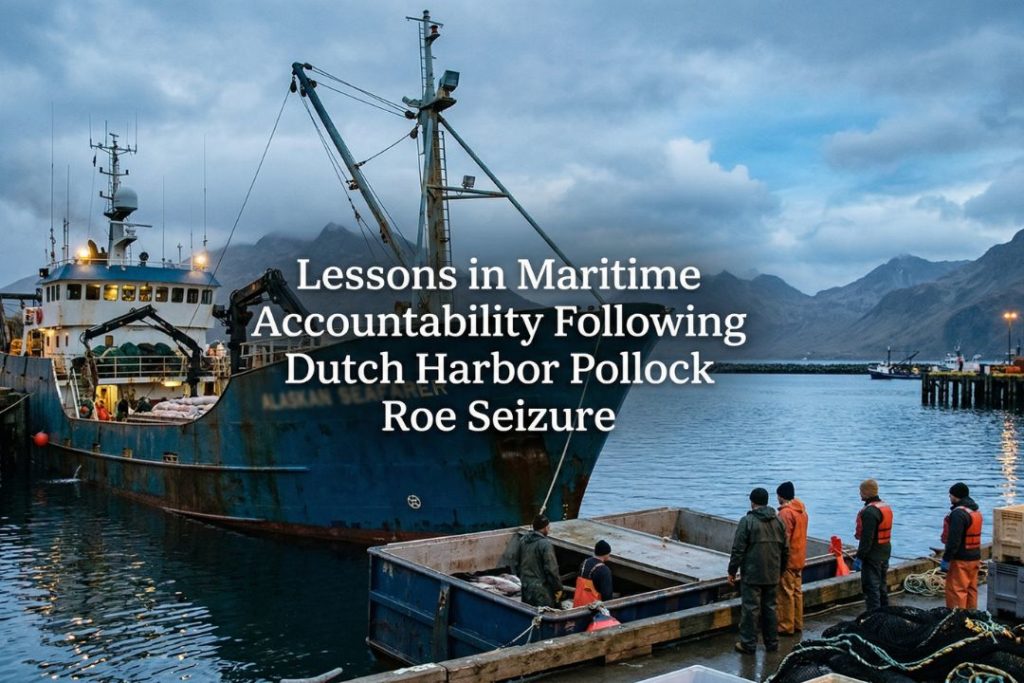
The case, detailed by the United States Coast Guard, involved the seizure of over $65,000 in unreported pollock roe during an inspection in Dutch Harbor.
According to the official report, a pre-boarding audit conducted by the National Oceanic and Atmospheric Administration revealed inconsistencies that led to the boarding and subsequent enforcement action. You can review the full report here: Coast Guard Cutter Waesche seizure press release.
For those managing documented vessels, this event highlights the growing importance of maintaining precise, accurate records across all federal systems.
The Expanding Scope of Maritime Accountability in Federal Oversight
Regulatory oversight in the maritime industry has evolved significantly. What was once a system of isolated inspections has become a network of interconnected databases and agencies sharing information in real time.
Maritime accountability now involves multiple federal entities, including:
- The United States Coast Guard for enforcement and safety compliance
- NOAA for fisheries management and reporting accuracy
- The National Vessel Documentation Center for ownership and vessel records
This interconnected framework means that discrepancies in one system can quickly surface in another. In the Dutch Harbor case, the initial trigger was not a physical boarding but a data-driven audit. That shift is critical.
Instead of relying solely on random inspections, agencies are now:
- Cross-referencing catch reports with landing data
- Comparing historical voyage records against current filings
- Identifying anomalies through digital audits before vessels reach port
For vessel owners, this means that documentation must be consistent across all filings, not just internally accurate.
How Pre-Boarding Audits Are Reshaping Maritime Accountability
The most striking element of this case is the role of the pre-boarding audit. This was not a routine stop or a random enforcement action. It was a targeted response based on identified discrepancies.
Pre-boarding audits represent a fundamental shift in enforcement strategy. Rather than reacting to violations, agencies are proactively identifying them.
Characteristics of this approach include:
- Data analysis conducted before vessel arrival
- Coordination between agencies prior to boarding
- Increased likelihood of targeted inspections
In practical terms, this means that:
- Errors in reporting are more likely to be detected
- Intentional misreporting carries a higher risk of exposure
- Even minor inconsistencies can trigger a deeper review
For documented vessel owners, maintaining accurate filings is no longer just best practice—it is essential for avoiding scrutiny.
The Ripple Effect: Secondary Violations and Historical Review
One of the most consequential aspects of the Dutch Harbor seizure was what followed the initial discovery. After identifying the unreported pollock roe, investigators expanded their review and uncovered evidence of prior violations totaling approximately $150,000.
This illustrates a major principle in maritime enforcement: once a vessel is flagged, its history becomes subject to closer examination.
Maritime accountability extends beyond a single voyage
A single discrepancy can open the door to a comprehensive audit of past activities. This includes:
- Reviewing previous catch reports and landings
- Examining logbooks and recorded voyages
- Cross-checking documentation across multiple reporting periods
The implications are significant:
- Past errors that went unnoticed may resurface
- Financial penalties can accumulate rapidly
- Regulatory standing can be jeopardized
For operators, this reinforces the importance of maintaining consistent accuracy over time—not just in response to an immediate inspection.
Maintaining a Clean Federal Record Across Agencies
In an environment where agencies share data and collaborate on enforcement, maintaining a clean record is more important than ever. This is particularly true for vessels that rely on federal documentation to operate.
Accurate records with the National Vessel Documentation Center are a cornerstone of maritime compliance. These records form the foundation upon which other regulatory data is built.
A clean federal record should include:
- Up-to-date ownership information
- Accurate vessel specifications
- Timely submission of required filings
When these records are aligned with operational data reported to other agencies, the risk of discrepancies is significantly reduced.
The Role of USCG Documentation in Compliance
Federal documentation is not just a formality—it is a critical component of a vessel’s legal identity. USCG documentation establishes ownership, nationality, and eligibility for certain operations.
For commercial operators, this documentation must remain current and accurate at all times.
Our service simplifies the process of applying for and maintaining this documentation. By providing a streamlined platform for submissions, we help ensure that vessel records remain consistent with federal requirements.
This consistency is essential for:
- Avoiding administrative delays
- Reducing the likelihood of discrepancies
- Supporting overall compliance efforts
The Importance of an Accurate Abstract of Title
Ownership history plays a crucial role in vessel documentation. An abstract of title provides a complete record of a vessel’s ownership and any associated encumbrances.
This document is often required for:
- Transfers of ownership
- Financing arrangements
- Verification of clear title
Maintaining an accurate abstract of title ensures that ownership records align with federal documentation. Discrepancies in ownership history can raise red flags during audits or inspections.
For vessel owners, this underscores the need for precise recordkeeping at every stage of ownership.
Vessel Documentation Renewal and Ongoing Compliance
Compliance is not a one-time event. It requires ongoing attention, particularly when it comes to vessel documentation renewal.
Failing to renew documentation on time can lead to:
- Lapses in federal status
- Increased scrutiny during inspections
- Potential operational disruptions
Our platform provides a straightforward way to complete renewal applications, helping vessel owners maintain continuous compliance.
Regular renewal is a crucial component of maritime accountability, ensuring that vessel records remain current and accurate within federal systems.
Compliance for Vessels in Foreign Countries
For vessels with international histories, documentation becomes even more complex. A foreign vessel title search/transcript of registry may be necessary to verify prior registration and ownership details.
This process is particularly relevant when:
- Importing a vessel into the United States
- Transitioning from foreign to US documentation
- Verifying historical ownership records
Accurate documentation in these cases helps prevent inconsistencies that could trigger audits or delays.
Practical Steps to Strengthen Compliance
In light of the Dutch Harbor incident, vessel owners can take several proactive steps to strengthen compliance and reduce risk.
- Ensure all reported data is consistent across agencies
- Review historical records for accuracy
- Maintain up-to-date federal documentation
- Address discrepancies immediately when identified
How Our Service Supports Documentation Accuracy
Our role is focused on simplifying the process of applying for and maintaining federal vessel documentation. By providing an accessible online portal, we make it easier to submit required forms accurately and efficiently.
This includes:
- Initial documentation applications
- Ownership updates
- Renewal submissions
By streamlining these processes, we help vessel owners maintain alignment with federal requirements, which is essential in an era of increased data sharing and enforcement.
Maritime Accountability as a Long-Term Strategy
The Dutch Harbor seizure is more than an isolated incident—it is a reflection of broader trends in maritime enforcement. Agencies are leveraging data, collaborating more closely, and expanding the scope of their investigations.
This involves:
- Consistent attention to documentation
- Ongoing verification of records
- Alignment between operational and regulatory data
When these elements are in place, vessel owners are better positioned to navigate the complexities of federal oversight.
Staying Ahead in a Data-Driven Regulatory Environment
As enforcement continues to evolve, the importance of accurate documentation will only increase. Pre-boarding audits, cross-agency collaboration, and historical reviews are becoming standard practice.
Maritime accountability is no longer confined to inspections at sea—it begins with the data submitted onshore.
By maintaining accurate, consistent documentation through our platform, vessel owners can support compliance efforts and reduce exposure to enforcement actions in an increasingly interconnected regulatory landscape.