Purchasing or selling a boat in Florida involves more than just the exchange of money. To ensure the new owner is recognized as the legal owner and the state records are accurate, Florida boat ownership transfer must take place. Purchasers might experience registration issues, hold-ups in approval, or contention on ownership because the process is not completed correctly.
Florida has rules for titled vessels, including signature requirements, document standards, and deadlines. Changes in boat ownership related to recreation, leisure, fishing, and commercial activity must be done by law. In certain instances, federal documentation could also play a role.
By knowing definition of title transfer, registration update and documentation compliance, one does not get confused. This guide will give you the basics, document outline, compare the filing correct and incorrect method, and share tips for smooth filing.
Learn the Boat Ownership Laws in Florida
In Florida, boat ownership transfers begin with determining whether the vessel requires a title. Florida requires most motorized vessels to be titled before registration.
The Florida Department of Highway Safety and Motor Vehicles manages vessel title details. The title serves as legal evidence of ownership. The name on the title must reflect who owns it.
Check out the comparison table below that depicts the difference between Florida state titling and federal documentation.
| Feature | Florida State Title | Federal Documentation |
|---|---|---|
| Governing Authority | Florida State Agency | U.S. Coast Guard |
| Ownership Record | State-issued title | Certificate of Documentation |
| Lien Recording | State lien notation | Preferred ship mortgage |
| Registration Requirement | Required with title | Separate state registration |
| Renewal Frequency | Registration periodic | Annual documentation renewal |
If a vessel has federal documentation, further requirements may apply. Nonetheless, state titling laws govern most recreational boats.
Good documentation helps avoid legal confusion
- Accurate paperwork ensures compliance.
- Guide to Transferring Boat Ownership in Florida.
- Knowing each part makes the process easy.
- Check Seller Ownership and Title Condition.
The name of the seller must reflect on the current title. Sellers should verify that no active liens exist.
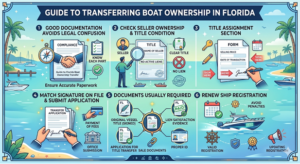
Finish the Title Assignment Section
The title is signed over to the buyer by seller. The form has the selling price and the date of the transaction.
Match signature on file
The buyer must lodge the duly signed title and the transfer application with the office.
Documents which are usually required
- Original vessel title signed.
- Finished off the application for the title transfer.
- Evidence showing that the lien is satisfied if applicable.
- Proper ID.
The sale documents prove that the transaction was legitimate.
Renew Ship Registration
Upon transfer of title, registration to be updated. Operating with no valid registration could incur penalties.
Prior preparation facilitates approvals
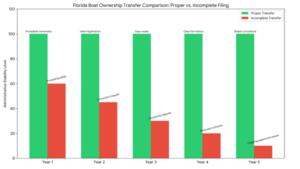
- Proper filing provides immediate benefits while incomplete documentation results in a lengthy delay. Filing of a complete application ensures immediate ownership along with valid registration in the first two years but incomplete documentation may lead to processing delays with requests for corrections that take time and resources.
- Accurate documentation facilitates an Easy resale by Year 3 and Clear lien history by Year 4, whereas incomplete transfers usually turn into ownership disputes and financial confusion.
- The Proper Transfer path operates at a high, stable compliance level through Year 5. Those with missing signatures or incorrect HIN experience chronic administrative headaches. We see this with L&L deficiencies and penalty letters from banks.
Advice to Follow for a Hassle-Free Transfer
If done carefully you can make the Florida boat ownership transfer process simple.
Duplicate identification numbers
Ensure that the hull identification number is the same as the title. Approval might become delayed due to minor errors.
Pay off Liens Prior to Sale Completion
Request written proof that all parties have satisfied any lien. Clear all financial claims before completing the transfer.
Best practices which are helpful include for Florida Boat Ownership Transfer
- Closely investigate the seller.
- Retain copies of all signed documents.
- Submit documents on time.
- Verify the completion of registration update.
These steps decrease admin risk.
Know Your Due Date – Florida Boat Ownership Transfer
Florida statute establishes timing requirements for title transfer submission. File on time, avoid penalties.
How to Successfully Transfer Florida Boat Ownership
A properly completed boat transfer protects the buyer and seller in Florida. When documents are not accurate, the state records may not reflect the true owner and registration system may become invalid.
The organized filing through the National Documentation E-Portal helps prevent long-term delays and issues. If documentation is incomplete or late, it can still cause processing problems or additional costs.
The vessel owners go about contenting themselves with the transfer by verifying title status, checking identification numbers, resolving liens and filing documents on time. Careful preparation makes a complicated process an easy step in the boat-ownership experience.
Managing the ownership changeover to the new owner in Florida in a smooth and secure manner, requires clear documentation, timely action and compliance with Florida regulations.