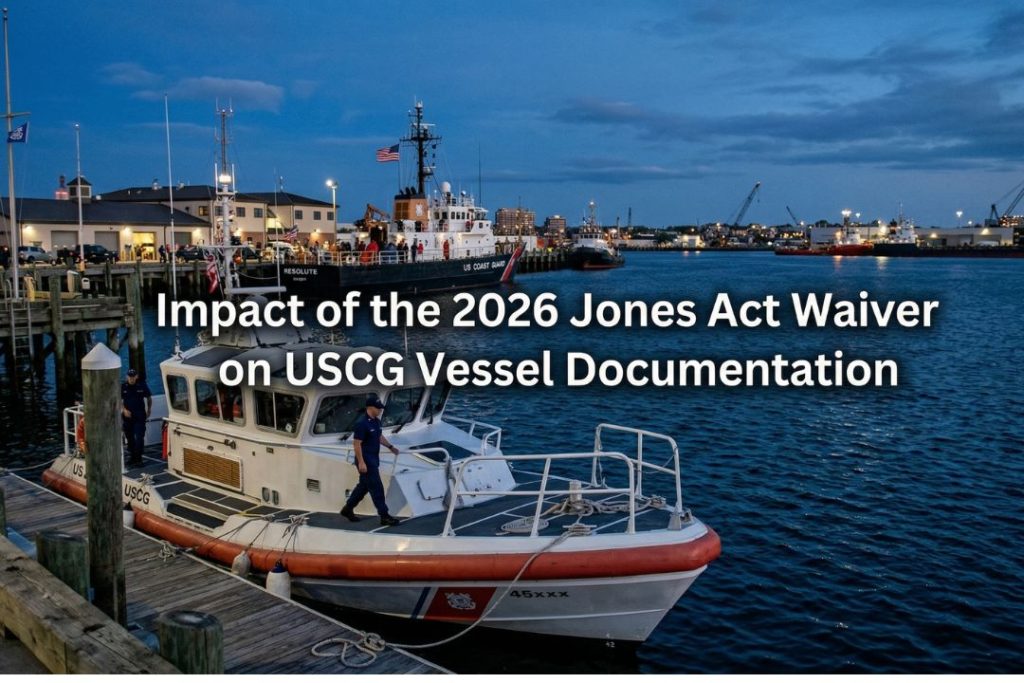
In March 2026, the Department of Homeland Security introduced a temporary measure that quickly became a focal point across the maritime industry. The 2026 Jones Act waiver was issued as a 60-day allowance to help stabilize energy transportation during a period of national supply concern.
While this action has significant implications for large-scale shipping operations, it has also created confusion among vessel owners regarding documentation requirements, endorsements, and compliance obligations.
At the National Documentation E-Portal, our role is to provide a streamlined way to handle USCG vessel documentation so that owners can stay compliant regardless of shifting regulatory headlines.
What is the 2026 Jones Act waiver?
The 2026 Jones Act waiver is a temporary 60-day measure that allows certain foreign-flagged vessels to transport energy-related cargo between U.S. ports. It was introduced to stabilize energy supply during a period of market disruption and applies only to a narrow segment of the shipping industry.
Does the 2026 Jones Act waiver change my vessel documentation requirements?
No, it does not affect standard USCG vessel documentation requirements. Vessel owners must still maintain valid documentation and ensure their endorsements accurately reflect their operations.
The Purpose Behind the 2026 Jones Act Waiver
The Jones Act has long governed domestic maritime trade in the United States. Its requirements ensure that vessels transporting goods between U.S. ports meet strict criteria tied to national security and economic interests.
The 2026 Jones Act waiver was not designed to alter that framework permanently, but rather to address a short-term disruption in energy logistics.
According to coverage from PBS NewsHour, the waiver allows certain foreign-flagged vessels to temporarily move energy-related cargo between U.S. ports. This exception was introduced to prevent supply bottlenecks and maintain stability in energy markets during a volatile period.
Characteristics of this waiver include:
- A defined 60-day duration with no guarantee of extension
- A narrow focus on energy-related transportation
- Limited applicability to large-scale commercial shipping operations
- Continued enforcement of standard regulations outside the waiver’s scope
For most vessel owners, these conditions mean business as usual when it comes to documentation and endorsements.
Coastwise Trade and Documentation Requirements
To fully grasp the impact of the waiver, it helps to revisit the fundamentals of coastwise trade. The Jones Act requires vessels engaged in domestic trade to meet specific standards:
- Built in the United States
- Owned by U.S. citizens
- Registered under the U.S. flag
- Crewed primarily by U.S. personnel
These requirements are reflected in a vessel’s CG documentation, particularly through the Coastwise Endorsement listed on the Certificate of Documentation. This endorsement determines whether a vessel can legally participate in activities such as:
- Transporting goods between U.S. ports
- Operating charter services
- Conducting passenger-for-hire operations
- Engaging in certain commercial fishing activities
The 2026 Jones Act waiver does not eliminate or rewrite these rules. Instead, it creates a very narrow and temporary exception that does not extend to most vessel owners.
How the 2026 Jones Act Waiver Affects Coastwise Endorsements
For vessel owners reviewing their endorsements, the 2026 Jones Act waiver may raise questions about whether temporary flexibility exists for their operations. The answer, in nearly all cases, is no.
The waiver does not:
- Change eligibility for Coastwise Endorsements
- Allow foreign-built recreational vessels to enter domestic trade
- Remove ownership or citizenship requirements
- Provide alternative pathways for standard commercial operations
This means that vessel owners must continue to maintain accurate and up-to-date documentation to remain compliant.
Can my foreign-built vessel operate in coastwise trade under this waiver?
In most cases, no. The waiver does not grant general permission for foreign-built vessels to engage in domestic trade, and standard eligibility rules still apply unless a separate MARAD waiver has been approved.
Do I still need to renew my vessel documentation during the waiver period?
Yes, renewal timelines and requirements remain unchanged. Keeping your documentation current is essential for maintaining compliance and avoiding operational issues.
What Vessel Owners Need to Know About Compliance
Despite the headlines, the regulatory environment for most vessel owners remains unchanged. Compliance still depends on maintaining proper documentation and ensuring that all endorsements accurately reflect the vessel’s use.
Important considerations include:
- Ensuring your Certificate of Documentation is current
- Verifying that your trade endorsements align with your operations
- Maintaining accurate ownership records
- Keeping documentation consistent with federal requirements
For those involved in commercial activity, the risks of non-compliance remain significant. Operating outside of Coastwise regulations can lead to penalties, fines, or even vessel seizure.
Documentation Records and Ownership Verification
Maintaining proper records is a core part of compliance. Vessel owners often rely on historical documentation to verify ownership and transaction history. This is where an abstract of title becomes relevant, as it provides a detailed record of a vessel’s ownership and encumbrances over time.
Accurate documentation ensures that:
- Ownership transfers are properly recorded
- Liens or claims are visible and addressed
- Federal records align with current vessel status
Foreign-Built Vessels and Limited Exceptions
One area where confusion often arises is the treatment of foreign-built vessels. Many owners wonder whether a temporary waiver could open the door for broader commercial use of these vessels within U.S. waters.
The reality is more restrictive.
Foreign-built vessels remain ineligible for Coastwise trade unless they receive a specific exemption through the Maritime Administration (MARAD). The waiver does not replace or bypass this process.
Owners of foreign-built vessels should understand:
- Temporary waivers do not grant permanent operating rights
- MARAD waivers are still required for certain small passenger operations
- Eligibility is limited to vessels carrying 12 or fewer passengers
- Documentation must still reflect approved endorsements
In situations involving international vessels, a foreign vessel title search/transcript of registry may be necessary to verify ownership and registration history before pursuing any documentation changes.
Staying Current With Boat Documentation Renewal
Even during periods of regulatory change, maintaining current documentation remains one of the most important responsibilities for vessel owners. Boat documentation renewal is not impacted by the waiver and must be completed within the standard timeframe.
Failing to renew documentation can result in:
- Loss of active documentation status
- Inability to legally operate in certain capacities
- Complications with ownership verification
- Delays in future transactions or endorsements
Our service provides a direct and efficient way to complete renewals online, helping vessel owners maintain uninterrupted compliance.
The Waiver and Ongoing Documentation Responsibilities
The waiver does not reduce or delay documentation obligations. Vessel owners should continue to treat renewal deadlines and endorsement updates as priorities.
Reminders include:
- Renewal timelines remain unchanged
- Documentation must reflect current ownership and use
- Endorsements should match operational activities
- Temporary waivers do not extend documentation validity
By keeping documentation current, vessel owners avoid unnecessary complications and ensure readiness for any regulatory environment.
Applying for Documentation and Endorsement Changes
For those acquiring new vessels or modifying how their vessels are used, proper documentation is essential. Whether applying for initial documentation or updating an existing certificate, accuracy is critical.
Common scenarios that require updates include:
- Purchasing a newly eligible vessel
- Changing from recreational to commercial use
- Adjusting trade endorsements
- Updating ownership information
Our portal allows vessel owners to complete these processes efficiently, reducing administrative friction and ensuring that submissions meet federal standards.
The Role of the 2026 Jones Act Waiver in Application Decisions
While the waiver may influence broader industry dynamics, it does not change the criteria used to evaluate documentation applications.
Applicants should proceed based on standard requirements, keeping in mind:
- Eligibility rules remain fully enforced
- Documentation must reflect actual vessel use
- Temporary waivers do not alter application criteria
- Federal review processes continue as usual
Navigating Your Course
Regulatory updates often create uncertainty, especially when they involve high-profile policies like the Jones Act. The 2026 Jones Act waiver is a clear example of a targeted measure that can appear broader than it actually is.
For most vessel owners, the biggest takeaway is consistency. The rules governing documentation, endorsements, and compliance remain firmly in place.
Our role is to provide a reliable way to handle documentation needs without unnecessary complexity. Through our online portal, vessel owners can:
- Submit documentation applications securely
- Complete renewals efficiently
- Update endorsements as needed
- Maintain accurate federal records
Staying informed while maintaining proper documentation ensures that vessel owners are prepared for both routine operations and unexpected regulatory developments.