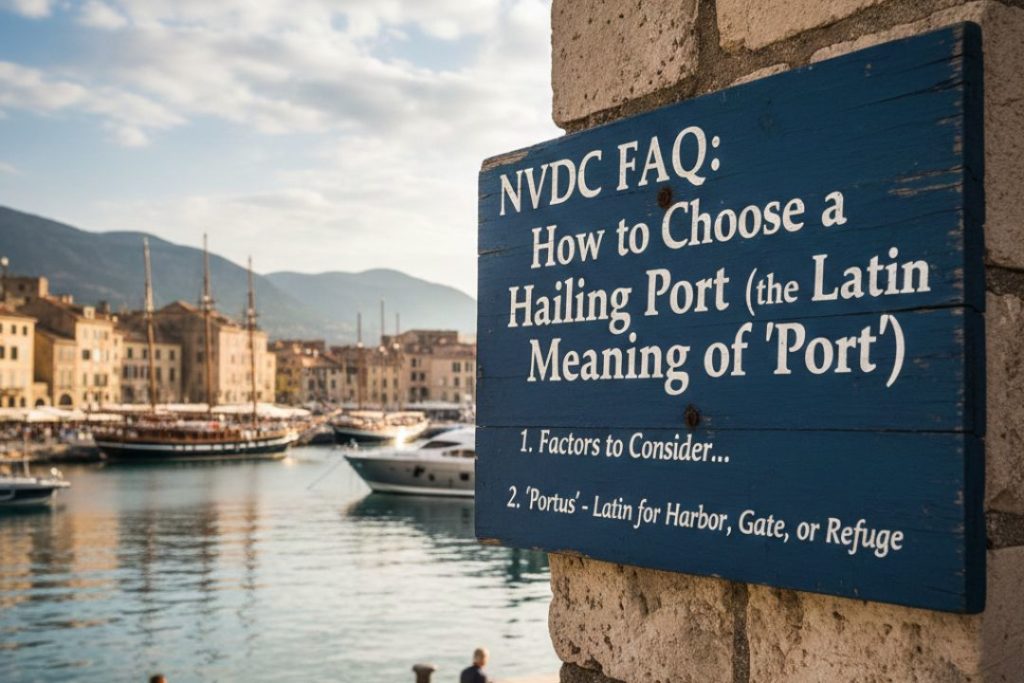
In plain terms, a hailing port is the city and state that legally identifies your vessel, and NVDC requirements focus on accuracy, federal recognition, and proper marking rather than where you personally live or keep the vessel. Choosing a hailing port is a required part of Coast Guard vessel documentation.
What does “port” mean, and why does it matter for a hailing port?
The word “port” has deep historical roots that help explain why it still matters in modern vessel documentation. The term comes from the Latin word portus, meaning harbor or haven, a place of shelter and entry. Closely related is porta, meaning gate or passage. Together, these ideas reflect the original role of ports as safe entry points for trade, travel, and navigation.
Over time, “port” became associated not just with physical harbors, but with the idea of identification and entry in maritime records. A hailing port is not a statement about where your vessel is physically located on a given day. Instead, it is a legal identifier that appears on your vessel and in federal records.
In nautical language, “port” also refers to the left side of a vessel. This usage developed because early ships steered using a right-side oar, known as the steorbord. Docking on the left side protected that steering oar from damage. While this usage is separate from the concept of a hailing port, both meanings reflect how maritime language evolved from practical needs.
How does the historical meaning of “port” connect to NVDC documentation today?
Modern Coast Guard documentation uses the hailing port as a consistent identifier tied to your Certificate of Documentation. The historical idea of a “gateway” or “official entry” remains relevant because the hailing port functions as part of the vessel’s legal identity.
When the Coast Guard issues documentation, the hailing port is recorded and must match what is physically marked on the vessel. This consistency is critical during events such as:
- A vessel documentation renewal
- A transfer of ownership
- The recording of a ship mortgage
- The issuance of an abstract of title
Our service is designed to help owners submit forms that reflect these requirements accurately, without confusion about what the hailing port represents.
What are the current GNIS requirements for choosing a hailing port?
For 2026, the Coast Guard requires that the hailing port be a recognized place name within the United States. This requirement is tied to the Geographic Names Information System, commonly referred to as GNIS. The GNIS is the federal database of official geographic names.
Under these rules, NVDC filings must list a hailing port that meets all of the following conditions:
- The location is a recognized place name in the United States
- The name appears in the GNIS database
- Both the city and the state are included
- The city name is spelled exactly as recognized
- The state may be abbreviated
A hailing port does not need to be coastal. Landlocked cities are acceptable as long as they are officially recognized place names.
Do you have to live in the city listed as your hailing port?
You do not have to live in the city you choose as your hailing port. Federal regulations do not require the hailing port to reflect your residence, marina, or storage location.
Owners often assume the hailing port must match where the vessel is used most frequently, but that is not the case. The hailing port is an identifier, not a usage description. What matters is that it is:
- Federally recognized
- Accurately recorded
- Consistently marked on the vessel
Our portal helps ensure that the hailing port you submit aligns with federal documentation standards, which helps avoid processing issues.
Why must the city and state be listed exactly as required?
Accuracy matters because the hailing port becomes part of your vessel’s permanent documentation record. Small discrepancies can lead to delays or correction requests.
When submitting information through NVDC, the hailing port must include:
- The full city name as recognized
- The state abbreviation
- No unofficial abbreviations for the city
- No alternative spellings
This requirement supports consistency across federal records and physical vessel markings.
Where must the hailing port be marked on your vessel?
Federal regulations require that the hailing port be marked on the exterior of the vessel. Specifically, it must appear on a clearly visible part of the stern.
The governing regulation is found in 46 CFR § 67.119 and related marking requirements.
These rules apply to documented vessels and are enforced as part of routine compliance checks.
What are the size and visibility rules for hailing port markings?
In addition to location, federal law specifies how the hailing port must be displayed. Under 46 CFR § 67.123, the marking must meet clear visibility standards.
The requirements include:
- Letters at least four inches in height
- Durable construction
- A color that contrasts with the hull
- Placement where the marking is plainly visible
These standards exist to ensure that the vessel can be properly identified without ambiguity.
What has changed in 2026 regarding hailing port markings?
In early 2026, the Coast Guard began issuing more correction notices related to marking durability. These notices are often referred to as “Fix-It” notices and are typically issued when existing markings no longer meet regulatory standards.
Common issues include:
- Faded lettering
- Peeling or cracked materials
- Reduced contrast with the hull
While the legal requirements themselves have not changed, enforcement has become more consistent. Accurate documentation through NVDC helps ensure that your records align with current enforcement expectations.
Can you change your hailing port without filing paperwork?
You cannot change a hailing port by simply altering the marking on your vessel. Any change to the hailing port requires an official update to your Certificate of Documentation.
To make this change, you must file an Application for Exchange using Form CG-1258. This filing updates the Coast Guard’s records and authorizes the new hailing port.
Our service assists with preparing and submitting this form so the updated information is properly recorded.
How does changing a hailing port affect your documentation record?
A hailing port change is treated as a documentation update. It becomes part of the vessel’s official history and is reflected in federal records.
This can be relevant during:
- Future sales
- Financing transactions
- Title reviews
- Documentation audits
Because the hailing port appears in official records, accuracy helps maintain a clean and consistent documentation profile.
How does your hailing port relate to other documentation actions?
The hailing port is one element of a larger documentation framework. It interacts with other filings and records, even though it serves a distinct purpose.
For example:
- During a transfer of ownership, the existing hailing port remains unless formally changed
- When recording a ship mortgage, the vessel’s identifying information must match existing records
- An abstract of title reflects the documented details on file, including the hailing port
Consistency across filings helps prevent discrepancies that could require correction later.
How does our portal help with hailing port compliance?
Our role is to make Coast Guard documentation easier to complete correctly. Through NVDC, we help vessel owners submit accurate information that aligns with federal requirements.
Our service focuses on:
- Supporting proper form completion
- Ensuring required fields are addressed
- Helping reduce avoidable processing delays
We do not conduct research on your behalf or provide guidance on marking methods or materials. Our role is to help ensure that the information you submit is structured and presented in a way that meets documentation standards.
Why is accuracy so important when choosing and marking a hailing port?
The hailing port may seem like a small detail, but it plays a central role in vessel identification. Errors can lead to delays, correction requests, or compliance notices.
Accuracy supports:
- Clear vessel identification
- Consistent federal records
- Smoother processing of future filings
Using NVDC to manage your documentation helps keep this information aligned with current requirements, reducing the likelihood of avoidable issues.
How can proper documentation help avoid future issues?
When your hailing port is correctly selected, filed, and marked, it becomes one less issue to address during future documentation actions. Whether you are updating records, renewing documentation, or preparing for a transaction, consistency matters.
Our service exists to support that consistency by helping vessel owners submit forms that reflect federal standards as they exist today.