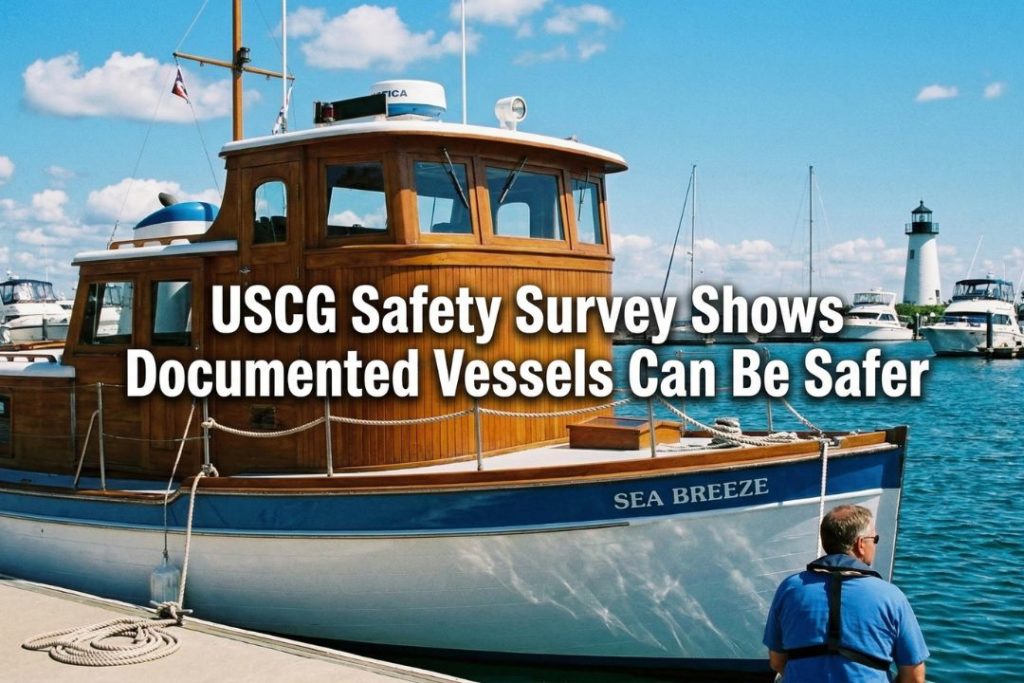
Federal data increasingly demonstrates that documented vessels often operate with an additional layer of traceability and accountability that supports safety across the maritime environment.
One of the most important sources of boating safety information in the United States comes from the National Recreational Boating Safety Survey, which collects extensive data on boating activity, safety practices, and accident trends.
For vessel owners who operate on coastal waters, lakes, or international routes, federal documentation can play a meaningful role in how authorities identify vessels and respond to emergencies.
At the National Documentation E-Portal, our service simplifies the process of applying for Coast Guard documentation so owners can maintain accurate federal records that support compliance and operational transparency.
The survey data gathered by the United States Coast Guard offers insight into how safety practices and recordkeeping contribute to boating outcomes nationwide.
What the National Recreational Boating Safety Survey Reveals About Documented Vessels
The National Recreational Boating Safety Survey (NRBSS) is widely regarded as one of the most comprehensive data efforts in American recreational boating. The study evaluates boating activity, vessel exposure, and safety practices throughout the country.
According to the official survey information published by the U.S. Coast Guard, the NRBSS tracks how frequently boats are used, how they are operated, and what safety measures are present on board. The survey does not simply count vessels—it analyzes the real-world conditions in which they operate.
This large-scale research project helps safety officials understand patterns that may otherwise go unnoticed. Through the survey, federal agencies can identify the behaviors, equipment, and recordkeeping systems that support safer boating.
Some of the factors evaluated include:
- Vessel activity hours on the water
- Safety equipment carried on board
- Operator experience and training
- Boat type and construction
- Geographic operating patterns
- Incident and accident data
By studying these variables together, the Coast Guard gains a more complete picture of boating exposure and risk. This data-driven approach allows policymakers and safety agencies to refine educational programs, enforcement strategies, and maritime response systems.
The “Safety Gap” That Can Appear in Data
One interesting insight that appears in boating safety data is the difference in how vessels are identified and tracked during search and rescue situations. In some cases, federal records help responders identify a vessel faster.
This difference is sometimes described informally as a “safety gap.” It does not imply that state-registered vessels are unsafe. Instead, it highlights how documentation records can assist responders when information about a vessel is already available within federal systems.
Documented vessels carry identifying information within the federal system. When authorities encounter a distress signal or locate a vessel involved in an emergency, that record can provide valuable context.
Information associated with federal documentation may include:
- Vessel name
- Hailing port
- Vessel dimensions and tonnage
- Owner contact information
- Structural details
- Registration history
When responders already have these details available, they may spend less time attempting to confirm a vessel’s identity. In emergency situations where time matters, access to reliable records can support faster coordination.
Federal documentation records also contribute to transparency in ownership history. For example, maritime transactions may reference an abstract of title, which shows the historical chain of ownership and recorded liens tied to the vessel.
How Documentation Helps Improve Identification During Emergencies
Clear identification is one of the most practical advantages associated with federal vessel documentation. The regulations governing these requirements can be found within federal maritime law, including the provisions described in the Coast Guard documentation rules.
Federal standards require documented vessels to display their name and hailing port on the hull. In addition, the official number assigned to the vessel must be permanently affixed inside the vessel’s structure.
These identification elements support recognition from a distance.
From the perspective of maritime responders, that visibility can make a difference. When a vessel must be located quickly, clear markings allow helicopters, patrol boats, and cutters to confirm the vessel’s identity without delay.
Vessels could be identified by:
- Vessel names and hailing ports visible on the exterior hull
- Official numbers permanently affixed within the vessel structure
- Federal registry information linked to the vessel’s identity
- Documentation records accessible through government systems
- Reduced uncertainty during visual confirmation
In contrast, small decals used in some state registrations may be harder to identify at long range, particularly in difficult conditions such as low visibility or rough seas.
National Character and International Awareness
When a boat is recorded within the United States Coast Guard documentation system, it becomes part of a federal registry that extends beyond individual states.
This national recognition becomes especially relevant when documented vessels travel across international boundaries or operate in offshore waters.
When maritime authorities from other countries encounter a vessel, federal documentation provides an established record that can be verified through government channels.
Important aspects of this international visibility include:
- Documentation records recognized through federal maritime systems
- Vessel identity tied to a national registry
- Access to documentation information through maritime authorities
- Consistent identification standards across jurisdictions
For vessels traveling beyond U.S. coastal waters, this form of recognition may help ensure that authorities can confirm the vessel’s nationality and ownership.
Our service through the National Documentation E-Portal allows vessel owners to apply for Coast Guard documentation through an online system designed to simplify submission of federal forms.
How Documented Vessels Support Efficient Search and Rescue Operations
Modern search and rescue operations depend heavily on accurate information. When emergency calls are received, rescue coordinators must make rapid decisions about the type of resources required.
When a distress call involves a federally documented vessel, the record associated with that vessel can help responders understand what type of boat they are dealing with.
Operational information that may influence response planning includes:
- Vessel size and tonnage
- Structural construction
- Fuel capacity
- Intended operational range
- Documented vessel identification details
This information can influence the type of assets deployed during a response.
Examples of response considerations include:
- Whether to deploy a large cutter or smaller response vessel
- The likely endurance of the vessel based on fuel capacity
- Structural stability in heavy weather
- Expected speed and maneuverability
By reducing uncertainty about the vessel involved, documentation records support more informed decisions during critical rescue operations.
For vessel owners, maintaining accurate records contributes to the reliability of these systems.
Vessel Documentation Renewal and Maintaining Accurate Records
Federal documentation requires periodic renewal to keep records current. Maintaining updated documentation ensures that vessel ownership and contact information remain accurate within Coast Guard databases.
Keeping documentation current supports:
- Accurate vessel ownership records
- Reliable contact information for authorities
- Updated hailing port information
- Correct vessel specifications within federal systems
This process is commonly referred to as vessel documentation renewal. Through the National Documentation E-Portal, vessel owners can submit renewal forms electronically rather than relying on paper submissions.
Updated records help prevent situations where outdated information could slow down verification efforts.
When a vessel record becomes outdated, the risk of incomplete information increases. Keeping documentation active helps maintain the integrity of federal vessel records.
Conducting a Vessel Documentation Search Before Ownership Transfers
When documented vessels are sold, purchased, or transferred, the rules are different than they are for undocumented vessels.
A vessel documentation search allows interested parties to review the existing federal record associated with a vessel.
This type of search may reveal information such as:
- Current documentation status
- Vessel identification details
- Documentation number and hailing port
Within the federal documentation framework, accurate recordkeeping allows each ownership transfer to be properly recorded and recognized.
Reinstatement and Addressing Expired Records for Documented Vessels
Documentation can occasionally lapse when renewal deadlines are missed. When that occurs, the vessel’s federal record may no longer reflect active documentation status.
In these situations, reinstatement may be required in order to restore the vessel’s documented standing with the Coast Guard.
Maintaining valid documentation supports the accuracy of federal records and helps prevent outdated entries sometimes referred to informally as “ghost records.”
These outdated records can create uncertainty if the information attached to a vessel no longer reflects the current owner or contact information.
Potential challenges associated with outdated records include:
- Incorrect owner information
- Outdated contact details
- Inaccurate hailing port information
- Delays in verifying vessel identity
Restoring documentation status through reinstatement allows vessel records to be updated and aligned with current ownership information.
Through our online portal, vessel owners can submit the necessary Coast Guard documentation forms to address documentation needs using a digital application process.
The Ongoing Importance of Accurate Federal Vessel Records
Reliable vessel records contribute to multiple aspects of maritime safety and administration. Data collected through national surveys and operational systems helps shape the way maritime agencies manage undocumented and documented vessels across the country.
When vessels are documented at the federal level, they become part of a broader registry that supports identification, recordkeeping, and regulatory compliance.
The NRBSS continues to provide valuable insight into how boating activity and safety practices intersect across the United States. Through the analysis of boating exposure and vessel characteristics, the survey provides information that informs future safety initiatives.