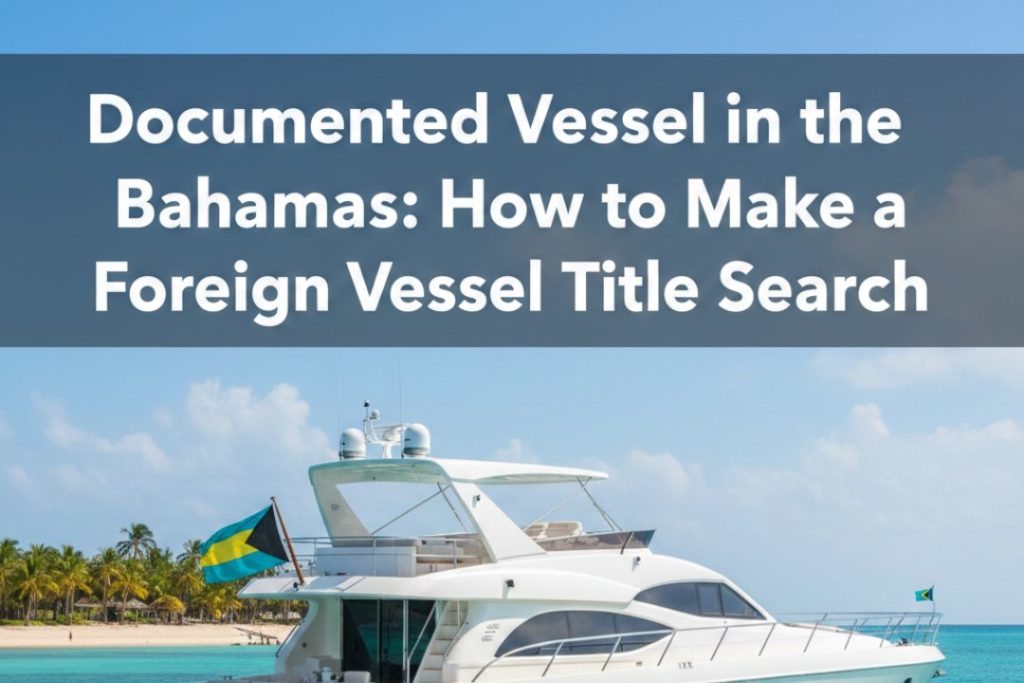
If you need to verify ownership or lien status for a documented vessel located in the Bahamas, the correct path is to request a Foreign Vessel Title Search through a Transcript of Registry issued under U.S. Coast Guard records.
Even when a boat is physically berthed in Nassau, Freeport, or the Exumas, its official nationality and ownership history remain tied to its flag state.
Through our online portal at the National Documentation E-Portal, we make it possible to securely request the appropriate federal documentation without relying on foreign offices or delayed international correspondence.
Does Location in the Bahamas Change a Vessel’s National Records?
A boat’s physical location does not alter its nationality under maritime law. The controlling principle is the “flag state” rule.
Under this rule:
- A vessel documented with the United States retains American nationality regardless of where it travels.
- Local registries in the Bahamas generally do not maintain historical ownership data for U.S.-flagged vessels.
- Title history, mortgages, and recorded instruments remain filed within the U.S. Coast Guard documentation system.
This means that even if a boat is docked long-term in Bahamian waters, the authoritative record remains in the United States. Federal regulations governing vessel documentation can be reviewed in 46 CFR § 67.59 at the Electronic Code of Federal Regulations.
If you are evaluating a documented vessel abroad, the only reliable method of verifying ownership and encumbrances is through official U.S. records.
What Is a Foreign Vessel Title Search?
A Foreign Vessel Title Search is a request for a Transcript of Registry for a U.S.-flagged vessel located outside the country.
This transcript provides:
- The vessel’s official number
- The current owner of record
- The chain of ownership
- Recorded mortgages
- Satisfaction or release of liens
- Historical vessel names
- Tonnage and build information
When a documented vessel is operating internationally, the Transcript of Registry functions as the recognized federal record for foreign authorities, lenders, and maritime professionals.
Our service allows you to request this transcript electronically, ensuring that you receive documentation sourced directly from the official federal database.
How Is a Transcript of Registry Different from an Abstract of Title?
Although both documents relate to vessel history, they serve different practical purposes.
What Is an Abstract of Title?
An abstract of title is generally used for domestic review of recorded instruments. It provides a chronological summary of filings, including:
- Bills of sale
- Mortgages
- Notices of claim of lien
- Satisfactions and releases
This document is often requested in U.S.-based transactions where the vessel remains within domestic waters.
What Is a Transcript of Registry?
A Transcript of Registry is the internationally recognized counterpart. It contains the same foundational data but is structured and certified in a way that is accepted by foreign maritime authorities, including the Bahamas Maritime Authority.
For a documented vessel located outside the United States, the transcript functions as:
- Official proof of U.S. nationality
- Evidence of lawful entitlement to fly the U.S. flag
- Verification of recorded ownership
- Confirmation of mortgage status
When conducting a vessel documentation search involving an international setting, the transcript is the appropriate record.
What Information Does a Transcript of Registry Include?
The depth of information within a transcript makes it indispensable for foreign transactions.
It typically contains:
- The vessel’s original build year
- Builder information, if recorded
- The official number assigned at documentation
- Every recorded vessel name change
- All recorded transfers of ownership
- Active and satisfied mortgages
- Notices of claim of lien, if filed
Name history is particularly important in the Caribbean market. Boats frequently undergo rebranding after relocation. A documented vessel that changed names when entering Bahamian waters will still have every prior name reflected in the federal record.
Mortgage records are equally critical. If a preferred ship mortgage is active and unsatisfied, it will appear in the transcript. That status does not disappear simply because the boat has crossed international boundaries.
Why Should You Conduct a Foreign Title Search Before Buying in the Bahamas?
Purchasing a vessel outside the United States introduces additional layers of risk.
Without a verified transcript, you may face:
- Hidden liens recorded in U.S. federal filings
- Unsatisfied mortgages
- Ownership discrepancies
- Conflicting registration claims
One major concern is dual registration. In some cases, a seller may attempt to re-flag a vessel locally while unresolved U.S. obligations remain on record. A documented vessel cannot escape prior recorded encumbrances simply by changing location.
If a lien was filed in Florida, Texas, or California, it remains attached to the federal record. Attempting to bring that vessel back into U.S. waters without resolving recorded claims may create legal complications.
A Foreign Vessel Title Search ensures you are reviewing the authoritative record before proceeding with any transaction.
Can a Vessel Be “Double-Booked” in Two Countries?
Dual registration conflicts can occur when a vessel is represented differently across jurisdictions.
A documented vessel is tied to its official number and Hull Identification Number (HIN). Cross-referencing these identifiers through an official transcript allows you to confirm:
- The vessel’s true documentation status
- Whether it remains actively documented in the U.S.
- Whether mortgages are still recorded
- Whether prior transfers were properly filed
Because U.S. documentation operates at the federal level, its record remains controlling for nationality and ownership under U.S. law.
Without verifying that record, a buyer risks inheriting unresolved obligations.
What Happens If a Lien Exists but the Boat Is in the Bahamas?
Geography does not erase recorded claims.
If a repair yard, lender, or creditor recorded a claim in the United States, it remains part of the federal documentation history. Even if the vessel relocates, the encumbrance remains visible in the transcript.
Potential consequences include:
- Difficulty selling the vessel later
- Problems refinancing
- Complications re-entering U.S. waters
- Enforcement of recorded claims
Because maritime creditors frequently monitor vessel movements, unresolved filings may surface at inconvenient times. Conducting a formal title search before purchase protects against unexpected liabilities.
Is There a Coast Guard Documentation Office in the Bahamas?
There is no physical U.S. Coast Guard documentation office in the Bahamas.
All federal documentation records are maintained within the United States. That means:
- You cannot walk into a local Bahamian office for U.S. documentation history.
- International mail delays can slow traditional requests.
- Brokers and buyers abroad must rely on digital filing methods.
Our portal provides an online pathway to request documentation directly from the official federal source without depending on overseas intermediaries.
How Does the 2026 Digital Portal Make This Easier?
Modern vessel transactions often occur across borders. Waiting for mailed transcripts can delay closing timelines.
Through our secure online platform, you can:
- Submit a Foreign Vessel Title Search request electronically
- Provide the vessel’s official number or identifying details
- Receive documentation sourced from federal records
For brokers working in locations such as Marsh Harbour or Nassau, digital submission helps prevent stalled transactions caused by mailing delays.
A documented vessel in international waters still requires U.S.-based record verification. Our service provides structured access to those records through an online process.
What Identifiers Are Needed to Request a Transcript?
To complete a request efficiently, you will typically need:
- The vessel’s official number, if known
- The vessel name
- The Hull Identification Number, if available
Providing accurate identifying information ensures the correct record is retrieved from federal documentation files.
Because multiple vessels may share similar names, the official number remains the most precise identifier.
How Does Federal Law Govern U.S.-Flagged Vessels Abroad?
Federal vessel documentation law establishes that a documented vessel remains subject to U.S. recordkeeping requirements, regardless of its geographic position.
Key principles include:
- Nationality is determined by documentation, not location.
- Transfers must be recorded to be effective against third parties.
- Mortgages recorded under federal law retain priority.
These requirements are reflected in Title 46 of the Code of Federal Regulations. Compliance with these regulations ensures that ownership and lien status are transparent within the official record.
When reviewing a vessel in the Bahamas, relying on informal representations is insufficient. Federal documentation remains the authoritative source.
When Is a Transcript Necessary Instead of Informal Verification?
A transcript becomes essential when:
- Purchasing a vessel located outside the U.S.
- Confirming mortgage payoff status
- Verifying chain of ownership
- Preparing for international sale
- Establishing nationality proof
Because a documented vessel carries its federal history wherever it travels, the transcript provides clarity that local marina paperwork cannot.
Our role is to provide access to that official documentation through an online process designed specifically for Coast Guard records.
How Does This Process Protect Buyers and Sellers?
Accurate federal documentation supports transparent transactions.
By reviewing a transcript:
- Buyers confirm ownership and lien status.
- Sellers verify that records reflect current reality.
- Brokers ensure compliance with U.S. documentation requirements.
- Lenders confirm mortgage position.
In international markets, documentation clarity reduces transactional uncertainty.
When dealing with a documented vessel in the Bahamas, relying solely on local representations creates avoidable exposure. Federal records remain the definitive source.
How Do You Begin a Foreign Vessel Title Search?
Starting the process through our portal involves:
- Accessing the appropriate request form
- Entering vessel identification details
- Submitting the request electronically
We provide structured access to Coast Guard documentation records through a secure digital format. Because the official record is maintained federally, this approach eliminates the need to search locally in the Bahamas for information that will not be found there.
A documented vessel carries its official history with its flag state. If that flag is the United States, the authoritative record resides within federal documentation files.
By requesting a Transcript of Registry through our online service, you obtain the recognized record needed to verify ownership, confirm mortgage status, and review the chain of title before proceeding with a purchase abroad.